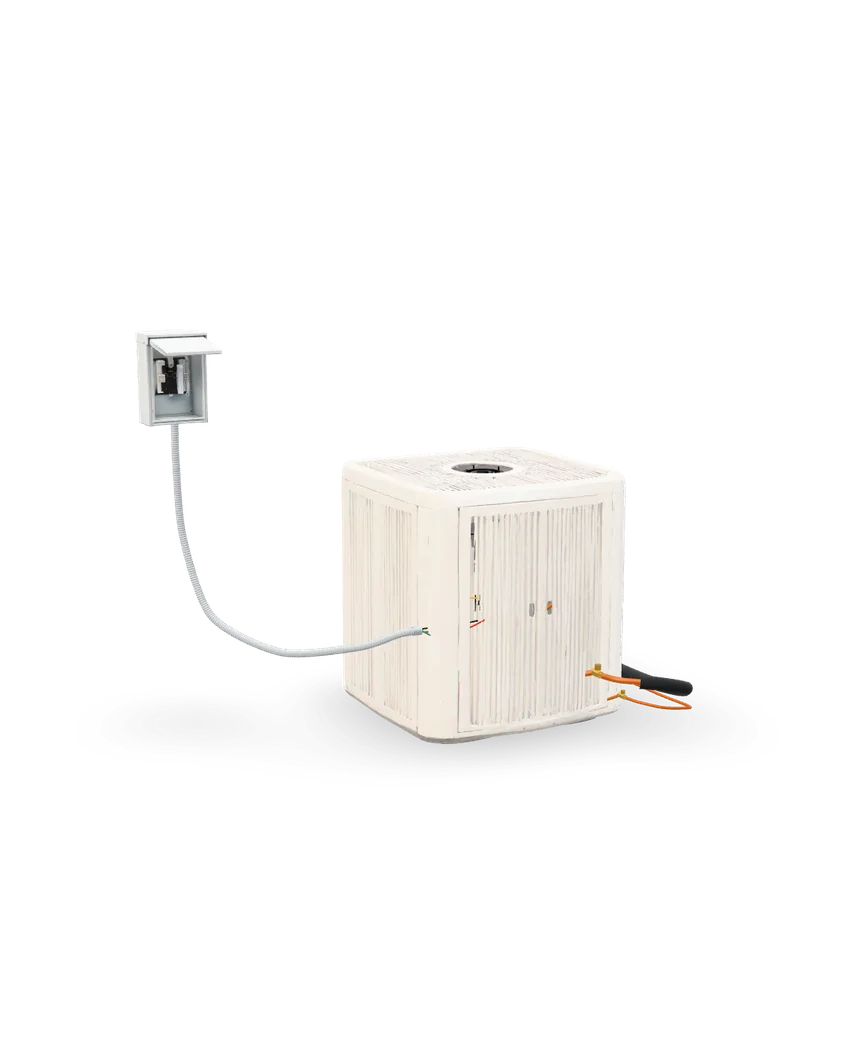
Central air conditioner (outdoor unit)
AC condenser repair, from the inside out
The condenser is the outdoor half of a central air conditioner. It takes the heat your house gave up and gets rid of it outside.
Pull one apart in 3D to see where each part sits. The electrical parts in the corner are the ones a careful homeowner can replace. The step-by-step fixes are being written now.
Parts
What is inside an AC condenser
Tap a part to find it in the model.
- Guide coming soon
- Call a pro
- Call a pro
- Guide coming soon
- Guide coming soon
- Guide coming soon
- Guide coming soon
- Guide coming soon
- Call a pro
How it works
How an AC condenser works
A compressor pumps refrigerant, a coil gives off the heat, and a fan pulls air through the coil.
- 1
The thermostat calls for cooling
A low-voltage signal from the thermostat pulls in the contactor. The contactor is a heavy switch that sends power to the compressor and the fan motor.
- 2
The capacitor helps the motors start and run
A dual run capacitor serves both motors: one side for the compressor, one for the fan.
- 3
The compressor and coil move the heat
The compressor pumps refrigerant through the coil that wraps the cabinet. This is the sealed system, and work on it is for a licensed pro.
- 4
The fan carries the heat away
The fan on top pulls outdoor air in through the coil and blows it out of the top of the unit.
Model number
Where to find your model number
The rating plate is a metal or foil label on the outside of the cabinet, usually on the back near where the refrigerant lines go in.
- Copy the model number and the serial number.
- The plate also gives the capacitor size the unit needs.
Safety first
Before you open an AC condenser
- Pull the disconnect beside the unit and turn off its breaker before you open the cabinet. Confirm the power is off with a tester.
- A capacitor can hold a charge after the power is off. Do not touch its terminals until it has been discharged.
- The sealed system (compressor, coil and refrigerant lines) is not a DIY job. Refrigerant work is for a licensed pro.