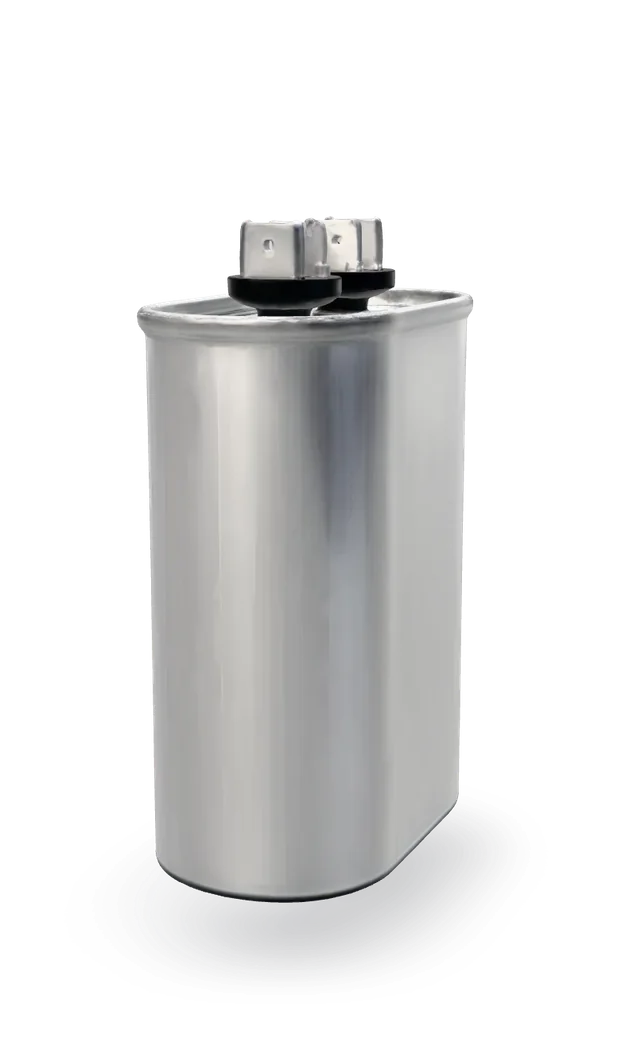
Furnace blower capacitor: test and replace
Blower humming but not spinning? Before you price a new motor, check this small can. It is cheap, it fails often, and it swaps out in about 20 minutes.
- Difficulty
- Easy
- Time
- 15–30 min
- Typical part cost
- $10–$50Pro: $150–$300
- Tools
- 6See the list
Two wires and one strap. The only real hazard is the charge a capacitor can hold after the power is off, so the safe discharge step is not optional.
What it does
What the capacitor does
Many furnace blower motors are the PSC type, short for permanent split capacitor. They need a capacitor wired to them to start turning and to run properly. It is a round or oval metal can strapped to the blower housing, with two wires on top.
The capacitor shifts the timing of the power going to one of the motor's windings. That gives the motor a push in the right direction when it starts, and keeps it running smoothly.
Not every furnace has one. Electronically commutated motors, called ECM or variable-speed motors, have an electronic module on the back and do not use a capacitor at all.
Why it fails
Capacitors wear out over time. A weak one reads below the µF number on its label, and at some point the motor no longer gets enough of a push to start.
Sometimes they fail more visibly. A failed capacitor can swell at the top, dent, or leak oil. Any of those means it is finished.
Symptoms
Signs of a bad capacitor
Blower hums but will not start
The burners run and you hear a steady hum from the blower compartment, but the fan does not turn. This is the classic weak capacitor.
Full diagnosisSlow start, or it needs a nudge
The blower takes a while to get up to speed, or starts only after you give the wheel a spin by hand. The capacitor is too weak to give it a proper start.
Swollen top or oily can
With the power off, look at the capacitor. A domed or bulged top, dents, or oily residue around it mean it has failed. Replace it.
Burners cycle off, no warm air
Without airflow, heat builds up until the high limit switch shuts the burners off. They cool, relight, and do it again.
Full diagnosis
How to test it
Test the capacitor before you buy
- Power off at the service switch or breaker and take off the blower door.
- Find the capacitor: a round or oval metal can with two terminals on top, held by a strap near the blower.
- Look at it without touching the terminals. Check the top, the sides and the area underneath.
- Good
- A flat top, no dents, and no oil or residue. It can still be weak inside, so do the meter test next.
- Bad
- A domed or bulged top, a dent, or oily residue. Replace it. Do not test it with the power on, and do not put power back on to a damaged capacitor.
- Power off. Discharge the capacitor first, as shown in the steps below.
- Label and pull both wires off the capacitor.
- Set the meter to capacitance. Touch one probe to each terminal and hold them there until the number settles.
- Compare the reading with the µF rating printed on the capacitor's label.
A good capacitor typically reads
Within the tolerance on its label, often ±5% or ±6%
Typical range. Check your part label or manual for the exact spec. Test with the wires off the capacitor so nothing else in the circuit affects the reading.
- Good
- The reading lands within the tolerance printed on the label. Many run capacitors are rated ±5% or ±6%. If it reads in that band, the capacitor is not your problem.
- Bad
- It reads below the label's tolerance band, reads zero, or the meter shows OL or will not settle. Replace it. One major maker's service manual says to replace a capacitor that is more than 10 percent off its rated value, so a reading that far off is a sure fail.
Safety first
Before you touch anything
- 1
Kill the power
Flip the furnace service switch off, or turn off its breaker. Confirm it with a voltage tester before you reach in.
- 2
Discharge the capacitor
A capacitor can hold a charge after the power is off, and touching its terminals can shock you. Bleed it with a discharge tool or a bleed resistor across the terminals, then confirm close to zero volts with a meter. Never use your fingers or a screwdriver.
- 3
Never test it powered
Only check a capacitor with the power off. A damaged one can burst if power is applied.
Tools you'll need
Grab these first
Tool and part links are affiliate links. We may earn a commission at no extra cost to you, and it never changes what we tell you to check first. How this works
- Capacitor discharge toolBleeds the stored charge off the capacitor before you touch its terminals. This is the safety step.Typically $10–$25Shop this tool
- Digital multimeterΩ, V, µF, µAReads the capacitor's value in microfarads (µF) so you know if it is weak. Your meter needs a capacitance setting.Typically $25–$60Shop this tool
- Non-contact voltage testerPen styleConfirms the power is off at the furnace before you open anything up.Typically $15–$30Shop this tool
- Nut driver1/4 in. hexBlower door screws and most capacitor strap screws are 1/4 in. hex heads.Typically $6–$15Shop this tool
- Needle-nose pliersPulls the push-on terminals straight off without bending the tabs.Typically $8–$20Shop this tool
- Painter's tape and markerLabel each wire with the terminal it came from.Typically $5–$12Shop this tool
Step by step
How to replace the capacitor
- 1
Shut off the power
Flip the service switch on or near the furnace to off, or turn off the furnace breaker.
You will not touch anything on the gas side for this job.
Tip. A dark status light on the control board is a good sign, but it is not proof. Confirm with a voltage tester before you reach in.
- 2
Take off the blower door
The lower door covers the blower. Most lift up and pull out at the bottom. Some have screws.
Removing this door also opens the door switch. Treat that as a backup only. The power is already off at the switch.
- 3
Find the capacitor
Look on or near the blower housing for a metal can held by a strap or bracket, with two wires on top.
If you only see a motor with a box bolted on its back and no can anywhere, you have an ECM motor. It has no capacitor, so this guide does not apply.
Tip. Take a photo of the label and the wires now. You will want both later.
- 4
Discharge it safely
Hold the discharge tool by its insulated handle only. Touch its two leads across the two capacitor terminals and hold them there for a few seconds.
If you use a bleed resistor instead, hold it with insulated pliers, never your fingers. Use the resistor rating your furnace's service manual calls for, or a purpose-made tool.
Then set your meter to DC volts and check across the terminals. It should read close to zero. If it does not, bleed it again and recheck before you touch anything.
Careful. Do not short the terminals with a bare screwdriver, and never touch the terminals with your hands. Stored charge can shock you even with the power off.
- 5
Label and pull the wires
Put a strip of tape on each wire and write the terminal it came from. Take a photo too.
Grip each push-on terminal with the needle-nose pliers and pull it straight off. Do not pull on the wire itself.
- 6
Loosen the strap and remove it
Back out the screw on the strap or bracket that holds the capacitor. Slide the old capacitor out.
Read its label carefully. You need the µF rating, the voltage rating and the shape.
- 7
Match the new capacitor
The new capacitor must have the same µF rating as the old one. The motor's label usually lists it too.
The voltage rating must be the same or higher, never lower. A 440 V capacitor can replace a 370 V one, but not the other way around.
Match the shape and size so it fits the strap.
Buy the part
Blower motor run capacitor
Opens AppliancePartsPros in a new tab. Where’s my model number?
What to look for
- The same µF rating as the old capacitor or the motor label. Do not guess or round it.
- The same voltage rating or higher. 370 V and 440 V are the common ratings.
- The same shape, round or oval, and a size that fits the strap.
- A run capacitor, not a start capacitor. They are not interchangeable.
Generic run capacitors are fine here as long as the µF rating matches and the voltage rating is the same or higher. The furnace does not care who made it.
- 8
Mount it and reconnect the wires
Slide the new capacitor into the strap and snug the screw.
Using your labels, push each wire onto the matching terminal. Each one should feel snug. Keep the wires clear of the blower wheel.
- 9
Close up and test
Refit the blower door. The furnace will not run without it, because the door switch cuts power.
Turn the power on and set the thermostat fan to ON. The blower should start promptly and run quietly. Then set the fan back to AUTO.
Tip. Still humming with a new capacitor? Power off and check that the wheel spins freely by hand. If it does, look at the blower motor next.
Buy the part
Get the right replacement
Buy the part
Blower motor run capacitor
Opens AppliancePartsPros in a new tab. Where’s my model number?
What to look for
- The same µF rating as the old capacitor or the motor label. Do not guess or round it.
- The same voltage rating or higher. 370 V and 440 V are the common ratings.
- The same shape, round or oval, and a size that fits the strap.
- A run capacitor, not a start capacitor. They are not interchangeable.
Generic run capacitors are fine here as long as the µF rating matches and the voltage rating is the same or higher. The furnace does not care who made it.
Know your limits
When to call a pro
Stop and call a pro if
- You smell gas at any point. Do not touch any switches. Leave the house and call your gas utility from outside.
- You see scorch marks, melted terminals or burned wires around the capacitor or the blower.
- The motor has no capacitor and an electronic module on the back. That is an ECM motor, and it is diagnosed differently.
- A new capacitor does not fix it and the wheel spins freely by hand. The motor or the control board may be the problem.
- The new capacitor fails again within weeks.
- You are not comfortable discharging a capacitor.
FAQ
Blower motor run capacitor questions
Is it the capacitor or the blower motor?
Start with the capacitor. It is far cheaper and easier to test. A blower that hums but will not start is very often a weak capacitor. If the new capacitor tests good and the motor still hums, check the blower motor.
Can I use a capacitor with a higher voltage rating?
Yes. A higher voltage rating is fine. A 440 V capacitor can replace a 370 V one. Never go lower than the original. The µF rating, on the other hand, must match.
How much can the reading be off and still be OK?
Use the tolerance printed on your capacitor's label. Many are rated ±5% or ±6%. A reading below that band means it is getting weak, and more than 10 percent low means replace it.
Why do I have to discharge it if the power is off?
A capacitor stores electrical energy. It can hold a charge for a while after the power is cut, and touching the terminals releases it through you. Bleeding it with a discharge tool takes seconds. Then check it with your meter on DC volts to be sure it reads close to zero.
My furnace does not seem to have a capacitor. Why?
Your blower probably has an ECM or variable-speed motor. You can spot it by the electronic module bolted to the back of the motor. Those motors do not use a run capacitor.
Related
Keep going
- SymptomFurnace blower won't turn onThe big fan that pushes warm air to your vents does not start. A humming motor that never spins points to the run capacitor. Silence points to the door switch, a fuse, the board or the motor.Open guide
- SymptomFurnace short cyclingThe furnace starts, runs briefly, shuts off, and starts again before the house warms up. A clogged filter is the most common cause. A dirty flame sensor is next.Open guide
- SymptomFurnace blowing cold airThe vents blow, but the air is cool or room temperature. Often the thermostat fan is set to On. Otherwise the burners are not lighting, or are shutting down early.Open guide
- Furnace partBlower motor and wheelThe blower motor spins a squirrel-cage wheel that pushes warm air through your ducts. A dusty wheel chokes airflow, and a worn motor hums, squeals or stops. You can clean both, and replace a standard motor yourself.Open guide
- Furnace partControl boardThe control board runs the furnace's start-up sequence and flashes a code when something fails. Read the blink code first, because most codes point at a part the board is reporting on.Open guide
- Furnace partHigh limit switchThe high limit switch shuts the burners off if the furnace gets too hot. It trips most often because of poor airflow, so check the filter and the blower before you replace it.Open guide