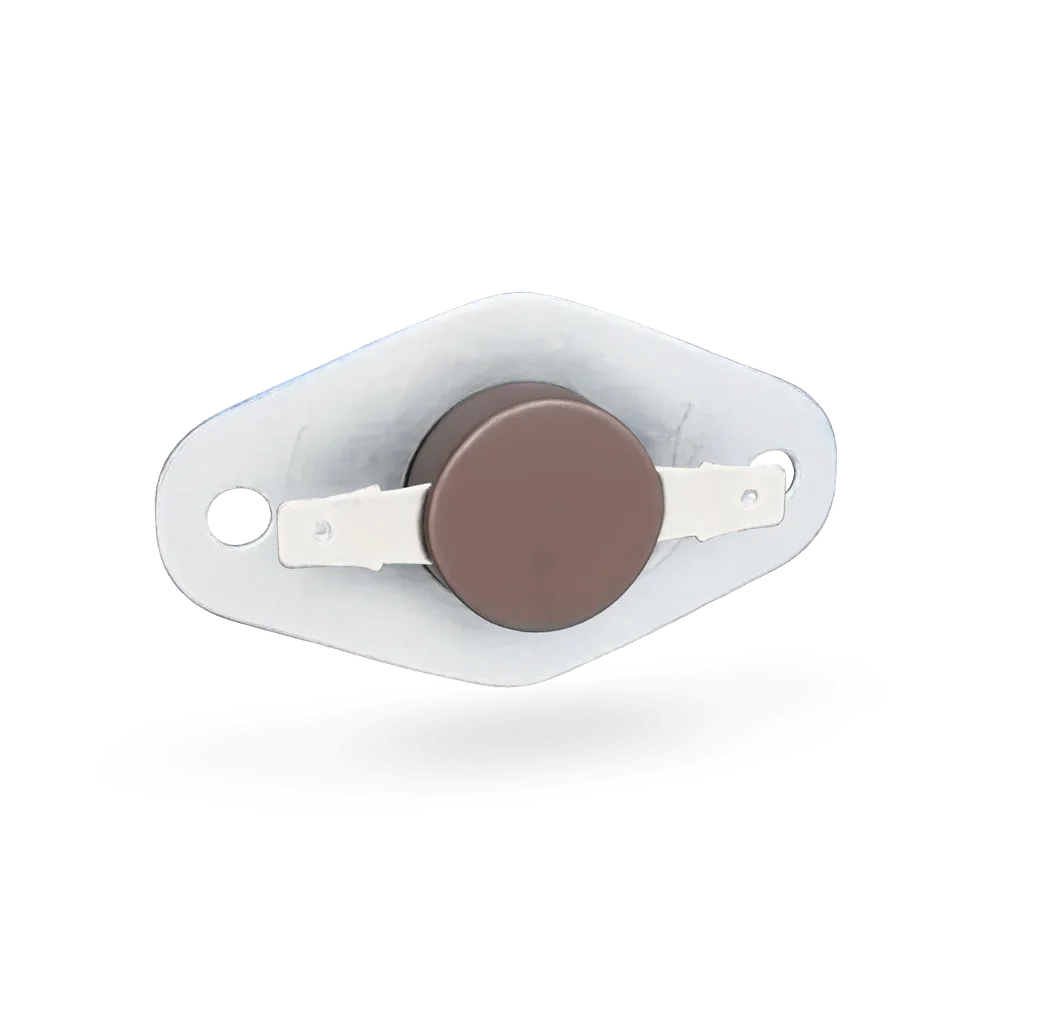
Furnace high limit switch: test and replace
Good news: the limit switch is usually the messenger, not the problem. Find out why the furnace got too hot, and the switch often goes back to working on its own.
- Difficulty
- Easy
- Time
- 20–40 min
- Typical part cost
- $20–$80Pro: $150–$400
- Tools
- 5See the list
Two wires and two screws. The real work is finding and fixing the airflow problem that tripped it.
What it does
What the limit switch does
The high limit switch is a small safety switch with a metal probe or disc that reaches into the hot air around the heat exchanger. Two wires run to it. When the furnace is cool the switch is closed, so the circuit passes straight through it.
If the furnace gets hotter than the switch's set point, the switch opens and the burners shut down. The blower keeps running to carry the heat away. Once things cool off, a standard high limit closes again on its own and the furnace can try again.
It is there to stop the furnace from overheating. Manufacturers are clear that it must never be bypassed.
Why it fails
Most of the time the switch is fine and doing its job. It trips because heat is not getting carried away. A clogged filter, closed or blocked vents, or a blower problem starves the furnace of air, and the temperature climbs.
Switches do fail, though. One that tests open when it is cold, has a damaged or corroded probe, or keeps tripping after every airflow problem is fixed should be replaced.
Symptoms
Signs of a bad limit switch
Runs, then shuts off after a few minutes
The burners light and heat fine, then cut out while the blower keeps running. After a cool-down the furnace lights again. That loop is the limit switch tripping.
Full diagnosisBlower runs, but no heat
The burners are off and the blower keeps blowing room-temperature air. An open limit switch keeps the blower on to cool the furnace.
Full diagnosisA limit code on the board
Many control boards flash a specific pattern for an open limit. Check the code chart on the inside of the blower door.
Full diagnosisDirty filter, weak airflow
If the filter is packed or several vents are closed, the limit switch is almost certainly reacting to that. Fix the airflow first.
How to test it
Test the limit switch before you buy
- Pull the air filter and hold it up to a light. If you cannot see light through it, replace it.
- Walk the house. Open supply vents in every room and move furniture or rugs off them. Make sure the return grilles are clear.
- Check that the blower runs when the furnace heats. A blower that is slow, noisy or not running points to the blower motor or its capacitor.
- Run a full heating cycle. If it runs normally, the switch was only doing its job.
- Good
- With a clean filter and open vents, the furnace runs a full cycle without the burners cutting out. Leave the switch alone.
- Bad
- Airflow is good and the burners still cut out after a few minutes. Test the switch itself next.
- Power off at the service switch or breaker. Check the switch wires with a voltage tester.
- Let the furnace cool to room temperature. A hot switch can read open and still be fine.
- Take a photo, then pull both wires off the limit switch.
- Touch one probe to each terminal. Polarity does not matter.
A good switch at room temperature shows
Continuity (near 0 Ω)
Typical range. Check your part label or manual for the exact spec. Test it cold. Some switches stay open until they cool all the way down.
- Good
- Near zero, or a beep on the continuity setting, means the switch is closed. It is working. The cause is airflow or something else.
- Bad
- OL, or no beep, at room temperature means the switch is open when it should be closed. Replace it.
Safety first
Before you touch anything
- 1
Kill the power
Flip the furnace service switch off, or turn off its breaker. The control board light should go dark, but confirm it with a voltage tester too.
- 2
Let it cool
The limit switch sits right next to the heat exchanger. Give the furnace time to cool all the way down before you touch it, and so the test reads true.
- 3
Verify, then glove up
Check the switch wires with a non-contact voltage tester before you touch them. The sheet metal around the switch is sharp, so work gloves help.
Tools you'll need
Grab these first
Tool and part links are affiliate links. We may earn a commission at no extra cost to you, and it never changes what we tell you to check first. How this works
- Nut driver1/4 in. hexThe door screws and the limit switch screws are usually 1/4 in. hex heads.Typically $6–$15Shop this tool
- Digital multimeterΩ, V, µF, µAA quick continuity test tells you whether the switch is open or closed.Typically $25–$60Shop this tool
- Non-contact voltage testerPen styleConfirms the power is really off before you touch the switch wires.Typically $15–$30Shop this tool
- Needle-nose pliersPulls tight spade connectors straight off the terminals.Typically $8–$20Shop this tool
- Painter's tape and markerOptionalMark which wire goes on which terminal before you pull them.Typically $5–$12Shop this tool
- HeadlampThe switch sits on the panel above the burners, often in shadow.Typically $12–$30Shop this tool
Step by step
How to replace the limit switch
- 1
Shut off the power
Flip the service switch on or near the furnace to off. If you cannot find one, turn off the furnace breaker.
You will not touch anything gas-related in this job, so the gas can stay as it is.
Tip. A dark status light on the control board is a good sign, but it is not proof. Confirm with a voltage tester at the switch wires.
- 2
Take off the upper door
Lift the burner compartment door up and away. Some have two screws along the top edge.
The main limit is usually on the panel above the burners. Some furnaces have a second limit in the blower compartment, on the blower housing. The wiring diagram inside the door shows where yours are.
- 3
Find the limit switch
Look for a small switch held by a couple of screws, with two wires on spade terminals. Its probe or disc reaches through the panel into the heat exchanger area.
Do not confuse it with a flame rollout switch. Rollout switches sit near the burners and have a button you press to reset them. If a rollout switch tripped, flame went where it should not. That is a pro call, not a part swap.
Tip. Take a photo now. It shows which wire goes where and how the switch is turned.
- 4
Label and pull the wires
Put a strip of tape on each wire and mark it. Then pull each spade connector straight off its terminal. Grip the connector, not the wire.
On a two-terminal limit, the wires usually do not care which side they go on. Label them anyway.
- 5
Remove the two screws
Back out the screws that hold the switch to the panel. Hold the switch with your other hand so it does not drop inside.
Tip. A magnetic nut driver keeps the screws from falling behind the panel.
- 6
Slide the switch out
Pull the switch straight out of the panel. Long probe types need a little wiggle to clear the opening. Keep the old one. You need its part number to order the new one.
- 7
Match the new switch exactly
Order by the part number on the old switch, or from the parts list for your furnace's model number. The set point is chosen for each furnace model and cannot be adjusted, so the new switch has to be the one made for your unit.
Hold the two side by side. The probe, the mounting holes and the terminals should match.
Careful. Never fit a switch with a different rating to stop it tripping. That defeats the safety.
Buy the part
High limit switch
Opens AppliancePartsPros in a new tab. Where’s my model number?
What to look for
- The part number printed on the old switch, or your furnace model number from the rating plate.
- A switch listed for your exact furnace model. Set points differ from model to model.
- The same probe, mounting holes and terminals as the old one.
Skip generic limit switches. The set point is matched to your furnace, so get the part made for your model.
- 8
Install the new switch
Slide the new switch in the same way the old one came out. Drive the screws in snug. Firm is enough.
- 9
Reconnect the wires and close up
Push each spade connector fully onto its terminal, matching your labels and photo. Each one should feel snug.
Refit the upper door so it sits flat and tight. Never run the furnace with a door off.
- 10
Power up and run a full cycle
Turn the power back on and set the thermostat a few degrees above room temperature. Let it run until the thermostat is satisfied.
The burners should stay lit until the thermostat is satisfied. If the new switch trips too, the furnace is still overheating. Recheck the filter, vents and blower, then call a pro.
Buy the part
Get the right replacement
Buy the part
High limit switch
Opens AppliancePartsPros in a new tab. Where’s my model number?
What to look for
- The part number printed on the old switch, or your furnace model number from the rating plate.
- A switch listed for your exact furnace model. Set points differ from model to model.
- The same probe, mounting holes and terminals as the old one.
Skip generic limit switches. The set point is matched to your furnace, so get the part made for your model.
Know your limits
When to call a pro
Stop and call a pro if
- The new switch trips too, even with a clean filter and open vents. Something is still trapping heat.
- A flame rollout switch tripped. Flame escaped the burner area, which can mean a venting or heat exchanger problem.
- You see scorch marks, soot or melted wiring near the burners.
- You smell gas. Leave the house now and call your gas utility or 911 from outside. Do not flip switches on the way out.
- The blower runs weak or not at all. The blower motor or its capacitor may need attention first.
- You cannot find the exact replacement for your model.
FAQ
High limit switch questions
Why does my high limit switch keep tripping?
Usually airflow. A clogged air filter, closed or blocked vents, or a blower problem traps heat in the furnace. Fix that first. If it still trips with good airflow, the switch itself may be bad.
Can I bypass the limit switch to get heat?
No. It is a safety shutdown, and manufacturers say it must not be bypassed for any reason. Never jumper it, even for a few minutes.
Does a limit switch reset itself?
A standard high limit resets by itself once the furnace cools down. Rollout switches are different: they have a button you press by hand. If any safety switch keeps tripping, find out why before you keep resetting it.
What is the difference between a limit switch and a rollout switch?
The high limit watches the temperature around the heat exchanger. A rollout switch sits by the burners and trips if flame escapes where it should not, such as from a blocked vent or a heat exchanger problem. A tripped rollout switch is a reason to call a pro.
Related
Keep going
- SymptomFurnace short cyclingThe furnace starts, runs briefly, shuts off, and starts again before the house warms up. A clogged filter is the most common cause. A dirty flame sensor is next.Open guide
- SymptomFurnace blowing cold airThe vents blow, but the air is cool or room temperature. Often the thermostat fan is set to On. Otherwise the burners are not lighting, or are shutting down early.Open guide
- SymptomFurnace control board blinking an error codeThe light on the control board flashes a code when something fails. Count the flashes, match them to the chart inside the blower door, and write the code down before you reset anything.Open guide
- Furnace partAir filterThe air filter catches dust before it reaches the blower and heat exchanger. A clogged one chokes airflow, makes the furnace work harder and can trip it off on high heat. Check it monthly.Open guide
- Furnace partBlower motor and wheelThe blower motor spins a squirrel-cage wheel that pushes warm air through your ducts. A dusty wheel chokes airflow, and a worn motor hums, squeals or stops. You can clean both, and replace a standard motor yourself.Open guide
- Furnace partBlower motor run capacitorThe run capacitor is the small metal can that helps the blower motor start and run. A weak one leaves the blower humming, slow or dead. It is cheap and easy to test and replace, once you discharge it safely.Open guide