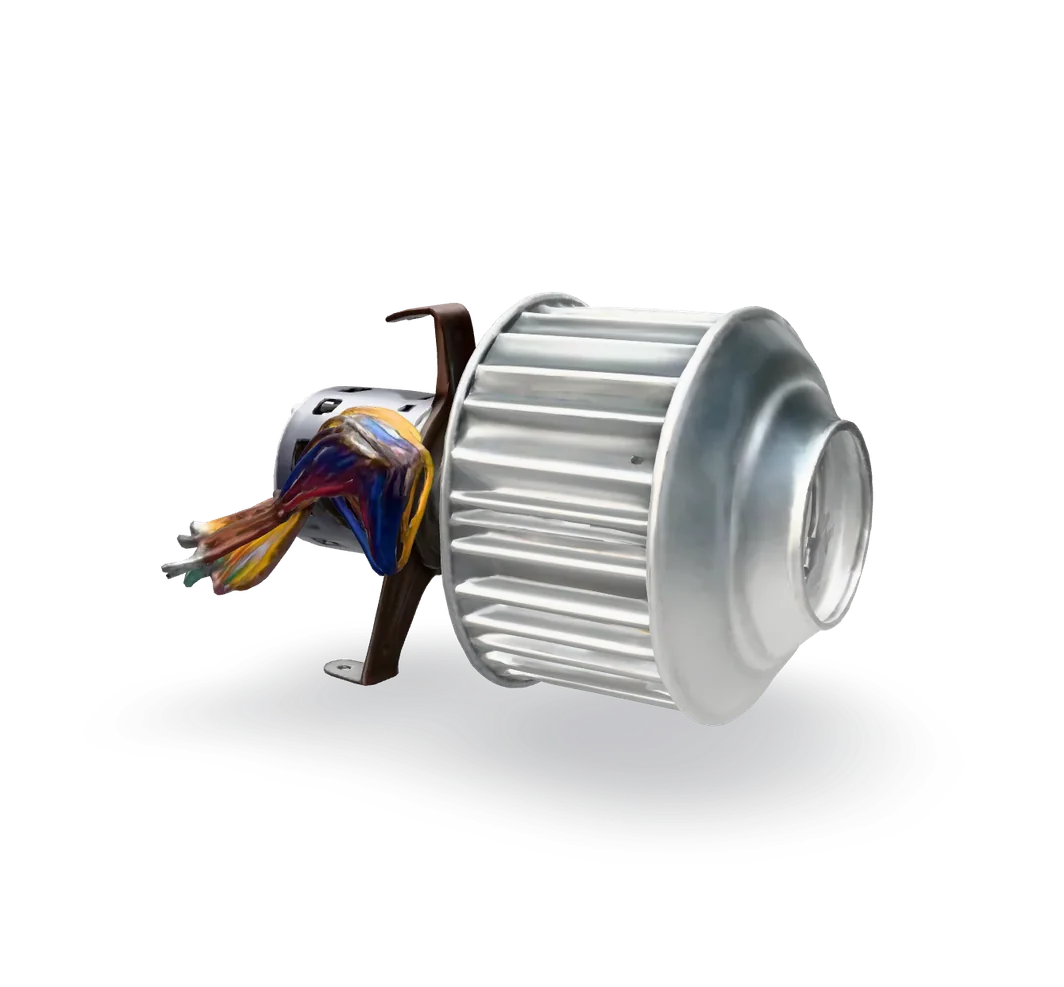
Furnace blower motor and wheel: clean or replace
Weak airflow or a blower that will not start? Start with a cleaning and a capacitor check. Both are cheap. If the motor really is dead, the swap is a solid afternoon job.
- Difficulty
- Moderate
- Time
- 1 hr–2.5 hr
- Typical part cost
- $150–$450Pro: $300–$900
- Tools
- 11See the list
The blower slides out on rails, but it is bulky and the wires need careful labeling. Cleaning is very doable. An ECM motor is usually best left to the exact factory part or a pro.
What it does
What the blower motor does
The blower sits in the lower compartment, behind the blower door. It is a motor inside a wide, drum-shaped fan wheel, called a squirrel cage, in a sheet metal housing that slides out on rails.
Once the burners have warmed the heat exchanger for a short delay, the control board starts the blower. It pulls house air in through the air filter, pushes it across the heat exchanger, and out to your vents. The same blower runs your air conditioning.
Furnaces use one of two motor types. A PSC motor has a separate run capacitor strapped nearby and a few colored speed wires. An ECM motor, also called constant-torque or variable-speed, has an electronic module on the back and uses no capacitor.
Why it fails
Dust is the first problem. Whatever gets past the filter collects on the wheel blades and the motor. A dirty wheel moves less air, and dust packed on the motor can make it run hot.
Wear is the second. As the bearings age, the motor can squeal, hum or turn slowly, and eventually stop.
On PSC motors, a weak capacitor is a common reason a blower hums and will not start. Check the run capacitor first. It is cheap and quick.
Symptoms
Signs of a bad blower motor
Burners run, no air from the vents
You hear the burners light, but the blower never starts. The furnace overheats and the high limit shuts the burners off, again and again.
Full diagnosisHums but does not spin
A steady hum from the blower compartment, but the wheel does not turn or turns very slowly. On a PSC motor, test the capacitor first.
Full diagnosisWeak airflow
Air comes out of the vents, but barely. With a clean filter, a dirty blower wheel is a common reason.
Squealing, grinding or rattling
A squeal or grind that follows the motor points to the bearings. A rattle or thump often means a loose wheel, a loose mount or something caught in the housing.
Full diagnosisShort cycling on the limit switch
Weak or no airflow lets heat build until the high limit trips. The burners go off, cool down, and come back on.
Full diagnosis
How to test it
Test the blower motor before you buy
- Power off at the service switch or breaker. Take off the blower door.
- Reach in and turn the wheel by hand. On some furnaces you can reach it from the front. On others you see it best once the blower is out.
- Rock the wheel gently and feel for play or rubbing on the housing.
- Shine a light between the blades to see how much dust is on them.
- Good
- The wheel spins freely and coasts. No grinding, no wobble, no rubbing. If it is clean too, check the [run capacitor](/furnace/blower-motor-run-capacitor) and the control board next.
- Bad
- It drags, grinds or will not turn: the motor is likely worn out. It wobbles or rubs: the wheel is loose or off center. Dust packed on the blades: clean the wheel.
- If a round or oval metal can is strapped near the motor, it is a PSC motor with a run capacitor.
- A blower that hums but will not start is often a weak capacitor, not a dead motor.
- Follow the run capacitor guide to discharge it safely and test it before you buy a motor.
- Good
- The capacitor tests close to its label. Look at the motor, the wheel and the control board.
- Bad
- It reads low, or the can is bulged or leaking. Replace the capacitor and try the blower again before you replace the motor.
Safety first
Before you touch anything
- 1
Kill the power
Flip the furnace service switch off, or turn off its breaker. Confirm it with a voltage tester before you touch any wires.
- 2
Discharge the capacitor
A PSC motor's run capacitor can hold a charge after the power is off. Bleed it with a discharge tool across its terminals and confirm close to zero on a meter before you handle the blower wires. An ECM motor's module stores charge too, so wait at least 5 minutes after the power goes off before you unplug it.
- 3
Mask and gloves
Wear a dust mask for the cleaning and gloves for the whole job. The housing edges and blades are sharp.
Tools you'll need
Grab these first
Tool and part links are affiliate links. We may earn a commission at no extra cost to you, and it never changes what we tell you to check first. How this works
- Nut driver1/4 in. hexBlower door and housing screws are often 1/4 in. hex heads.Typically $6–$15Shop this tool
- Nut driver5/16 in. hexThe other common size on blower housings.Typically $6–$15Shop this tool
- Socket set1/4 in. drive, with extensionReaches the motor mount bolts and the wheel's hub bolt.Typically $20–$45Shop this tool
- Hex key setSAE, L-shapedSome blower wheels lock to the shaft with a hex socket set screw.Typically $8–$20Shop this tool
- Capacitor discharge toolBleeds any charge off a PSC motor's run capacitor before you handle its wires.Typically $10–$25Shop this tool
- Non-contact voltage testerPen styleConfirms the power is off before you unplug the blower wires.Typically $15–$30Shop this tool
- Painter's tape and markerLabel every blower wire before it comes off the control board.Typically $5–$12Shop this tool
- Stiff nylon brushScrubs dust off the wheel blades without bending them.Typically $5–$12Shop this tool
- Shop vacuumPulls the loosened dust out of the wheel and the housing.Typically $40–$90Shop this tool
- Dust maskN95Years of fine dust come off the wheel. Keep it out of your lungs.Typically $10–$25Shop this tool
- Work glovesHousing edges and wheel blades are sharp.Typically $8–$20Shop this tool
Step by step
How to clean or replace the blower motor and wheel
- 1
Shut off the power
Flip the service switch on or near the furnace to off, or turn off the furnace breaker.
You will not touch anything on the gas side for this job.
Tip. A dark status light on the control board is a good sign, but it is not proof. Confirm with a voltage tester before you touch any wires.
- 2
Take off the blower door
The lower door covers the blower. Most lift up and pull out at the bottom. Some have screws.
Taking this door off opens the door switch, which cuts power to the furnace. Treat that as a backup. Never tape or defeat the switch.
- 3
Discharge the capacitor
If the motor has a run capacitor, hold the discharge tool by its insulated handle and touch its leads across the capacitor's terminals for a few seconds. Then check across the terminals with your meter on DC volts. It should read close to zero.
An ECM motor has no separate capacitor, but its electronic module holds a charge for a few minutes. Wait at least 5 minutes after the power goes off before you unplug it, and never open the module.
Careful. Never short a capacitor with a bare screwdriver or touch its terminals. The run capacitor guide shows the safe method in detail.
- 4
Photograph and label the wires
Take a clear photo of the control board. Follow the blower wires from the motor to the board, and tape a label on each one with the terminal it came from.
Label the two capacitor wires too. Then unplug the blower motor plug, or pull its wires off the board, holding each terminal by its body.
Tip. Unused speed wires often park on spare terminals. Label those too. They go back to the same spot.
- 5
Remove the blower housing screws
The blower assembly is held at the front by a couple of screws or bolts. Remove them and keep them.
If the control board is mounted on the blower housing, unscrew the board and set it aside with its wires attached.
- 6
Slide the blower out
Carefully pull the whole blower straight out through the front of the furnace. It is heavy and awkward, so support it as it clears the cabinet.
Set it on a towel or cardboard with the wheel opening facing you.
Tip. Watch the wires as it comes out so nothing catches on the cabinet.
- 7
Clean the wheel and housing
Put on the dust mask. Work the brush into the blades and vacuum the dust out as you go. Turn the wheel by hand to reach every blade.
Vacuum the inside of the housing and the motor's cooling vents. Dust packed on the motor makes it run hot.
Some wheels have small metal balance clips on the blades. Leave them exactly where they are, and do not bend or drop the wheel.
Tip. Cleaning only? Skip ahead to the step where the blower goes back in.
Careful. Do not soak the motor or spray water into it.
- 8
Separate the motor from the wheel
Replacing the motor? Find the bolt or set screw on the wheel's hub, where it grips the motor shaft. Loosen it. Mark the shaft first so you know where the wheel sat.
Remove the bolts that hold the motor mount to the housing and slide the motor out of the wheel. Keep the mount if it is a band-style mount. Many replacement motors reuse it.
- 9
Match and fit the new motor
Read the old motor's label. A replacement PSC motor should match its horsepower, voltage, rotation direction, frame and shaft size, and number of speeds. Fit a new capacitor of the size the new motor's label calls for.
ECM motors come in different types. Some replacements are pre-programmed and plug in, but they still have to match the motor type, horsepower and voltage, and some need a technician to set and check airflow. Order the part listed for your furnace model, or call a pro.
Fit the new motor into the mount and slide it into the wheel to your mark. Center the wheel in the housing, then tighten the hub bolt on the flat of the shaft. Bolt the mount back in.
Buy the part
Blower motor and wheel
Opens AppliancePartsPros in a new tab. Where’s my model number?
What to look for
- The motor's own label: horsepower, voltage, rotation, speeds, frame and shaft size. Match all of them.
- PSC or ECM. A motor with a module on the back needs the replacement listed for your furnace model, or a pro.
- A new run capacitor sized to the new motor's label, if it is a PSC motor.
- The mounting style, such as a band mount or bolt-on arms, so it fits your blower housing.
Universal PSC replacement motors are a fair choice when they match the old motor's horsepower, voltage, rotation and frame, and mount in your housing. For ECM motors, stick to the replacement listed for your furnace.
- 10
Slide the blower back in
Spin the wheel by hand. It should turn freely and not rub the housing. Check that the hub bolt is tight.
Slide the blower back in on its rails until it seats. Put the front screws back in and snug them.
- 11
Reconnect the wires
Using your labels and photo, connect each blower wire back to its terminal on the board, and the capacitor wires back to the capacitor. Each one should feel snug.
Tuck the wires so they cannot touch the wheel.
- 12
Close up and test
Refit the blower door. The furnace will not run without it, because the door switch cuts power. The door also has to be in place whenever the furnace runs.
Turn the power on and set the thermostat fan to ON. The blower should start smoothly and quietly. Then set it back to AUTO and call for heat to check a full cycle.
Tip. Feel the airflow at a vent. After a cleaning it is often noticeably stronger.
Buy the part
Get the right replacement
Buy the part
Blower motor and wheel
Opens AppliancePartsPros in a new tab. Where’s my model number?
What to look for
- The motor's own label: horsepower, voltage, rotation, speeds, frame and shaft size. Match all of them.
- PSC or ECM. A motor with a module on the back needs the replacement listed for your furnace model, or a pro.
- A new run capacitor sized to the new motor's label, if it is a PSC motor.
- The mounting style, such as a band mount or bolt-on arms, so it fits your blower housing.
Universal PSC replacement motors are a fair choice when they match the old motor's horsepower, voltage, rotation and frame, and mount in your housing. For ECM motors, stick to the replacement listed for your furnace.
Know your limits
When to call a pro
Stop and call a pro if
- You smell gas at any point. Do not touch any switches. Leave the house and call your gas utility from outside.
- The motor has an electronic module on the back (ECM) and you cannot get the replacement listed for your furnace.
- You see scorched wires, a burned smell or melted connectors at the control board.
- A new motor still trips the breaker or blows the furnace fuse.
- The wheel is cracked, the housing is rusted through, or the blower will not slide out.
- You are not sure which wire goes where. A wrong speed wire can change airflow and overheat the furnace.
FAQ
Blower motor and wheel questions
Is it the motor or the capacitor?
On a PSC motor, a blower that hums but will not start is often the capacitor. It is cheap and easy to test, so check it first. If the capacitor is good and the wheel spins freely by hand, the motor or the control board is next.
How often should the blower wheel be checked?
Furnace manuals commonly call for a look at the blower wheel at the start of each heating season, and a cleaning if it is dirty. Some manuals list this as a job for a service technician, so check yours.
Can I oil the blower motor?
Most modern blower motors have permanently lubricated bearings and need no oil. Some older motors have small oil ports. If yours does, follow your furnace manual, which typically calls for a few drops of light non-detergent oil. No ports means no oil.
What is the difference between a PSC and an ECM motor?
A PSC motor is the older, simpler kind. It has a separate run capacitor and a few speed wires. An ECM motor has an electronic module on the back and no capacitor. ECM replacements have to match the original type, and some need a technician to set them up, so buy the part listed for your furnace.
Why does the furnace shut off when the blower does not run?
Without airflow, the heat has nowhere to go. The high limit switch senses the furnace getting too hot and shuts the burners off. Fix the airflow and the cycling stops.
Related
Keep going
- SymptomFurnace blower won't turn onThe big fan that pushes warm air to your vents does not start. A humming motor that never spins points to the run capacitor. Silence points to the door switch, a fuse, the board or the motor.Open guide
- SymptomFurnace short cyclingThe furnace starts, runs briefly, shuts off, and starts again before the house warms up. A clogged filter is the most common cause. A dirty flame sensor is next.Open guide
- SymptomFurnace making loud or unusual noisesSqueals and grinding usually mean a worn motor or a loose blower wheel. Rattles mean something is loose. Humming points to a motor or capacitor. A boom at start-up is delayed ignition and needs a pro.Open guide
- Furnace partBlower motor run capacitorThe run capacitor is the small metal can that helps the blower motor start and run. A weak one leaves the blower humming, slow or dead. It is cheap and easy to test and replace, once you discharge it safely.Open guide
- Furnace partHigh limit switchThe high limit switch shuts the burners off if the furnace gets too hot. It trips most often because of poor airflow, so check the filter and the blower before you replace it.Open guide
- Furnace partControl boardThe control board runs the furnace's start-up sequence and flashes a code when something fails. Read the blink code first, because most codes point at a part the board is reporting on.Open guide
- Furnace partAir filterThe air filter catches dust before it reaches the blower and heat exchanger. A clogged one chokes airflow, makes the furnace work harder and can trip it off on high heat. Check it monthly.Open guide