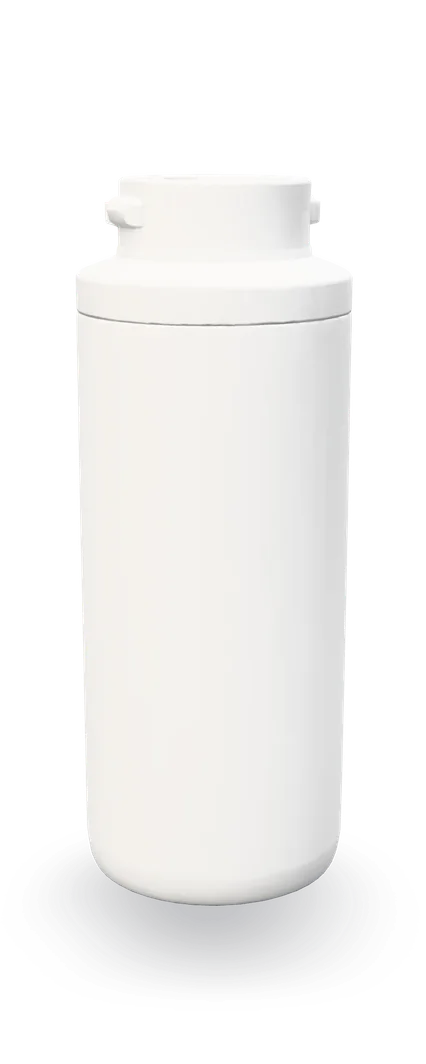
French-door refrigerator water filter replacement
Good news: this is a five-minute job with no tools. Twist the old one out, the new one in, and run a few gallons through.
- Difficulty
- Anyone can do it
- Time
- 5–20 min
- Typical part cost
- $15–$60Pro: $60–$150
- Tools
- 1See the list
No tools. The only things to get right are the part number, a full quarter-turn or click into place, and a good flush afterward.
What it does
What the water filter does
Every drop for the dispenser and the in-door ice maker passes through the filter first. On many French-door models it hangs in the top right corner of the fresh-food compartment, behind a small cover. Some models put it in the base grille or a lower corner instead, so check your manual.
The filter is part of the water path. Take it out with nothing in its place and, on most models, no water reaches the dispenser or the ice maker. Models that can run without a filter use a bypass plug in its spot.
Why it fails
It does not break. It fills up. Makers suggest a new filter about every six months, and sooner if your water is hard or full of sediment.
A filter that is not fully seated can leak or let the dispenser drip.
Symptoms
Signs of a bad water filter
Filter light on
The filter status light or message has come on. It is your reminder to swap the filter and reset the light.
Six months or more
It has been about six months, or longer than your manual says, since the last change.
Slow dispenser flow
Water trickles from the dispenser, or the ice maker makes small or hollow cubes. A clogged filter is the cheapest thing to rule out.
Full diagnosisDrips around the filter
Water drips from the filter cover or runs down the inside wall after a filter change. The filter is usually not fully locked in.
Full diagnosis
How to test it
Test the water filter before you buy
- Check the date. If the filter is older than your manual's interval, change it first.
- Hold a glass under the dispenser and press for a few seconds. Note how strong the flow is.
- Make sure the water supply valve behind or below the refrigerator is fully open and the line behind it is not kinked.
- Good
- The flow is strong with a fresh filter. You are done.
- Bad
- Still weak or nothing with a new filter and the water on. Look at the [door water line](/refrigerator/door-water-line) for ice, then the [water inlet valve](/refrigerator/water-inlet-valve).
Safety first
Before you touch anything
- 1
Unplug the refrigerator
Pull the plug at the wall so the dispenser and ice maker cannot call for water while the filter is out.
- 2
Shut off the water
Close the supply valve that feeds the refrigerator. Fewer drips, and nothing can spill if a seal is not seated.
Tools you'll need
Grab these first
Tool and part links are affiliate links. We may earn a commission at no extra cost to you, and it never changes what we tell you to check first. How this works
- Shallow pan and towelsA towel under the filter catches the few drips that come out of the head.Typically $5–$15Shop this tool
- HeadlampOptionalHelps you read the part number on a filter tucked into the top corner.Typically $12–$30Shop this tool
Step by step
How to replace the water filter
- 1
Unplug it and shut off the water
Unplug the refrigerator and close its water supply valve, usually behind it, under the sink or in the basement.
Lay a towel on the top shelf under the filter.
- 2
Find the filter
Open the French doors and look in the top right corner of the fresh-food compartment for a small hinged cover. That is where many models keep it.
No cover there? Check the base grille below the freezer and the lower corners of the fresh-food section. Your manual's water filter section shows where yours is.
- 3
Take the old filter out
Open the cover. Then release the filter the way your model does it: most turn a quarter turn to the left and pull straight out, some push in to release, and some have an eject button.
Pull it out level so the last bit of water stays in the cartridge, and set it on the towel.
Tip. Read the part number printed on the old filter before you throw it out.
- 4
Match the new filter
Buy the filter with the same part number as the old one, or the one your manual lists. Filters for different models can look alike and still not lock in.
Take the cap off the new filter's inlet, if it has one.
Buy the part
French-door water filter
Opens Amazon in a new tab. Where’s my model number?
What to look for
- The part number printed on the old filter, or the one in your manual. Your model number finds it too.
- The same release style: quarter-turn, push-in or eject button.
- A two-pack or three-pack if you want the next change ready to go.
Compatible filters from other makers usually cost less than the original. Check that the listing names your filter's part number.
- 5
Lock the new filter in
Line the filter up with the head, push it in, and turn it about a quarter turn to the right until it stops or clicks. Push-in types just click home.
Close the filter cover. It should shut flat. If it will not, the filter is not all the way in.
Careful. A filter that is only partly turned can leak once the water is back on.
- 6
Water on, power on, flush it
Open the water supply slowly and plug the refrigerator in. Watch the filter cover for a minute for drips.
Run water through the dispenser into a pitcher to push the air and loose carbon out of the new filter. Many makers ask for about 2 to 4 gallons, and some filters say 1. Use the number in your manual or on the filter box.
Tip. Sputtering at first is just air leaving the line. It stops as you flush.
- 7
Reset the filter light
On most models, press and hold the filter reset button for about three seconds until the light changes. The button is on the dispenser panel or an inside control, depending on the model.
Some newer models reset on their own when they detect a new filter. If the light stays on, follow your manual's reset steps.
Buy the part
Get the right replacement
Buy the part
French-door water filter
Opens Amazon in a new tab. Where’s my model number?
What to look for
- The part number printed on the old filter, or the one in your manual. Your model number finds it too.
- The same release style: quarter-turn, push-in or eject button.
- A two-pack or three-pack if you want the next change ready to go.
Compatible filters from other makers usually cost less than the original. Check that the listing names your filter's part number.
Know your limits
When to call a pro
Stop and call a pro if
- The filter head or its cover is cracked, or water leaks from the head with a new filter fully locked in.
- No water reaches the dispenser with a new filter and the water on, and the door water line is not frozen.
- Water is soaking the shelves, the floor or the cabinet under the refrigerator.
FAQ
French-door water filter questions
How often should I change a French-door refrigerator water filter?
Most makers say about every six months. Change it sooner if the flow slows or the water tastes off, and follow your manual if it gives a different interval.
How much water should I flush through a new filter?
Usually about 2 to 4 gallons, which takes a few minutes of dispensing. Some filters ask for less. The filter box or your manual gives the exact amount.
Can I run the refrigerator without a filter?
Only if your model has a bypass plug for the filter spot, and only with the plug installed. Without the filter or the plug, most models will not send water to the dispenser or the ice maker.
The filter light will not turn off. What now?
Hold the reset button for about three seconds. On some models it is a combination of two buttons, and some reset themselves when they sense a new filter. Your manual lists the exact steps for your model.
Related
Keep going
- SymptomFrench-door refrigerator water dispenser not workingFrench-door refrigerators with a door dispenser only. No water, or only a trickle, usually means the control lock is on, a door is not fully closed, or the filter is new, clogged or not seated. After that, look for a frozen water line in the door, then the water inlet valve.Open guide
- SymptomRefrigerator leaking waterWater under the crisper drawers or on the floor in front usually means a clogged or frozen defrost drain. Water at the back, on models with ice and water, points to the water line, the inlet valve or the filter.Open guide
- Refrigerator partDoor water lineFrench-door refrigerators only. The water for the dispenser and the in-door ice maker crosses into the left door at a hinge and runs past the cold ice box. If it freezes, nothing comes out. Thaw it gently, then fix the cause: a freezer set too cold, a door that does not seal, or blocked airflow.Open guide
- Refrigerator partWater inlet valveThe water inlet valve sits at the bottom back of the refrigerator. When the ice maker or the dispenser asks for water, a coil in the valve opens it. A dead coil means no water; a valve that will not close fully can drip or overfill the ice maker.Open guide
- Refrigerator partIn-door ice makerFrench-door refrigerators only. The ice maker sits in an insulated ice box on the inside of the left door, fed by cold air from the freezer. A switch or a shut-off arm stops it when the bin is full. Before you buy one, check the switch, the water and the ice box for frost.Open guide
Get the next fix before it breaks
A short email when the seasons turn: filters to change, detector batteries to check, and new repair guides. No spam, unsubscribe any time.
We send it with Kit. Privacy