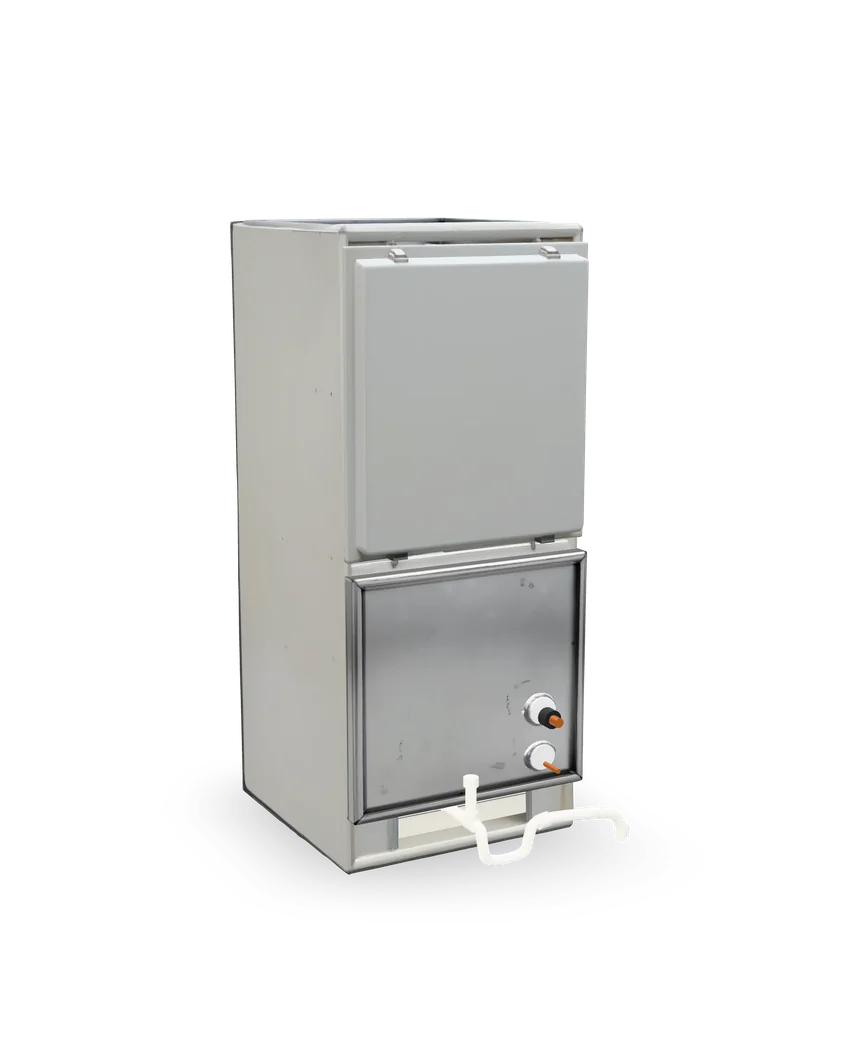
Air handler (heat pump indoor unit)
Air handler repair, from the inside out
An air handler is the indoor half of a heat pump or central air system. It has a blower, a coil and, in many homes, a rack of electric heat strips, all in one tall cabinet. The blower pulls house air through a filter, pushes it across the coil and sends it out through the ducts.
When the vents go quiet, the coil ices over, water fills the drain pan or the backup heat will not come on, the cause is usually one of a few parts: a clogged filter, a plugged drain line, a tired run capacitor, a float switch, the blower motor or the heat strips and their sequencer. Spin the unit, pull it apart in 3D, and tap any part to see what it does and how it fails.
Many of these are careful homeowner jobs. An air handler with heat strips runs on 240 V and may be fed by more than one breaker, so every guide starts with all the power off and confirmed dead. The coil and refrigerant lines are a sealed system, and that work is for a certified pro. We will say so plainly.
Parts
Air handler parts that fail most
- Air filterFor heat pump and central air handlers, including units with electric heat strips. The filter cleans the air before it reaches the blower and coil. A clogged one chokes airflow, which can freeze the coil in summer and trip the heat strips in winter. Check it monthly.Most common5–15 min$5–$25Fix it
- Condensate drain pan and lineFor heat pump and central air handlers, including units with electric heat strips. In cooling, the coil wrings water out of the air into a drain pan, and a pipe with a trap carries it away. When slime or debris blocks that pipe, the pan fills and a float switch shuts the system off.20–45 min$0–$10Fix it
- Blower motor run capacitorFor heat pump and central air handlers with a PSC blower motor, including units with electric heat strips. The run capacitor helps the blower motor start and run. A weak one leaves the blower humming, slow or dead. Air handlers with an ECM motor have no capacitor.20–45 min$10–$50Fix it
- Float switchFor heat pump and central air handlers, including units with electric heat strips. The float switch sits on the drain pan or the drain line. When water rises, the float lifts and cuts the low-voltage control circuit so the system shuts off before the pan overflows.20–45 min$15–$50Fix it
- Blower motor and wheelFor heat pump and central air handlers, including units with electric heat strips. The blower motor spins a squirrel-cage wheel that pulls air through the filter and coil and pushes it into the ducts. A dirty wheel chokes airflow, and a worn motor hums, squeals or stops.1 hr–2.5 hr$150–$450Fix it
- Heat sequencer and heat relaysAir handlers with electric heat only. The sequencer, or a set of heat relays on some units, switches the heat strips on in stages. When it fails, some or all of the strips never come on, even though they are fine.30 min–1.3 hr$40–$55Fix it
- Electric heat stripsAir handlers with electric heat only. The heat strips are coils of resistance wire on a rack inside the air handler. They back up the heat pump in cold weather and during defrost. When they fail, auxiliary and emergency heat stop working.1 hr–2.5 hr$115–$275Fix it
- Control boardThe control board in an air handler takes the thermostat's signals and switches the blower and the electric heat. A blown fuse or a burned relay on it can stop the fan, the heat, or the whole system.30 min–1.5 hr$55–$270Fix it
- Evaporator coilThe evaporator coil is the A-shaped coil of refrigerant tubing and thin fins inside the air handler. House air passes through it to be cooled. A dirty coil chokes the airflow, ice blocks it, and a leak leaves the system low on refrigerant. Coil service is pro work.Call a proPro: $100–$1,600Learn more
- Refrigerant linesThe refrigerant lines, or line set, are the two copper tubes between the air handler's coil and the outdoor unit. A leak at a joint or in a line leaves the system low on refrigerant. Damaged insulation makes the lines sweat. Repairs need an EPA-certified technician.Call a proPro: $250–$1,600Learn more
Symptoms
What is it doing?
- Air handler not blowing air: no airflow from the ventsThe blower inside the air handler is not moving air. A humming motor that never spins points to the run capacitor. Silence points to power, the blower door switch, a tripped float switch, the board or the motor. Ice on the coil can also block the air.
- Air handler coil frozen: ice on the evaporator coil or linesThe indoor coil has iced over, so little or no cool air reaches the vents. Turn the system off or to fan only and let it thaw. Then check the filter, the return grilles and the blower. If it keeps freezing, low refrigerant is a job for a certified pro.
- Air handler heat strips not working: no backup or emergency heatHeat pump air handlers with electric heat strips only. The strips are the backup heat. When they do not come on, look first at their own breakers, then the sequencer, a burned-out strip, a tripped limit from low airflow, or the board.
- Water in the air handler drain pan: pan full or system shut offWater is backing up in the drain pan under the coil, or in the pan under the unit, and the system may have shut itself off. A clogged condensate drain is the usual cause. A stuck float switch, a coil that froze and melted, or a cracked pan are the others.
How it works
How an air handler works
One cabinet moves the air, cools or heats it at the coil, backs the heat pump up with electric strips, and shuts itself off if its drain backs up.
- 1
The blower moves the air
The blower pulls house air in through the filter at the bottom of the cabinet and pushes it out the top into the ducts. On a standard blower motor, a run capacitor helps the motor start and run. Variable-speed motors do without one.
- 2
The coil cools the air and makes water
On its way through, the air crosses the A-shaped evaporator coil. In cooling mode, refrigerant from the outdoor unit makes the coil cold, and it takes heat and moisture out of the air. The water drips into the drain pan under the coil and runs out the condensate drain line.
- 3
In winter, the heat pump runs the coil warm
A heat pump reverses the flow of refrigerant in winter, so the same indoor coil gets warm and heats the air instead. Every so often the outdoor unit runs a defrost cycle to melt frost off its own coil. During defrost, most systems turn on the backup heat so the house does not get a blast of cool air.
- 4
Heat strips back the heat pump up
When the heat pump cannot keep up, during defrost, or when you set the thermostat to Emergency heat, the electric heat strips at the top of the cabinet come on. A heat sequencer switches them on in stages so they do not all draw power at once, and limit switches cut them off if they overheat.
- 5
The float switch guards against floods
If the drain line clogs, water rises in the pan. A float switch rises with it and shuts the system down, outdoor unit and blower included, before the water spills over. Clear the drain and it lets the system run again. Never bypass it.
Model number
Where to find your model number
The rating plate is a label on the cabinet. On many air handlers it is inside the blower door or on a side panel near the electrical controls. Some put it on the outside of a side or front panel.
- Turn off every breaker and the disconnect before you take the blower door off to read it.
- Copy the model and serial numbers exactly, including dashes and letters.
- The outdoor unit has its own rating plate and its own model number. Note both.
Safety first
Before you open an air handler
- Turn off every breaker that feeds the air handler and the disconnect switch beside it before you open a panel. A unit with heat strips runs on 240 V and may be fed by more than one breaker and more than one disconnect. Many heat kits also have breakers of their own on the front of the kit.
- Confirm the power is off with a voltage tester at the unit before you touch anything inside. Switching off is not proof.
- The blower's run capacitor can hold a charge after the power is off. Discharge it with a resistor, then confirm with a meter that it reads near zero before you touch its terminals.
- Never bypass the float switch or the blower door switch. They are there to stop the system.
- If you smell burning, or hear buzzing or arcing, turn the system off at the breakers and leave it off.
- The coil and refrigerant lines are a sealed system. Adding or recovering refrigerant and repairing leaks is for an EPA certified technician.