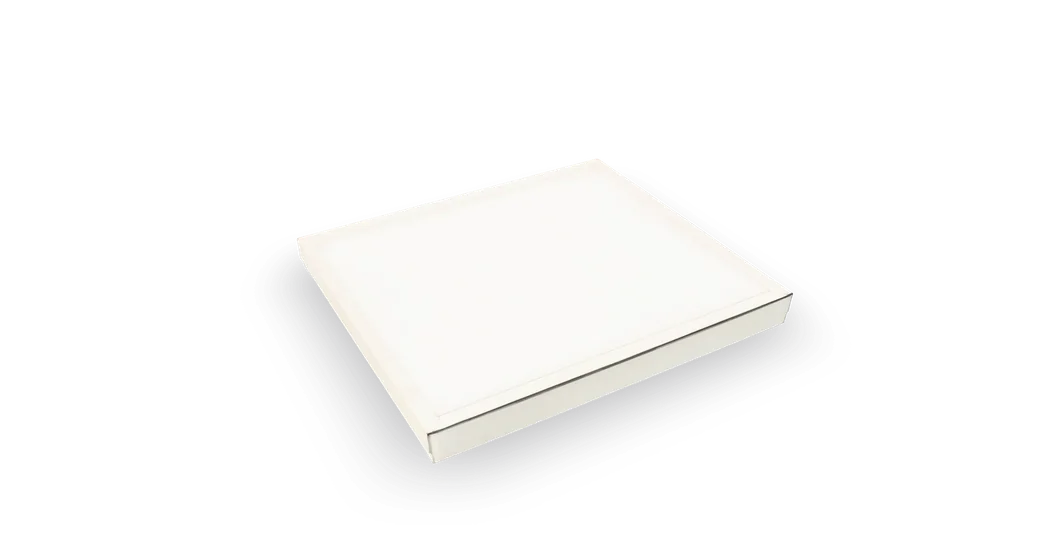
Air handler filter: find it, size it and change it
Good news: this is the one job every air handler maker hands to the homeowner. Five minutes, no tools on most units, and it protects the coil, the blower and the heat strips.
- Difficulty
- Anyone can do it
- Time
- 5–15 min
- Typical part cost
- $5–$25Pro: $70–$200
- Tools
- 1See the list
No tools on most air handlers. The only things to get right are the size, which way the arrow points, and turning the system off first.
What it does
What the air filter does
Every bit of air your air handler moves comes in through the return duct and passes through a filter first. On many units it slides into rails at the bottom of the cabinet, behind a small filter access door. On others the filter sits behind a return air grille in a wall or ceiling instead.
The filter traps dust and lint so they do not coat the blower wheel and the indoor coil. As it does its job it fills up, and the blower has to work harder to pull air through it.
Why it fails
A filter does not break. It just gets full. A packed filter slows the airflow, so the system runs longer and uses more energy.
In cooling, too little air across the indoor coil lets it get cold enough to freeze over. A frozen coil blocks the air even more.
In heating, the electric heat strips need a steady flow of air to carry their heat away. A dirty filter is one of the listed reasons their limit switch opens and shuts them off.
Pets, allergies, dusty rooms, remodeling and heavy use fill a filter faster.
Symptoms
Signs of a bad air filter
Packed with dust
Pull it out and look. A gray, matted filter packed with dust is due. Check it once a month.
Weak airflow at the vents
A clogged filter slows the air through the whole system, so less air reaches the rooms.
Full diagnosisIce on the coil or the copper lines
In cooling, a dirty filter is one of the common reasons the indoor coil freezes. Turn the cooling off and check the filter first.
Full diagnosisBackup heat cuts out
Without enough air, the heat strips run hot and their limit switch opens. The heat comes and goes, or the air feels lukewarm.
Full diagnosis
How to test it
Test the air filter before you buy
- Turn the system off at the thermostat.
- Slide the filter out of its rails or from behind the return grille.
- Look at both sides. Then hold it up to a bright window or a flashlight.
High MERV filters block more light even when they are new, so judge those mostly by how dirty they look and how long they have been in.
- Good
- You can see light through the media and the surface is light colored. It is fine for now. Check again next month.
- Bad
- It is gray and matted with dust, or you can barely see light through it. Replace it.
Safety first
Before you touch anything
- 1
Turn the system off first
Set the thermostat to off so the blower is not pulling air, and dust, through the open slot. If your filter sits behind the blower door or any panel with wiring behind it, also turn off every breaker that feeds the air handler and the disconnect beside it, then check with a voltage tester before you reach in. Units with heat strips may be fed by more than one breaker.
Tools you'll need
Grab these first
Tool and part links are affiliate links. We may earn a commission at no extra cost to you, and it never changes what we tell you to check first. How this works
- Tape measureMeasures the filter slot when the old filter has no readable size on it.Typically $6–$15Shop this tool
- Multi-bit screwdriverPhillips, flat, squareOptionalSome filter doors and return grilles are held by a screw or two.Typically $10–$25Shop this tool
- Non-contact voltage testerPen styleOptionalOnly needed if your filter sits behind a panel that opens the blower or electrical compartment.Typically $15–$30Shop this tool
- HeadlampOptionalHelps you read the size on the frame in a dark closet or attic.Typically $12–$30Shop this tool
- Dust maskN95OptionalA loaded filter sheds dust when you pull it out.Typically $10–$25Shop this tool
Step by step
How to replace the air filter
- 1
Turn the system off
Set the thermostat to off. The blower should stop.
If you will have to open the blower door to reach the filter, also switch off every breaker for the air handler and the disconnect at the unit. An air handler with heat strips runs on 240 V and often has two breakers or a double breaker.
- 2
Find the filter
On many air handlers the filter slides into rails at the bottom of the cabinet, behind a narrow filter access door near where the return duct meets the unit.
No filter in the cabinet? Check behind the return air grilles in your walls or ceiling. Some homes have the filter there instead, and some have one behind every return grille.
Tip. If the filter door uses thumb screws, keep track of the washer behind the panel. One maker notes it has to stay in place when the door goes back on.
- 3
Note the size and the arrow
Before you pull it, look at the frame. Most filters have the size printed on the edge, like 20 x 20 x 1. The last number is the thickness. Write it down.
Also notice which way the printed airflow arrow points. It should point in the direction the air travels, toward the blower.
- 4
Slide the old filter out
Open the filter door or grille and slide the filter straight out. Go slowly so the dust stays on the filter.
If there is no size printed on it, measure it with a tape measure: width, height and thickness.
Tip. A trash bag held under the slot catches anything that falls.
- 5
Get the right replacement
Buy the size printed on the old filter. That number is the nominal size, rounded for shopping. The real filter measures a little smaller so it slides in, so a slightly smaller tape reading is normal.
Pick a MERV rating your system can handle. MERV 8 to 13 is the usual range for homes. A thin 1 in. filter slows the air more than a thick one of the same rating, so check your air handler's manual before you go toward the top of that range.
Buy the part
Air filter
Opens Amazon in a new tab. Where’s my model number?
What to look for
- The exact size printed on the old filter's frame, including the thickness: 1, 2, 4 or 5 in.
- A MERV rating your system can handle. MERV 8 to 13 is the usual range for homes. Check your air handler's manual for the highest rating it allows.
- A pleated filter. Higher ratings catch finer particles, which helps with allergies.
- For a thick 4 or 5 in. media cabinet, a filter that fits that cabinet. A 1 in. filter will not seal in it.
Filters are sold by size, not by brand, so any filter of the right size and a suitable MERV rating fits. A multi-pack makes the monthly check easy to keep up with.
- 6
Slide the new filter in, arrow toward the blower
Find the airflow arrow on the new filter's frame. Point it the way the air flows, into the air handler and toward the blower. On a ceiling return grille that means pointing up.
Slide it all the way in so it sits flat with no gaps around the edges.
Careful. A filter put in backwards can restrict airflow. Check the arrow twice.
- 7
Close up and turn it back on
Close the filter door or the grille so all the air goes through the filter. Put back any panel you removed before you turn the power back on.
Switch the disconnect and breakers back on if you turned them off, then set the thermostat back to heat or cool. You should feel steady airflow at the vents once the blower starts.
Tip. Write today's date on the new filter's frame. Next month, you will know exactly how long it has been in.
Buy the part
Get the right replacement
Buy the part
Air filter
Opens Amazon in a new tab. Where’s my model number?
What to look for
- The exact size printed on the old filter's frame, including the thickness: 1, 2, 4 or 5 in.
- A MERV rating your system can handle. MERV 8 to 13 is the usual range for homes. Check your air handler's manual for the highest rating it allows.
- A pleated filter. Higher ratings catch finer particles, which helps with allergies.
- For a thick 4 or 5 in. media cabinet, a filter that fits that cabinet. A 1 in. filter will not seal in it.
Filters are sold by size, not by brand, so any filter of the right size and a suitable MERV rating fits. A multi-pack makes the monthly check easy to keep up with.
Know your limits
When to call a pro
Stop and call a pro if
- The filter is clean but airflow is still weak. A dirty blower wheel, a failing blower motor, an iced or dirty coil or a duct problem may be the cause.
- The coil is still freezing with a clean filter and open vents. A refrigerant leak is one possible cause, and that is a job for a licensed pro.
- The heat strips keep cutting out with a clean filter. See the heat strips guide, then call a pro.
- You want a higher MERV or a thicker media filter than your air handler was built for. A pro can check that the blower and ducts can handle it.
- You find no filter anywhere, or the filter slot has no cover and leaks air.
FAQ
Air filter questions
How often should I change my air handler filter?
Check it every month and change it whenever it looks dirty. One air handler maker's manual says to clean or replace it regularly, typically once a month. A 1 in. filter typically lasts 1 to 3 months. Thick media filters last longer, so follow the filter's packaging.
Change it more often with pets, allergies, a dusty home or remodeling, or heavy use.
Where is the filter on an air handler?
Usually in rails at the bottom of the cabinet, behind a small filter access door, on an upflow unit. If there is no filter in the cabinet, look behind the return air grilles in your walls or ceiling.
Can a dirty filter freeze my coil?
Yes. A dirty filter is one of the common reasons an indoor coil freezes in cooling. Turn the cooling off, set the fan to on to thaw it, and change the filter. If it freezes again with a clean filter, call a pro.
Which way does the arrow go?
Toward the air handler's blower. The arrow shows the direction the air flows, from the return duct into the unit. On a ceiling return grille, it points up.
What MERV rating should I use?
MERV 8 to 13 is the usual range for homes. Higher numbers catch smaller particles but also slow the air more, and a thin 1 in. filter slows it more than a thick one. Check your air handler's manual, or ask a pro, before going above what it was designed for.
Related
Keep going
- SymptomAir handler not blowing air: no airflow from the ventsThe blower inside the air handler is not moving air. A humming motor that never spins points to the run capacitor. Silence points to power, the blower door switch, a tripped float switch, the board or the motor. Ice on the coil can also block the air.Open guide
- SymptomAir handler coil frozen: ice on the evaporator coil or linesThe indoor coil has iced over, so little or no cool air reaches the vents. Turn the system off or to fan only and let it thaw. Then check the filter, the return grilles and the blower. If it keeps freezing, low refrigerant is a job for a certified pro.Open guide
- SymptomAir handler heat strips not working: no backup or emergency heatHeat pump air handlers with electric heat strips only. The strips are the backup heat. When they do not come on, look first at their own breakers, then the sequencer, a burned-out strip, a tripped limit from low airflow, or the board.Open guide
- Air handler partBlower motor and wheelFor heat pump and central air handlers, including units with electric heat strips. The blower motor spins a squirrel-cage wheel that pulls air through the filter and coil and pushes it into the ducts. A dirty wheel chokes airflow, and a worn motor hums, squeals or stops.Open guide
- Air handler partCondensate drain pan and lineFor heat pump and central air handlers, including units with electric heat strips. In cooling, the coil wrings water out of the air into a drain pan, and a pipe with a trap carries it away. When slime or debris blocks that pipe, the pan fills and a float switch shuts the system off.Open guide
- Air handler partElectric heat stripsAir handlers with electric heat only. The heat strips are coils of resistance wire on a rack inside the air handler. They back up the heat pump in cold weather and during defrost. When they fail, auxiliary and emergency heat stop working.Open guide
- Air handler partEvaporator coilThe evaporator coil is the A-shaped coil of refrigerant tubing and thin fins inside the air handler. House air passes through it to be cooled. A dirty coil chokes the airflow, ice blocks it, and a leak leaves the system low on refrigerant. Coil service is pro work.Open guide
Get the next fix before it breaks
A short email when the seasons turn: filters to change, detector batteries to check, and new repair guides. No spam, unsubscribe any time.
We send it with Kit. Privacy