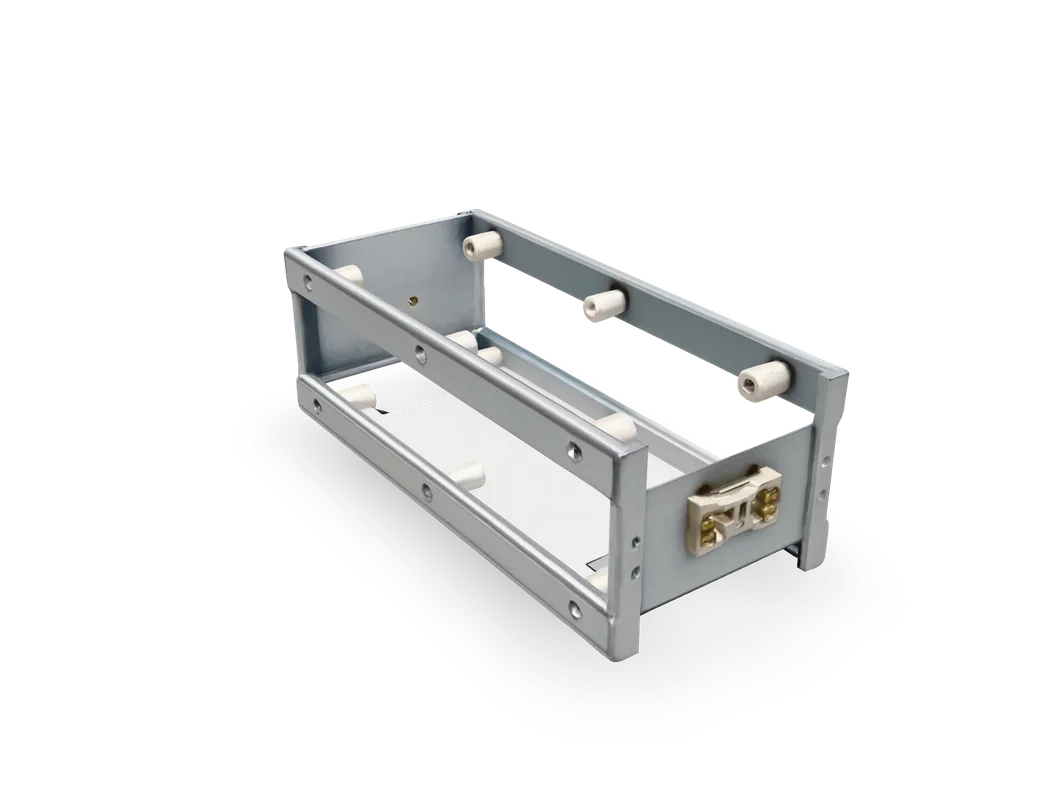
Air handler heat strips: test and replace the heat kit
Heat strips are simple coils of wire, and the kit slides out as one piece. The part that matters is the power: these run on 240 V, and the unit may be fed by more than one breaker, so you prove every circuit dead before you touch anything.
- Difficulty
- Hard
- Time
- 1 hr–2.5 hr
- Typical part cost
- $115–$275Pro: $150–$900
- Tools
- 7See the list
Few screws, but serious power. The kit sits on one or more 240 V circuits, and you must turn off and prove dead every one before you touch it. Matching the replacement to your air handler takes care too.
What it does
What the heat strips does
A heat pump moves heat in from outside. In very cold weather, or while the outdoor unit defrosts, it needs help. The heat strips are that help: open coils of wire that glow hot when current runs through them, right in the airstream.
The strips come as a heat kit: a sheet metal rack with the elements, their safety limits and a wiring block or breakers on the front. The kit slides into the air handler as one piece.
Each element has safety limits wired in. An automatic-reset limit opens if the strip gets too hot and closes again once it cools. A one-time limit, often a fusible link, opens for good as a backup if the first one fails to stop the heat.
Why it fails
Poor airflow is the big one. A clogged filter, closed vents or a weak blower lets the strips overheat. The limits trip over and over, and in time an element or a one-time limit burns open.
Elements burn open with age, and wiring connections at the kit can loosen, scorch and burn.
Sometimes the strips are fine and the problem is upstream: a tripped breaker, the sequencer or relay that switches them on, or the control board that calls for them.
Symptoms
Signs of a bad heat strips
Emergency heat blows cool air
Set to emergency heat, the blower runs but the air from the vents is barely warm. Every strip may be out, or nothing is switching them on.
Full diagnosisThe house falls behind on cold days
The heat pump runs and runs, auxiliary heat shows on the thermostat, and the house still drifts colder. Some or all of the strips may not be heating.
Full diagnosisA heat breaker trips
One of the air handler's breakers, at the panel or on the heat kit itself, trips when the heat comes on. If it trips again right after a reset, leave it off and call a pro.
A burning smell that does not fade
A mild dusty smell on the first cold day is normal and fades within the hour. A sharp electrical smell, or any smoke, is not. Turn the system off at the thermostat and the breakers.
How to test it
Test the heat strips before you buy
- Find every breaker that feeds the air handler. With electric heat the unit may be fed by more than one double breaker at the panel, and many heat kits have their own breakers on the front of the kit.
- Look for one sitting in the middle or tripped position.
- If you find one, turn it fully off, then back on once. Watch whether it trips again when the heat comes on.
Never keep resetting a breaker that trips. It is telling you something is wrong.
- Good
- Every breaker is on and stays on. Move on to the element and limit tests with the power off.
- Bad
- A breaker that trips again when the heat comes on points at a short in the kit or its wiring. Leave it off and call a pro.
- Do this only with every breaker and the disconnect off and the kit proven dead, as in steps 1 to 4 below. Let the strips cool.
- Find the two ends of one element on the kit. Take a photo, then take one wire off that element so the meter reads only it.
- Touch one probe to each end of the element. Polarity does not matter.
- Write the number down, put the wire back, and repeat for each element.
A good element on a common 240 V kit typically reads
Roughly 10–18 Ω per element
Typical range. Check your part label or manual for the exact spec. If the kit's label or manual gives a resistance for its elements, use that. If not, get a rough figure from the label: volts times volts, divided by the watts of one element. A 5 kW element at 240 V works out to about 11.5 Ω. A kit with two or more elements splits its total kW between them, so divide first. A cold element often reads a little under the worked-out figure, and that is fine.
- Good
- A steady reading close to the number for that element's wattage means the coil is intact.
- Bad
- OL, or no reading, means the element has burned open. A kit with an open element needs replacing.
- Keep every breaker off and let the kit cool all the way. A warm automatic limit can still be open.
- Find the limits on the kit: small disc switches, and on many kits a one-time limit or fusible link, wired in line with each element.
- Take one wire off a limit and touch one probe to each of its terminals. Repeat for each limit.
A good, cool limit reads
Continuity (near 0 Ω)
Typical range. Check your part label or manual for the exact spec. Never jumper or remove a limit, not even for a test. It is the only thing that stops a strip from overheating.
- Good
- Continuity on every limit. The safeties are closed and are not what is stopping the heat.
- Bad
- OL on a cool limit means it is open. A one-time limit that has opened means the kit has overheated, and one heat kit maker's troubleshooting guide says the kit then needs replacing. Find out why it overheated, usually a dirty filter or weak airflow, before the new kit goes in.
Safety first
Before you touch anything
- 1
Every breaker off, then prove it
Set the thermostat to off. Turn off every breaker that feeds the air handler, any breakers on the heat kit, and the disconnect next to the unit. There can be more than one 240 V circuit. Then prove the kit terminals dead with a tester you have just checked on a live outlet.
- 2
Lock or tag the breakers
If your panel takes a breaker lock, use one. If not, tape over the breakers and write a note saying not to turn them on. Someone flipping one back on while your hands are in the kit is the real danger.
- 3
Let the strips cool
The elements and limits get very hot. Give them time to cool before you touch the kit, and before you test a limit.
- 4
Keep clear of the run capacitor
The blower's run capacitor can hold a charge after the power is off. You do not need to touch it for this job, so keep your hands and tools away from its terminals. Our [run capacitor guide](/air-handler/run-capacitor) shows how to discharge one.
Tools you'll need
Grab these first
Tool and part links are affiliate links. We may earn a commission at no extra cost to you, and it never changes what we tell you to check first. How this works
- Non-contact voltage testerPen styleProves the heat kit terminals are dead before you touch them. Check it on a live outlet first.Typically $15–$30Shop this tool
- Digital multimeterΩ, V, µF, µAConfirms 0 V across the supply terminals, then tests each element and limit for an open circuit.Typically $25–$60Shop this tool
- Nut driver1/4 in. hexBlower door and heat kit screws are often 1/4 in. hex heads.Typically $6–$15Shop this tool
- Nut driver5/16 in. hexSome panels and kit mounting screws are 5/16 in.Typically $6–$15Shop this tool
- Multi-bit screwdriverPhillips, flat, squareLoosens the field wiring lugs on the kit's breaker or terminal block.Typically $10–$25Shop this tool
- Painter's tape and markerLabels each wire, and tags the breakers off so nobody turns them back on.Typically $5–$12Shop this tool
- HeadlampThe heat kit sits high in a dark cabinet. Keeps both hands free.Typically $12–$30Shop this tool
- Work glovesOptionalSheet metal edges inside the cabinet are sharp.Typically $8–$20Shop this tool
Step by step
How to replace the heat strips
- 1
Thermostat off, every breaker off
Set the thermostat to off so nothing calls for heat.
At the main panel, turn off every breaker for the air handler. With electric heat there may be more than one double breaker, often labeled air handler, AHU or heat strips. If you are not sure which, turn off the ones you think, then prove it at the kit in step 4.
Careful. Do not rely on the thermostat or one breaker. Heat kits can be fed by more than one circuit, and any one of them can still be live.
- 2
Disconnect off, and tag it all
Turn off the disconnect switch next to the air handler, and any breakers on the face of the heat kit.
Put a breaker lock on if you have one. Otherwise tape over each breaker and the disconnect with a note: do not turn on, work in progress.
- 3
Take off the blower door
Remove the screws and lift the blower door away. The heat kit sits above the blower, usually with its breakers or terminal block facing you.
- 4
Prove the kit is dead
Check your voltage tester on a live outlet so you know it works. Then hold it to every supply wire at the heat kit's breaker or terminal block. It should stay quiet on every one.
For a second check, set your multimeter to V AC and touch the probes across each pair of supply terminals on the kit. It should read 0 V. Then check the tester on the outlet again.
Tip. Not sure the strips are the problem? Run the element and limit tests above now, with the kit still in place.
Careful. If the tester beeps or the meter shows any voltage, stop. Something is still on. Find that breaker before you go any further.
- 5
Photograph and label the wires
Take clear photos of every wire on the kit: the heavy supply wires at the breaker or terminal block, and the plug or small wires that run to the sequencer or control board.
Put a strip of tape on each wire and write where it goes.
- 6
Disconnect the kit
Loosen the lugs and pull the supply wires out of the kit's breaker or terminal block. Unplug the control plug or take off the small wires to the sequencer or relays.
Fold the wires aside so they cannot catch when the kit slides out.
- 7
Slide out the old kit
Remove the screws that hold the kit's front plate to the cabinet and slide the kit straight out. Go slowly so the coils do not snag on the cabinet.
Look it over. A broken or sagging coil, a scorched terminal or melted insulation tells you what failed.
- 8
Match the new kit
Read the air handler's rating plate and its manual. They list which heat kits that air handler is approved for. Buy one from that list, with the same kW and voltage as the old kit.
Check the manual for the blower speed the new kit needs. Heat kits need a minimum airflow, and a bigger kit can need a higher speed tap.
Careful. Never fit a bigger kit than the rating plate lists. The wiring and breakers are sized for what the plate allows.
Buy the part
Electric heat strips
Opens Amazon in a new tab. Where’s my model number?
What to look for
- A kit your air handler's rating plate or manual lists as approved. That list is the surest match.
- The same kW and voltage as the old kit, and a cabinet size that fits your air handler.
- The same wiring type: with built-in breakers, or with a terminal block, as your setup was wired.
- Check the voltage: a 240 V kit run on 208 V puts out about a quarter less heat.
Universal kits exist, but only fit one if your air handler's rating plate or manual lists it. Otherwise buy the kit by the air handler's model number.
- 9
Slide in the new kit
Slide the new kit into the same opening, coils first, and line up its front plate. Put the screws back in.
Follow the new kit's own instructions. If they say to mark the air handler's rating plate with the kit you installed, do it.
- 10
Reconnect the wires
Work from your labels, your photos and the wiring diagram that comes with the kit. Seat each supply wire fully in its lug and tighten it firmly. Loose lugs get hot and burn.
Reconnect the control plug or small wires. Make sure no wire touches the coils or the blower.
- 11
Close it up
Check that a clean filter is in. Then put the blower door back on and screw it down.
- 12
Power on and test the heat
Take off your tags. Turn on the disconnect, any breakers on the kit, and every breaker at the panel.
Set the thermostat to emergency heat and turn it up. After a short delay the air from the vents should get noticeably warm. A brief dusty smell from new strips is normal.
Set the thermostat back to normal heat when you are done.
Careful. If a breaker trips, leave it off and call a pro.
Buy the part
Get the right replacement
Buy the part
Electric heat strips
Opens Amazon in a new tab. Where’s my model number?
What to look for
- A kit your air handler's rating plate or manual lists as approved. That list is the surest match.
- The same kW and voltage as the old kit, and a cabinet size that fits your air handler.
- The same wiring type: with built-in breakers, or with a terminal block, as your setup was wired.
- Check the voltage: a 240 V kit run on 208 V puts out about a quarter less heat.
Universal kits exist, but only fit one if your air handler's rating plate or manual lists it. Otherwise buy the kit by the air handler's model number.
Know your limits
When to call a pro
Stop and call a pro if
- A heat breaker trips again after one reset.
- A one-time limit has opened, or the limits trip again with a clean filter. Something is restricting the airflow, and a pro should find it.
- You see scorched wires, a melted terminal block or burned insulation.
- You cannot get the tester to stay quiet at the kit, or you are not sure which breakers feed it.
- The strips test good and still do not heat. The sequencer, relays or control board may not be switching them on.
- You are not comfortable proving 240 V wiring dead before you touch it.
FAQ
Electric heat strips questions
What is the difference between auxiliary heat and emergency heat?
Both use the same heat strips. Auxiliary heat is the thermostat adding the strips on its own when the heat pump needs help, like on a very cold day or during defrost. Emergency heat is you switching the heat pump off and running on the strips alone.
Can I reset a heat strip limit switch?
Many kits have an automatic limit that resets itself when the strip cools. The one-time limit, often a fusible link, does not reset. One heat kit maker's troubleshooting guide says a kit with an open one-time limit needs replacing. Check your kit's manual.
Either way, a limit opens because the strips got too hot. Fix the airflow first: change the filter and open the vents.
Why might my air handler have more than one breaker?
The heat strips draw a lot of current, so larger kits can be split over more than one 240 V circuit. Every one of them has to be off before you work on the kit.
Why does my heat smell like burning?
On the first cold day, dust that settled on the strips burns off with a mild smell that fades within the hour. A sharp electrical smell that lasts, or any smoke, is not normal. Turn the system off and call a pro.
Can I put in a bigger heat kit for more heat?
Only up to what the air handler's rating plate lists. The wires, breakers and blower speed are matched to it.
Related
Keep going
- SymptomAir handler heat strips not working: no backup or emergency heatHeat pump air handlers with electric heat strips only. The strips are the backup heat. When they do not come on, look first at their own breakers, then the sequencer, a burned-out strip, a tripped limit from low airflow, or the board.Open guide
- SymptomAir handler not blowing air: no airflow from the ventsThe blower inside the air handler is not moving air. A humming motor that never spins points to the run capacitor. Silence points to power, the blower door switch, a tripped float switch, the board or the motor. Ice on the coil can also block the air.Open guide
- Air handler partHeat sequencer and heat relaysAir handlers with electric heat only. The sequencer, or a set of heat relays on some units, switches the heat strips on in stages. When it fails, some or all of the strips never come on, even though they are fine.Open guide
- Air handler partControl boardThe control board in an air handler takes the thermostat's signals and switches the blower and the electric heat. A blown fuse or a burned relay on it can stop the fan, the heat, or the whole system.Open guide
- Air handler partAir filterFor heat pump and central air handlers, including units with electric heat strips. The filter cleans the air before it reaches the blower and coil. A clogged one chokes airflow, which can freeze the coil in summer and trip the heat strips in winter. Check it monthly.Open guide
Get the next fix before it breaks
A short email when the seasons turn: filters to change, detector batteries to check, and new repair guides. No spam, unsubscribe any time.
We send it with Kit. Privacy