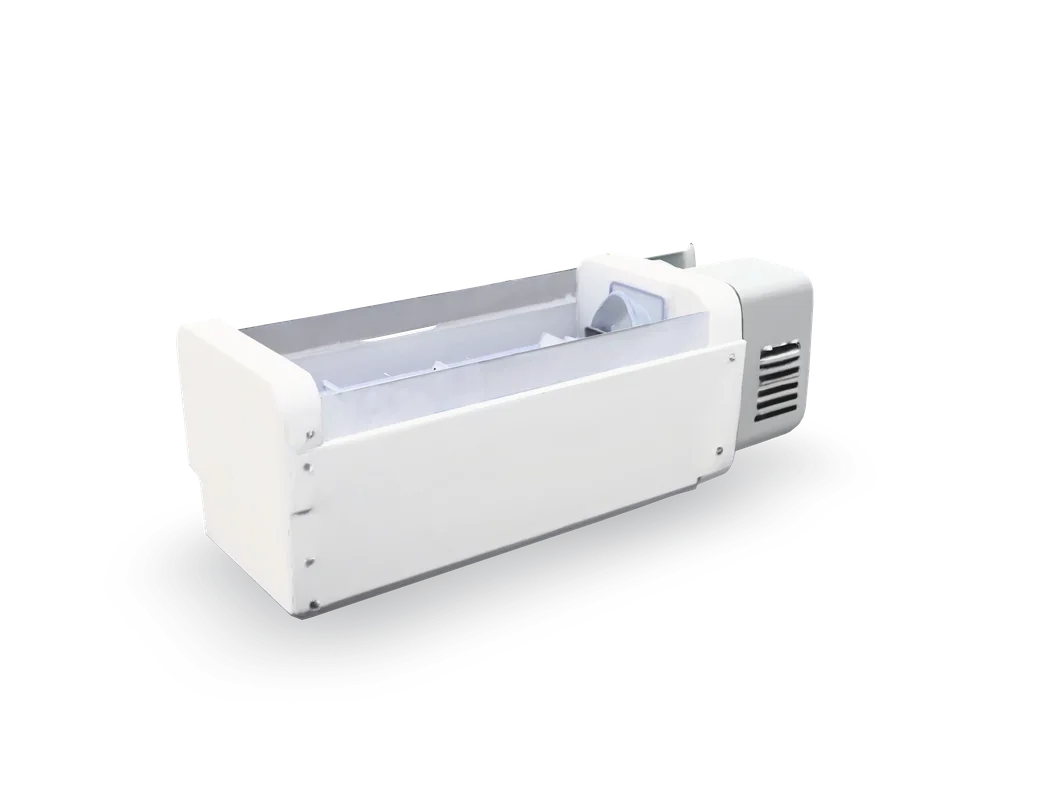
French-door in-door ice maker troubleshooting and replacement
Most in-door ice makers that stop are switched off, frosted up or short of water. Check those first. If it has really died, the swap is a couple of screws and a plug.
- Difficulty
- Easy
- Time
- 20 min–1 hr
- Typical part cost
- $75–$260Pro: $100–$500
- Tools
- 2See the list
Most fixes are checks, not tools. The swap is two to four screws and one plug, working inside a small compartment.
What it does
What the in-door ice maker does
The ice box on the inside of the left door is kept below freezing by cold air carried up from the freezer. The ice maker sits at the top of the box, with the ice bin below it and the dispenser behind.
When it is ready for a batch, water comes through the door's water line into a fill cup and the mold. Once it has frozen, the ice maker pushes the cubes out into the bin.
It stops when the bin is full. Some models use a wire shut-off arm that rests on the ice: raised means off. Many French-door models use an on/off switch instead, often under the ice maker, which you reach by opening the ice box door.
Why it fails
Often nothing has failed. The switch is off, the shut-off arm is up or jammed by ice, or the freezer is too warm.
Frost and moisture build up inside the ice box. The ice maker slows down, the cubes clump and the bin freezes in place. That points to a seal or the ice box fan, not the ice maker.
The door water line or the fill cup freezes, so no water reaches the mold.
The ice maker's own motor or control fails. Then it neither fills nor ejects, even with the switch on, water reaching it and a cold ice box.
Symptoms
Signs of a bad in-door ice maker
No ice, switch on?
The bin stays empty. Check that the ice maker switch is on, or that the shut-off arm is down, before anything else.
Full diagnosisBin frozen in, cubes clumped
The bin is stuck in a block of ice or the cubes are welded together. The ice box is getting warm and damp air. Look at the seals and the ice box fan.
Full diagnosisSmall or hollow cubes
Not enough water is reaching the mold: an old or clogged filter, a partly closed supply valve, low house water pressure or a restricted water valve.
Full diagnosisNo water from the dispenser either
The dispenser and the ice maker both stopped. The door water line is the likely place, not the ice maker.
Full diagnosis
How to test it
Test the in-door ice maker before you buy
- Open the ice box door and make sure the ice maker is switched on, or its shut-off arm is down and moves freely.
- Check the freezer is close to 0°F. A warm freezer means a warm ice box.
- Make sure the water supply valve is open and the filter is seated, or the bypass plug is in.
- Look inside the ice box for heavy frost, and at the fill cup for a plug of ice.
- Good
- All four look right and still no ice after a day. Move on to the next check.
- Bad
- One was off. Fix it and give the ice maker up to a day to start again. Frost in the box means thaw it and find the leak or the [ice box fan](/refrigerator/ice-box-fan) problem.
- Try the water dispenser.
- If the dispenser gives nothing too, the water is not reaching the door. See the door water line guide.
- If the dispenser works but the mold stays dry, the ice maker's fill cup may be frozen or its side of the water valve has failed.
- If water reaches the mold but the ice maker never ejects or refills, the ice maker has failed.
- Good
- Water in the mold, switch on, cold box, but nothing happens: replace the ice maker.
- Bad
- No water in the mold: thaw the fill cup and test the [water inlet valve](/refrigerator/water-inlet-valve).
Safety first
Before you touch anything
- 1
Unplug the refrigerator
The ice maker's motor can start on its own, and its plug is live. Unplug the refrigerator before you take it out.
- 2
Shut off the water
Close the water supply valve so the fill cup cannot spill into the door while the ice maker is out.
Tools you'll need
Grab these first
Tool and part links are affiliate links. We may earn a commission at no extra cost to you, and it never changes what we tell you to check first. How this works
- Multi-bit screwdriverPhillips, flat, squareMost in-door ice makers are held by Phillips screws.Typically $10–$25Shop this tool
- Nut driver1/4 in. hexOptionalSome models use 1/4 in. hex screws instead.Typically $6–$15Shop this tool
- Putty knifeStiff, 1-1/2 in.OptionalA plastic putty knife eases the bottom edge of a clipped-in ice maker free without scratching the liner.Typically $5–$12Shop this tool
- Shallow pan and towelsA towel catches the water left in the mold and fill cup.Typically $5–$15Shop this tool
- HeadlampOptionalThe ice box is dark with the power off.Typically $12–$30Shop this tool
Step by step
How to replace the in-door ice maker
- 1
Unplug it and shut off the water
Unplug the refrigerator and close its water supply valve. Have a towel ready.
- 2
Open the ice box and take out the bin
Open the left door, then the ice box door on the inside of it. Lift the ice bin up and out, and empty it into the sink.
- 3
Check for frost before you go on
Look around the ice maker and the walls of the box. Heavy frost or a bin frozen in place means warm, damp air is getting in. A new ice maker will not fix that.
Let it melt with the door open, or use a hair dryer on low kept moving. Then check the ice box seal and the ice box fan.
- 4
Remove the mounting screws
Most in-door ice makers are held to the ice box by two screws, usually Phillips. Some have a second set into the door, and some also clip in at the bottom edge.
Remove the screws and keep a hand under the ice maker so it does not drop.
- 5
Unplug it and lift it out
Ease the ice maker forward. If it clips in, lift the bottom edge gently with a plastic putty knife. Find the wire connector behind it and squeeze the tab to unplug it.
Tip the mold over the towel to empty any water, then set the old ice maker aside.
Tip. Take a photo of the wires and the shut-off arm before you pull anything.
- 6
Match the new ice maker
Check the part number against your model. In-door ice makers differ a lot between models, and some kits come with a new fill cup and hardware.
If your old unit's shut-off arm, sensor or harness is a separate piece, move it to the new one in the same position.
Buy the part
In-door ice maker
Opens Amazon in a new tab. Where’s my model number?
What to look for
- Your model number. In-door ice makers fit only certain models, even within one brand.
- The part number on the old ice maker's label.
- Whether the kit includes the fill cup, the shut-off arm or sensor, and the screws.
There is no universal in-door ice maker. Buy the one matched to your model number.
- 7
Install it
Plug the connector in until it clicks. Set the ice maker in place, then refit the screws snug, not tight.
Check that the fill cup sits right under the water outlet and spills into the mold. Slide the bin back in and close the ice box door.
- 8
Water on, power on, and wait
Open the water supply, plug the refrigerator in and switch the ice maker on.
The first ice takes a few hours. Throw out the first few batches before you use the ice.
Buy the part
Get the right replacement
Buy the part
In-door ice maker
Opens Amazon in a new tab. Where’s my model number?
What to look for
- Your model number. In-door ice makers fit only certain models, even within one brand.
- The part number on the old ice maker's label.
- Whether the kit includes the fill cup, the shut-off arm or sensor, and the screws.
There is no universal in-door ice maker. Buy the one matched to your model number.
Know your limits
When to call a pro
Stop and call a pro if
- Frost keeps coming back in the ice box after you have checked the seals and the ice box fan.
- The ice maker has no power at its plug, so the control or the door wiring has a fault.
- Water is leaking inside the door or running out under the dispenser.
FAQ
In-door ice maker questions
Where is the on/off switch on a French-door ice maker?
On many models it is on the ice maker itself, often underneath it, inside the ice box: open the ice box door to reach it. On some it is elsewhere inside the fresh-food compartment, and some models have a wire arm you lower to turn it on instead. Your manual shows which yours has.
The ice bin is frozen in. Is the ice maker broken?
Usually not. A frozen-in bin means warm, damp air is getting into the ice box. Thaw it, then check the ice box door seal, the main door gasket and the ice box fan.
Do I need to shut off the ice maker if the water is off?
Yes. Turn it off so it does not keep calling for water that never comes.
Should I keep the first ice from a new ice maker?
No. Replacement instructions advise throwing away the first few batches. After that, use the ice as normal.
Related
Keep going
- SymptomFrench-door ice maker jammed or frozen upFrench-door refrigerators with the ice maker in the left door only. Ice clumps in the bucket, frost builds up in the ice box, or the dispenser grinds and gives nothing. Clear the jam first, then find why: a stopped ice box fan, a frozen fill tube or a leaky seal.Open guide
- SymptomRefrigerator ice maker not making iceThe ice maker makes no ice, or only small, hollow cubes. Check the shut-off arm, the water supply and the freezer temperature first. After that, the water inlet valve and the ice maker itself are the parts that fail.Open guide
- Refrigerator partIce box fanFrench-door refrigerators only. The ice box on the left door sits in the fresh-food section, so freezer air is piped to it through a duct, and on many models a small fan does the pushing. When the fan stops, the freezer stays cold but the ice maker slows down or quits.Open guide
- Refrigerator partDoor water lineFrench-door refrigerators only. The water for the dispenser and the in-door ice maker crosses into the left door at a hinge and runs past the cold ice box. If it freezes, nothing comes out. Thaw it gently, then fix the cause: a freezer set too cold, a door that does not seal, or blocked airflow.Open guide
- Refrigerator partFrench-door water filterFrench-door refrigerators only. The water filter cleans the water for the dispenser and the ice maker. On many models it sits in the top right corner of the fresh-food compartment. Change it on the schedule in your manual, usually about every six months.Open guide
- Refrigerator partWater inlet valveThe water inlet valve sits at the bottom back of the refrigerator. When the ice maker or the dispenser asks for water, a coil in the valve opens it. A dead coil means no water; a valve that will not close fully can drip or overfill the ice maker.Open guide
Get the next fix before it breaks
A short email when the seasons turn: filters to change, detector batteries to check, and new repair guides. No spam, unsubscribe any time.
We send it with Kit. Privacy