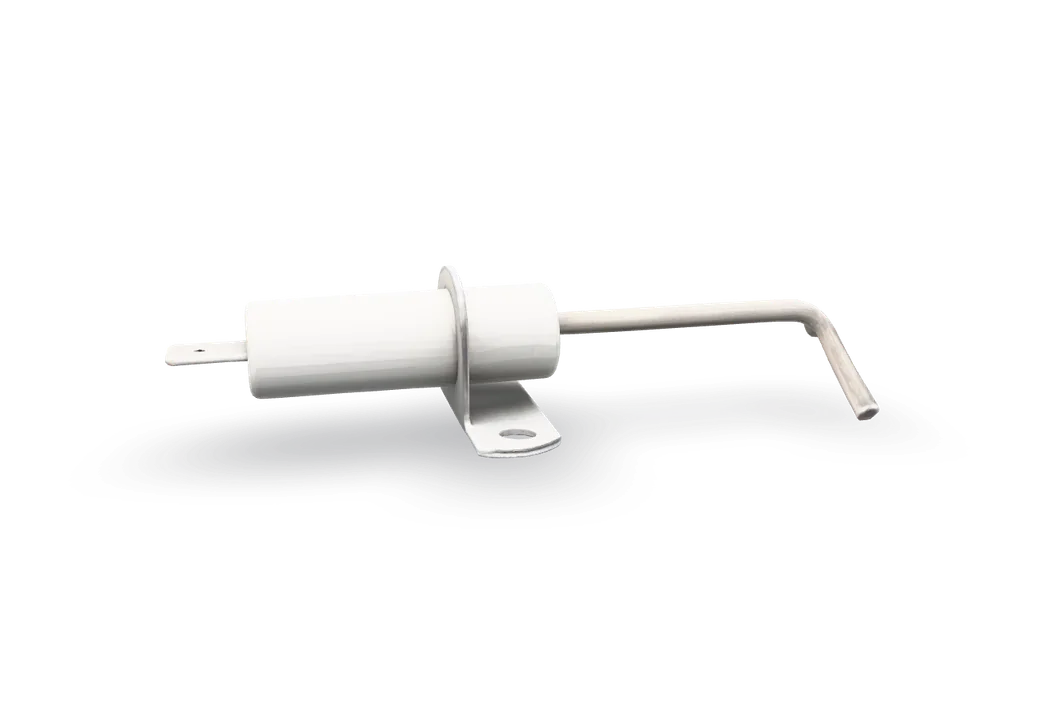
Furnace flame sensor cleaning and replacement
Good news: this fix usually costs next to nothing. One wire, one screw, a quick polish, and the burners stay lit.
- Difficulty
- Anyone can do it
- Time
- 10–20 min
- Typical part cost
- $10–$50Pro: $75–$250
- Tools
- 4See the list
One wire and one screw, in plain sight. The only care needed is with the brittle porcelain.
What it does
What the flame sensor does
The flame sensor is a thin metal rod in a white porcelain insulator, on a small bracket. Its tip sits in the burner flame, usually at the opposite end of the row from the igniter. Its one job is to tell the control board that the burners really lit.
It works because a flame can carry a little electricity. The board puts a voltage on the rod. When the burners are lit, a tiny current flows from the rod, through the flame, to the grounded burner. It is measured in microamps, which are millionths of an amp.
If the board sees that current, it keeps the gas valve open. If it does not see it within a few seconds, it assumes the gas never lit and shuts the valve. That is what stops a furnace from feeding unburned gas into your home.
Why it fails
Over time the rod picks up a thin coating of carbon, soot and oxidation. The coating acts like insulation. The signal gets weaker until the board can no longer see it, even though the burners are lit.
Less often the sensor itself is damaged. The porcelain can crack, the rod can corrode badly, or the wire connector can work loose.
A weak signal can also come from a poor ground. The current returns through the burner and the furnace chassis, so a loose ground connection has much the same effect as a dirty rod.
Symptoms
Signs of a bad flame sensor
Lights, then goes out
The igniter glows and the burners light normally. A few seconds later they shut off again. This is the classic dirty flame sensor.
Full diagnosisTries again, then gives up
The furnace waits, relights, and drops out again. After a few rounds the board locks out and flashes an error code.
Full diagnosisWorks some days, not others
A lightly coated rod sits right at the edge of what the board can read. The furnace may heat fine for a day, then fail several starts in a row.
Full diagnosisA dull or crusty rod
With the power off, look at the rod. Clean metal is bright. A dark, white or sooty coating is what blocks the signal. It does not have to look bad to cause trouble.
Blowing cold air
If the thermostat fan is set to On, the blower keeps running while the burners are out. The vents blow room-temperature air.
Full diagnosis
How to test it
Test the flame sensor before you buy
- Power off at the service switch or breaker, and let the burner area cool.
- Take off the upper door and find the sensor at the burners. Shine a light on it.
- Check the rod, the porcelain and the wire connector.
Many rods have a bend near the tip from the factory. That is fine. What matters is that the tip still sits in the flame.
- Good
- The porcelain is whole, the rod sits in the flame path, and the connector grips firmly. A dull or sooty coating is normal. Clean it.
- Bad
- Cracked porcelain, a badly corroded rod, or a rod bent out of the flame path. Replace the sensor. A loose or corroded connector needs fixing too.
Safety first
Before you touch anything
- 1
Kill the power
Flip the furnace service switch off, or turn off its breaker. The control board light should go dark. Before you pull the sensor wire, check it with a voltage tester. Try the tester on a working outlet first so you know it works.
- 2
Close the gas shutoff
Turn the handle on the gas line a quarter turn so it sits crosswise to the pipe. You will not open any gas fittings in this job. This is just a second layer of safety.
- 3
Let it cool
The rod sits right in the flame. If the furnace just tried to run, give it a few minutes before you touch it.
Wait about 10 min
Tools you'll need
Grab these first
Tool and part links are affiliate links. We may earn a commission at no extra cost to you, and it never changes what we tell you to check first. How this works
- Nut driver1/4 in. hexThe sensor bracket screw and most furnace door screws are 1/4 in. hex heads.Typically $6–$15Shop this tool
- Fine abrasive padTakes the coating off the rod without gouging the metal.Typically $4–$10Shop this tool
- HeadlampThe sensor is tucked in beside the burners. Both hands free helps.Typically $12–$30Shop this tool
- Non-contact voltage testerPen styleConfirms there is no power at the sensor wire before you pull it off.Typically $15–$30Shop this tool
Step by step
How to clean or replace the flame sensor
- 1
Shut off the power and the gas
Flip the service switch on or near the furnace to off. It looks like a light switch. If you cannot find one, turn off the furnace breaker.
Then turn the gas shutoff handle a quarter turn so it sits crosswise to the pipe.
Tip. Not sure the power is off? Turn the thermostat up. Nothing should start, and the status light on the control board should stay dark.
- 2
Take off the upper door
The upper door covers the burner compartment. Most lift up and pull away. Some have two screws along the top edge.
Set the door somewhere it will not get stepped on.
- 3
Find the flame sensor
Look at the row of burners. The igniter is usually at one end. The flame sensor is usually at the other end, with its rod reaching into the path of a burner flame.
It is a single bare metal rod with a white porcelain collar, held on a small bracket by one screw. One wire runs to it. The igniter has two wires and a plastic plug, so the two are easy to tell apart.
Tip. Take a photo now. It shows how the rod sits in front of the burner, which is how it has to go back.
- 4
Pull the wire off
Hold the voltage tester to the sensor wire. It should stay quiet. If it beeps or lights, stop and find the right breaker.
The wire ends in a push-on connector that grips a flat tab on the sensor. Hold the connector, not the wire, and pull it straight off. A gentle wiggle helps if it is tight.
Look at the connector while it is off. It should be clean and it should grip firmly. A loose or corroded connector can cause the same symptom as a dirty rod.
Tip. On some furnaces the wire is fixed to the sensor and unplugs a few inches away instead.
- 5
Remove the mounting screw
One screw holds the sensor bracket, usually a 1/4 in. hex head. Back it out with the nut driver and put it somewhere safe. A new sensor may not come with one.
Tip. A magnetic nut driver stops the screw from dropping behind the burners.
- 6
Slide the sensor out
Pull the sensor straight out of its opening. Go gently. The white porcelain is brittle and cracks if it gets knocked.
- 7
Decide: clean it or replace it
Look it over in good light. A dull, white or sooty coating on the rod is normal. That one gets cleaned in the next step.
Replace it instead if the porcelain is cracked, the rod is badly corroded or bent out of the flame path, or a cleaning did not fix the problem last time. Sensors are inexpensive.
Replacing it? Hold the old and new sensors side by side. The bracket, the rod length and the bend should match. Skip the next step and go straight to putting the new one in.
Buy the part
Flame sensor
Opens AppliancePartsPros in a new tab. Where’s my model number?
What to look for
- Any part number stamped on the bracket. Many sensors have none, so searching by your furnace model number is the surest match.
- The same bracket shape and screw position, so it mounts in the original hole.
- The same rod length and the same bend, so the tip sits in the flame exactly where the old one did.
- The same size of push-on terminal, so the wire connector grips it firmly.
Sensors vary by model. A universal one is only a fair choice when the bracket lines up with the original screw hole and the rod ends up in the same spot in the flame. If you would have to bend or force anything to make it fit, get the exact part instead.
- 8
Polish the rod
Hold the sensor by its bracket. Rub the metal rod gently with a fine abrasive pad, fine steel wool or fine emery cloth, working along its length and turning it as you go. Use light pressure. Stop when it is bright all the way around. This takes less than a minute.
Clean only the metal. Leave the porcelain alone, apart from a gentle wipe. Then wipe the rod with a clean, dry cloth or paper towel to take off the dust and any loose fibers.
Careful. No sandpaper, files or wire wheels. Rough abrasives scratch the rod, and some sandpapers leave a residue on it. You are taking off a coating, not metal.
- 9
Put the sensor back
Slide the sensor, cleaned or new, back into its opening the same way the old one came out. Line up the bracket and snug the screw. Firm is enough.
Check it against your photo. The rod should sit in the path of the burner flame, and it must not touch the burner or any other metal.
- 10
Reconnect the wire
Push the connector onto the tab until it is fully seated. It should feel snug. Keep the wire clear of the burners.
- 11
Put the door back on
Refit the upper door. Many furnaces will not run unless the doors are seated, because a door switch cuts power when one is off.
- 12
Turn it back on and watch it stay lit
Turn the gas shutoff handle back in line with the pipe, then flip the power on. Set the thermostat a few degrees above room temperature.
Watch through the sight glass or the door louvers. The burners should light and stay lit, well past the point where they used to cut out. Let the furnace run for a few minutes, until the blower comes on.
Tip. If the furnace was locked out, switching the power off and back on usually clears it.
Buy the part
Get the right replacement
Buy the part
Flame sensor
Opens AppliancePartsPros in a new tab. Where’s my model number?
What to look for
- Any part number stamped on the bracket. Many sensors have none, so searching by your furnace model number is the surest match.
- The same bracket shape and screw position, so it mounts in the original hole.
- The same rod length and the same bend, so the tip sits in the flame exactly where the old one did.
- The same size of push-on terminal, so the wire connector grips it firmly.
Sensors vary by model. A universal one is only a fair choice when the bracket lines up with the original screw hole and the rod ends up in the same spot in the flame. If you would have to bend or force anything to make it fit, get the exact part instead.
Know your limits
When to call a pro
Stop and call a pro if
- You smell gas at any point. Do not touch any switches. Leave the house and call your gas utility from outside.
- Your carbon monoxide alarm goes off. Get everyone outside to fresh air, then call 911 or the fire department from outside.
- The burners still drop out within seconds with a clean or new sensor. The cause may be a poor ground, the wiring or the control board. A pro can measure the flame signal with a microamp meter to find out.
- The flames look lazy, yellow or lifted off the burners, or do not reach the sensor. That is a burner or gas problem.
- The burners light late with a bang or a puff of flame.
- You see scorch marks, melted wires or flame rolling out around the burners.
- The rod is coated again within a few weeks. Something is off with the way the furnace is burning.
FAQ
Flame sensor questions
How do I know if it is the flame sensor or the igniter?
Watch a start-up. If the burners light and then go out a few seconds later, suspect the flame sensor. If there is no orange glow and no flame at all, suspect the igniter.
Should I clean the sensor or just replace it?
Clean it first. Most sensors just need the coating polished off, and that costs nothing. Replace it if the porcelain is cracked, the rod is badly corroded, or cleaning does not fix the problem.
How often should I clean the flame sensor?
Have it looked at once a year, ideally before the heating season starts. It takes a few minutes and heads off one of the most common mid-winter breakdowns.
I cleaned the sensor and the furnace still shuts off. Now what?
Check the basics first. The wire should be pushed firmly onto the sensor, the porcelain should not be cracked, and the rod should sit in the flame without touching the burner. If all of that is right, try a new sensor. They are cheap. If a new one does not help either, a pro can measure the flame signal and check the ground.
Then time the shutdown. A flame sensor problem shows up within seconds of the burners lighting. If the burners run for several minutes before they quit, look at airflow and the high limit switch instead.
Is it safe to keep running the furnace with a dirty flame sensor?
A dirty sensor fails safe. It shuts the gas off instead of leaving it on, so the usual result is no heat, not a gas leak. Do not keep resetting the furnace to squeeze out a few minutes of warmth, though. Fix the cause.
And never try to bypass the sensor. It is what shuts the gas off when the burners fail to light.
Related
Keep going
- SymptomFurnace lights, then shuts off after a few secondsThe burners light, then go out a few seconds later. The furnace waits, tries again, and eventually locks out. A dirty flame sensor is the usual cause, and cleaning it is a 15-minute job.Open guide
- SymptomFurnace short cyclingThe furnace starts, runs briefly, shuts off, and starts again before the house warms up. A clogged filter is the most common cause. A dirty flame sensor is next.Open guide
- SymptomFurnace control board blinking an error codeThe light on the control board flashes a code when something fails. Count the flashes, match them to the chart inside the blower door, and write the code down before you reset anything.Open guide
- Furnace partHot surface igniterThe igniter glows bright orange to light the burners. It is one of the most common reasons a furnace clicks but never lights, and it is usually a one-screw swap.Open guide
- Furnace partHigh limit switchThe high limit switch shuts the burners off if the furnace gets too hot. It trips most often because of poor airflow, so check the filter and the blower before you replace it.Open guide
- Furnace partControl boardThe control board runs the furnace's start-up sequence and flashes a code when something fails. Read the blink code first, because most codes point at a part the board is reporting on.Open guide