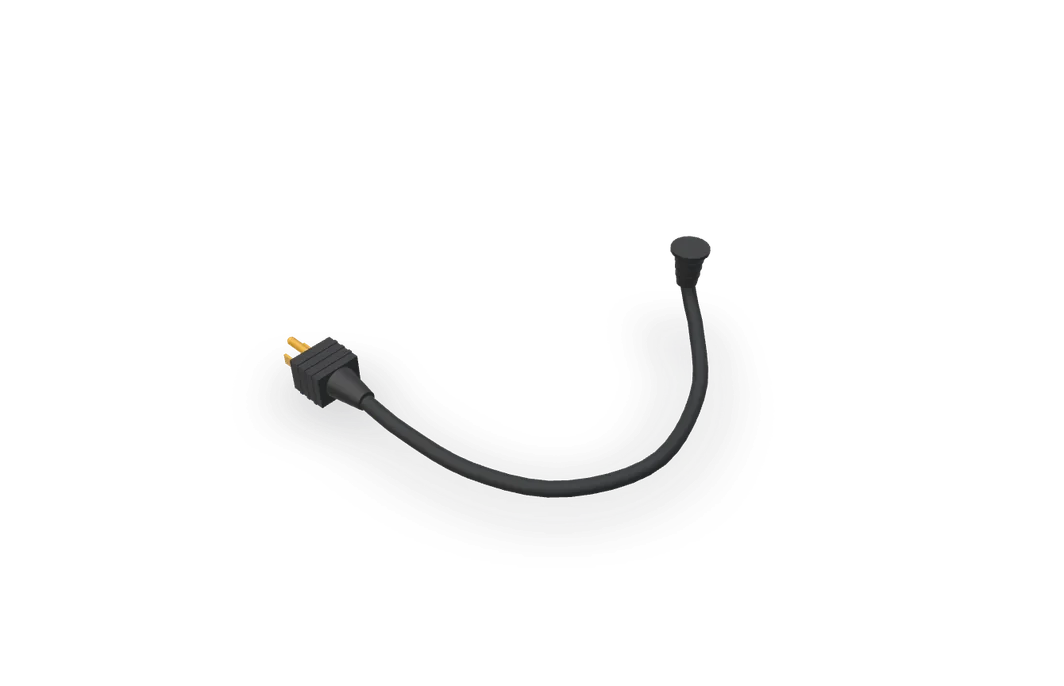
Garbage disposal power cord replacement
Many disposals do not come with a cord, and old cords get crushed or chewed under the sink. Fitting a new one is three wires and a cover plate, with the breaker off.
- Difficulty
- Easy
- Time
- 15–30 min
- Typical part cost
- $10–$30Pro: $100–$250
- Tools
- 3See the list
Basic wiring: strip, twist on wire nuts, tighten a ground screw. Easy if you have done a light fixture.
What it does
What the power cord does
On a plug-in disposal, a three-wire cord runs from the outlet under the sink to a small wiring compartment behind a cover plate on the bottom of the unit.
Inside, the cord's two power wires join the disposal's black and white wires with wire nuts, and the cord's green ground wire goes to a green ground screw.
The plug needs a grounded three-slot outlet close to the disposal. Never use an extension cord.
Why it fails
The cord gets crushed, kinked or cut by things stored under the sink.
Water and vibration loosen a connection in the box.
Many new disposals are sold without a cord, so one has to be fitted.
Symptoms
Signs of a bad power cord
Cut or crushed cord
Visible damage, a kink or exposed wire anywhere along the cord.
Works when you wiggle the cord
It cuts in and out when the cord is moved. A loose connection or a broken wire.
Full diagnosisDead, but the outlet works
A lamp works in the outlet and the reset button is in, but the disposal is silent.
Full diagnosis
How to test it
Test the power cord before you buy
- Unplug the disposal and plug a lamp into the same outlet. Flip the wall switch on. The lamp should light.
- With the disposal unplugged, look along the cord for damage.
- Good
- The outlet works and the cord looks fine. Check the reset button, then the connections in the box.
- Bad
- The outlet is dead: check the breaker and any GFCI. The cord is damaged: replace it.
Safety first
Before you touch anything
- 1
Unplug and switch off
Turn off the wall switch, unplug the disposal and switch off its breaker. Do not rely on the wall switch alone.
- 2
Test before you touch
Hold a voltage tester to the wires in the box before you touch them. Check the tester on a working outlet before and after.
Tools you'll need
Grab these first
Tool and part links are affiliate links. We may earn a commission at no extra cost to you, and it never changes what we tell you to check first. How this works
- Non-contact voltage testerPen styleConfirms there is no power at the cord or the outlet before you touch wires.Typically $15–$30Shop this tool
- Multi-bit screwdriverPhillips, flat, squareRemoves the cover plate and tightens the ground screw.Typically $10–$25Shop this tool
- Wire stripperStrips the cord wires if the kit is not pre-stripped.Typically $10–$25Shop this tool
Step by step
How to replace the power cord
- 1
Unplug and switch off the breaker
Unplug the disposal and switch off its breaker.
- 2
Open the wiring box
Remove the screw or screws on the cover plate on the bottom of the disposal and pull out the wires. Check them with the voltage tester. Leave any insulation shield inside the box in place.
- 3
Remove the old cord
Photograph the connections. Unscrew the wire nuts, loosen the green ground screw, and pull the old cord out through its strain relief.
- 4
Wire the new cord
Feed the new cord through the strain relief clamp. Follow the kit's instructions: the neutral wire (white, or the ribbed one) goes to the disposal's white wire, and the hot wire (black, or the smooth one) to its black wire. Join each pair with a wire nut, with no bare copper showing. Fit the green ground wire under the green screw and tighten it.
Tug each wire gently. Nothing should pull out. Tighten the strain relief and tug the cord to check it holds.
Buy the part
Power cord
Opens Amazon in a new tab. Where’s my model number?
What to look for
- A disposal cord kit with a three-prong grounded plug and a strain relief clamp.
- Long enough to reach the outlet without stretching.
Many cord kits fit most disposals, but some newer models need their own maker's cord. Check your manual and the kit's fit list.
- 5
Close up and test
Tuck the wires in without pinching any under the cover plate, then refit it.
Plug in only when everything is closed up.
Plug in, switch the breaker on, run water and switch the disposal on.
Buy the part
Get the right replacement
Buy the part
Power cord
Opens Amazon in a new tab. Where’s my model number?
What to look for
- A disposal cord kit with a three-prong grounded plug and a strain relief clamp.
- Long enough to reach the outlet without stretching.
Many cord kits fit most disposals, but some newer models need their own maker's cord. Check your manual and the kit's fit list.
Know your limits
When to call a pro
Stop and call a pro if
- Your disposal is hardwired into a junction box and you want to convert it to a plug. That may need a new outlet.
- There is no ground wire at the box or outlet, or the wiring is aluminum.
- There is no grounded outlet near the disposal, or the plug does not fit it. Do not change the plug or use an extension cord.
- The outlet or the wall switch is scorched or warm.
- You are not sure which wire is which, or the voltage tester shows power with the breaker off.
FAQ
Power cord questions
Do garbage disposals come with a cord?
Many do not. You can buy a cord kit, or reuse the cord from the old unit if it is in good shape and your new unit's instructions allow it.
Can I reuse my old cord?
Often, if it is undamaged and has a three-prong plug. Some newer disposals say to use only their own cord, so check the manual first.
Plug-in or hardwired: how do I tell?
Look under the sink. If the disposal's cord goes to an outlet, it is plug-in. If a cable goes straight into a metal box or the wall, it is hardwired. Switch off the breaker either way.
Related
Keep going
- SymptomGarbage disposal won't turn onYou flip the switch and hear nothing at all. A tripped reset button is the first thing to check. A tripped breaker or GFCI, a loose plug, a bad cord or switch, or a dead motor come next.Open guide
- Garbage disposal partReset buttonThe reset button is a thermal overload. It pops out to cut power when the motor overheats or jams. Free any jam, let it cool, and press it back in.Open guide
- Garbage disposal partWhole disposal unitWhen the body cracks, it leaks from the bottom or the reset button, or the motor is dead, the disposal gets replaced as a unit. Unhook it, move the cord, hang the new one and reconnect the drains.Open guide
Get the next fix before it breaks
A short email when the seasons turn: filters to change, detector batteries to check, and new repair guides. No spam, unsubscribe any time.
We send it with Kit. Privacy