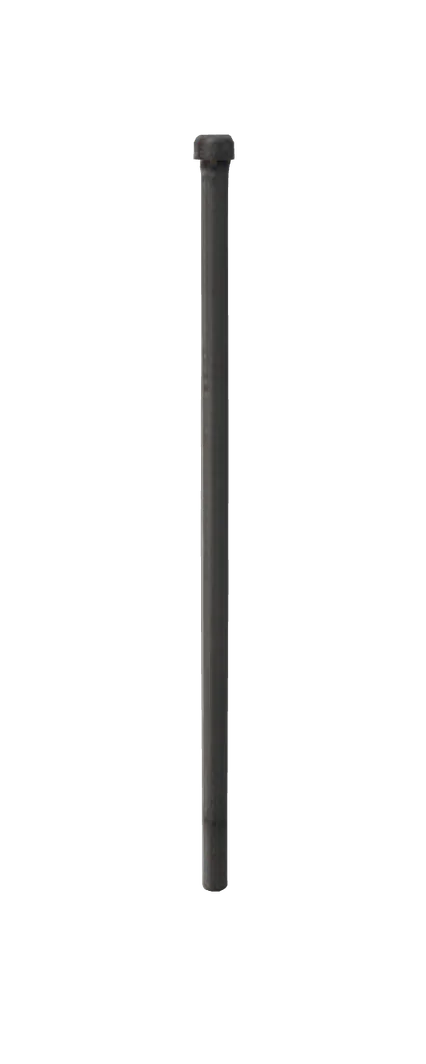
Water heater anode rod: inspect and replace
The anode rod is the cheapest insurance your tank has. Checking it takes one socket, a few gallons of drained water and some muscle.
- Difficulty
- Moderate
- Time
- 45 min–2 hr
- Typical part cost
- $20–$75Pro: $150–$350
- Tools
- 5See the list
Only a few steps, but an old rod can be very hard to break loose. You may need a long breaker bar, an impact wrench or a helper to hold the tank steady.
What it does
What the anode rod does
Every tank water heater, gas or electric, has at least one anode rod. It is a long metal rod, usually magnesium or aluminum, that hangs down inside the tank from a fitting on top.
The rod corrodes so the tank does not. While there is metal left on the rod, it takes the damage that would otherwise eat at the steel tank and its glass lining.
Most rods screw into their own port on top of the tank and have a hex head. Some heaters use a combination anode instead, built onto the hot water outlet fitting.
Why it fails
It does not break. It gets used up. Over the years the rod wears thinner until only its steel core wire is left, and then the tank is unprotected.
Water chemistry changes how it wears. In some water, the anode and bacteria in the tank also make a rotten egg smell in the hot water.
Symptoms
Signs of a bad anode rod
Rotten egg smell from hot water only
If only the hot water smells like sulfur and the cold water does not, the anode reacting with your water is a common cause. If the cold smells too, look at your water supply instead.
Full diagnosisThe rod is down to the wire
When you pull the rod, several inches of bare steel core wire, or a rod that is thin along most of its length, means it is used up.
It has not been checked in years
Manufacturers say to inspect the rod on a schedule, anywhere from every year to every three years. If nobody has looked in a long time, it is worth a check.
How to test it
Test the anode rod before you buy
- With the power and gas off, the cold supply closed and a few gallons drained, unscrew the rod and lift it out.
- Look along the whole length of the rod, top to bottom.
- Check for bare core wire at either end and for spots where the rod has worn thin.
Some scale and pitting is normal. What matters is how much metal is left.
- Good
- The rod is still mostly full thickness with no long stretch of bare wire. Seal the threads and put it back.
- Bad
- About 6 in. or more of bare core wire at either end, or most of the rod worn thinner than about 3/8 in. Replace it.
Safety first
Before you touch anything
- 1
Turn off the power or the gas
Electric heater: turn off its breaker, then hold a voltage tester to the power cable where it enters the heater. Try the tester on a live outlet first so you know it works. Gas heater: turn the gas control to OFF or PILOT as the label on the heater says.
- 2
Close the gas shutoff (gas heaters)
Turn the handle on the gas line to the heater so it sits crosswise to the pipe. You will not open any gas fittings. This is a second layer of safety while you work on top of the tank.
- 3
Shut off the cold water and relieve pressure
Close the cold water supply valve to the heater, then open a hot water faucet nearby so the tank is not under pressure.
- 4
Let the water cool
Tank water can scald, and an insulated tank stays hot for hours. Give it at least a couple of hours with the heat off, and still treat the water as hot when you drain it.
Wait about 120 min
- 5
Drain a few gallons
Drain a few gallons through the drain valve so the water level drops below the top of the tank. One manufacturer says about 5 gallons.
Tools you'll need
Grab these first
Tool and part links are affiliate links. We may earn a commission at no extra cost to you, and it never changes what we tell you to check first. How this works
- Socket and breaker bar1-1/16 in.Fits the hex head of most anode rods. A 6-point socket grips a stuck hex better than a 12-point one.Typically $25–$50Shop this tool
- Non-contact voltage testerPen styleConfirms an electric heater has no power before you work on it.Typically $15–$30Shop this tool
- PTFE thread tapeSeals the new rod's threads. Pipe dope works too.Typically $2–$6Shop this tool
- Garden hoseRuns the few gallons you drain from the tank to a floor drain or outside.Typically $15–$35Shop this tool
- Bucket5 galOptionalCatches drips from the hose and the anode port.Typically $4–$10Shop this tool
- Work glovesThe rod and fittings can be hot and sharp with scale.Typically $8–$20Shop this tool
- Tongue-and-groove pliers10 in.OptionalOnly for a combination anode on the hot outlet, which comes out with a pipe wrench.Typically $12–$28Shop this tool
Step by step
How to inspect and replace the anode rod
- 1
Turn off the power, or the gas
Electric heater: turn off the water heater's breaker. Confirm with a voltage tester at the power cable where it enters the heater.
Gas heater: turn the gas control to OFF or PILOT, as the label on the heater says. Then turn the gas shutoff handle on the line so it sits crosswise to the pipe.
Careful. An electric heater must stay off until the tank is full again. A heating element that runs dry can burn out.
- 2
Shut off the cold water and open a hot tap
Close the cold water supply valve on the pipe that feeds the heater.
Open a hot water faucet nearby. That lets the pressure out of the tank so water does not spray when the rod comes out.
- 3
Drain a few gallons
Attach a garden hose to the drain valve near the bottom of the tank and run it to a floor drain or outside.
Open the drain valve and let a few gallons out, then close it. One manufacturer says about 5 gallons. That drops the water below the top of the tank.
Careful. The water can be hot enough to scald. Keep the hose end where it cannot splash anyone.
- 4
Find the anode rod
Look on top of the tank for a hex head about the size of a large bolt, set into its own fitting. That is the anode on most heaters.
If you find no hex head, your heater may use a combination anode on the hot water outlet. The parts diagram for your model number will tell you which kind you have.
Tip. A combination anode comes out with a pipe wrench after the hot water line is disconnected. If you are not comfortable taking that line apart, call a plumber.
- 5
Break the rod loose
Fit the 1-1/16 in. socket on the hex and turn it counterclockwise. Old rods are often seized, so use a long breaker bar for leverage.
If it will not budge, an impact wrench often breaks it loose.
Tip. Have a helper hold the tank steady so it does not twist and strain the water lines while you push.
- 6
Lift the rod out and look at it
Pull the rod straight up and out. If the ceiling is low, it may bend as it comes out, which is fine for a rod you are replacing.
About 6 in. or more of bare core wire at either end, or a rod worn thin along most of its length, means replace it. If it still has plenty of metal, wrap the threads with fresh tape and put it back.
- 7
Match the new rod
Get a rod with the same thread and fitting type as the old one, and about the same length. A hex-plug rod and a hot-outlet combination rod are different parts.
Short on headroom above the heater? Segmented rods, made of short sections linked by a cable, are made for that. They bend as you feed them in.
Careful. Do not leave the rod out. A tank with no anode loses its corrosion protection, and manufacturers say running without one can void the warranty.
Buy the part
Anode rod
Opens AppliancePartsPros in a new tab. Where’s my model number?
What to look for
- The same fitting type: a hex-plug rod for a port on top of the tank, or a combination rod for the hot outlet. Most hex heads take a 1-1/16 in. socket.
- The same thread size as the old one. The parts list for your model number has it.
- About the same length as the original, unless you are switching to a segmented rod sized for your tank.
- A segmented, flexible rod if there is not enough room above the heater to lower a solid rod in.
Generic rods fit many heaters when the thread and length match. If your hot water smells like sulfur, an aluminum-zinc rod is a common choice that often helps, though not always.
- 8
Seal the threads and install it
Wrap the new rod's threads with PTFE tape, or coat them with pipe dope. Lower the rod into the port and start the threads by hand.
Tighten it with the socket until it is snug and sealed.
- 9
Refill and push the air out
Make sure the drain valve is closed. Leave the hot faucet open and turn the cold supply back on.
The faucet sputters while air is pushed out of the tank. When water runs from it in a steady stream, the tank is full. Close the faucet.
- 10
Check for leaks
Look at the threads around the new rod. Any drip means tighten it a little more. Check again in about 24 hours.
- 11
Turn the heat back on
Electric heater: only once the tank is full, turn the breaker back on.
Gas heater: open the gas shutoff so the handle lines up with the pipe, then follow the lighting instructions on the heater's label.
Buy the part
Get the right replacement
Buy the part
Anode rod
Opens AppliancePartsPros in a new tab. Where’s my model number?
What to look for
- The same fitting type: a hex-plug rod for a port on top of the tank, or a combination rod for the hot outlet. Most hex heads take a 1-1/16 in. socket.
- The same thread size as the old one. The parts list for your model number has it.
- About the same length as the original, unless you are switching to a segmented rod sized for your tank.
- A segmented, flexible rod if there is not enough room above the heater to lower a solid rod in.
Generic rods fit many heaters when the thread and length match. If your hot water smells like sulfur, an aluminum-zinc rod is a common choice that often helps, though not always.
Know your limits
When to call a pro
Stop and call a pro if
- You smell gas near a gas water heater. Do not touch any switches. Leave the house and call your gas utility from outside.
- The rod will not break loose even with a breaker bar or impact wrench, or the tank starts to twist as you push.
- Your heater has a combination anode on the hot outlet and you are not comfortable disconnecting the hot water line.
- The anode port or tank top leaks after you install the new rod and tightening does not stop it.
- Water is leaking from the tank itself rather than a fitting.
FAQ
Anode rod questions
How often should I check the anode rod?
Manufacturers differ. Some say every year, others every three years. Softened or poor-quality water can wear a rod faster, so if your first check shows a lot of wear, look sooner next time.
Do gas and electric water heaters both have an anode rod?
Yes. Every glass-lined tank heater has at least one, whether it heats with gas or electricity. The job is the same. The only difference is how you shut off the heat before you start.
My hot water smells like rotten eggs. Is the anode the problem?
It can be. In some water, bacteria and the anode together make a sulfur smell in the heated water. A different rod, often aluminum-zinc, is a common fix. See rotten egg smell for the full checklist.
If you smell gas rather than sulfur in the water, leave the house and call your gas utility from outside.
Can I just take the anode rod out to stop the smell?
No. Without an anode the tank has nothing protecting it from rust, and manufacturers say running without one can void the warranty.
There is not much room above my water heater. What can I do?
Use a segmented anode rod. It is made of short sections joined by a cable, so it bends as you feed it into the tank. Make sure the old rod will come out before you buy one.
Related
Keep going
- SymptomWater heater smells like rotten eggsA rotten egg smell in the air near a gas appliance can mean a gas leak: leave now and call the gas utility from outside. Sulfur-smelling hot water is a different, harmless problem, usually bacteria reacting with the anode rod.Open guide
- SymptomWater heater leakingWater on the floor or dripping down the tank. Shut off the power or gas and the cold supply, dry everything, then trace the water to its source: a valve, a fitting, an element gasket, or the tank itself.Open guide
- Water heater partDrain valve and tank flushThe drain valve near the bottom of the tank lets you empty it and flush out sediment. Manufacturers suggest flushing gas and electric tanks about once a year, more often with hard water.Open guide
- Water heater partDip tubeThe dip tube carries cold water to the bottom of the tank. When it cracks or breaks, cold water mixes with the hot at the top and you run out fast. Gas and electric tanks both have one.Open guide
- Water heater partTemperature and pressure relief valveThe T&P relief valve opens to let water out if the tank gets too hot or the pressure gets too high. Gas and electric heaters both have one. Test it once a year by lifting its lever.Open guide