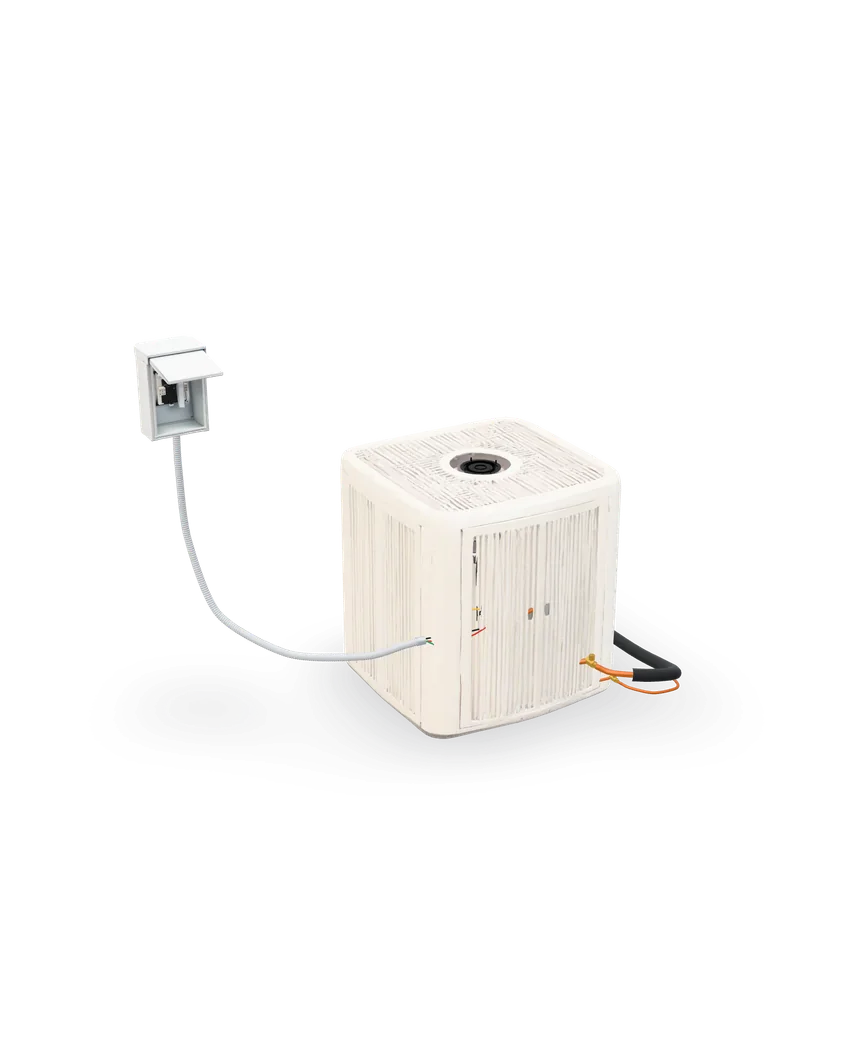
AC condenser fan not spinning
The compressor hums but the big fan on top sits still. Turn the AC off first, then check the capacitor before you buy a motor.
Check these first
Five-minute checks, no tools
Turn the AC off
Running without the fan overheats the compressor. Set the thermostat to off until it is fixed.
Nothing jammed in the blade
Look through the top grille for sticks, leaves or debris caught in the blade. Turn the power off at the disconnect before clearing anything.
Breaker and disconnect
If nothing at all is running outside, check the AC breaker and the disconnect beside the unit.
Likely causes
Ranked by how often they are the problem
- 1DIY fix
Dual run capacitor
The fan hums but will not start, or starts only if nudged. The FAN section of the capacitor is weak.
Fix the capacitor20–45 min$10–$60 - 2DIY fix
Condenser fan motor
The capacitor tests good but the blade is stiff, grinds, or the motor smells burnt.
Fix the fan motor45 min–1.5 hr$60–$400 - 3DIY fix
Contactor
Neither the fan nor the compressor runs. Burned contacts are not passing power.
Fix the contactor30 min–1 hr$20–$100
What's happening
What your AC condenser is doing
The fan pulls air through the coil to carry away the heat the compressor pumps out. Without it, the heat stays in the coil and the compressor overheats.
The fan motor gets its starting boost from the FAN side of the dual run capacitor. A weak capacitor is the most common reason a fan will not start, and a fan that starts with a nudge points to it.
A fan that is stiff to turn by hand, grinds, or smells burnt has a failed motor.
Know your limits
When to call a pro
Stop and call a pro if
- A new capacitor and a new fan motor, and the fan still will not run.
- The fan runs but the compressor will not start, or the breaker trips.
- You see burned wires or smell burning at the unit.
FAQ
Common questions
Can I keep running my AC with the outdoor fan stopped?
No. The heat has nowhere to go, the compressor overheats, and you risk turning a cheap repair into an expensive one.
The fan only starts if it gets a push. What does that mean?
Do not push-start a live fan: it can start suddenly and the unit is full of live parts. A fan that starts with a nudge points to a weak capacitor. Turn the power off and test or replace it.
Is it cheaper to replace the capacitor or the fan motor?
The capacitor, by a wide margin: the part is usually tens of dollars, while a fan motor replacement commonly runs several hundred with labor. That is why you test the capacitor first.
Related
Keep going
- SymptomAC humming but not startingWhen the outdoor unit hums but the fan and compressor do not start, the dual run capacitor is the most likely part. A contactor that buzzes or chatters can cause it too. If both test good, a seized compressor is the pro-only possibility.Open guide
- SymptomAC running but not coolingIf the indoor fan blows but the air is warm, look at the outdoor unit. A fan that will not spin, a hum with nothing turning, or a coil packed with debris all stop the cooling. Ice on the lines points to a dirty filter first, and to low refrigerant if the filter is clean.Open guide
- AC condenser partDual run capacitorThe dual run capacitor helps the compressor and the outdoor fan start and run. When it weakens, the unit hums without starting, the fan will not spin, or cooling fades. It is a few wires and one strap, but it must be discharged before you touch it.Open guide
- AC condenser partCondenser fan motorThe fan motor on top of the outdoor unit spins the blade that pulls air through the coil. When it fails, heat builds up, cooling stops and the compressor overheats. It hangs from the top grille, with a blade, a few bolts and a few wires.Open guide
- AC condenser partContactorThe contactor is the heavy switch that turns the outdoor unit on when the thermostat calls for cooling. Burned contacts or a dead coil leave the unit silent. Welded contacts keep it running nonstop. It swaps out with a few wires and two screws.Open guide
Get the next fix before it breaks
A short email when the seasons turn: filters to change, detector batteries to check, and new repair guides. No spam, unsubscribe any time.
We send it with Kit. Privacy