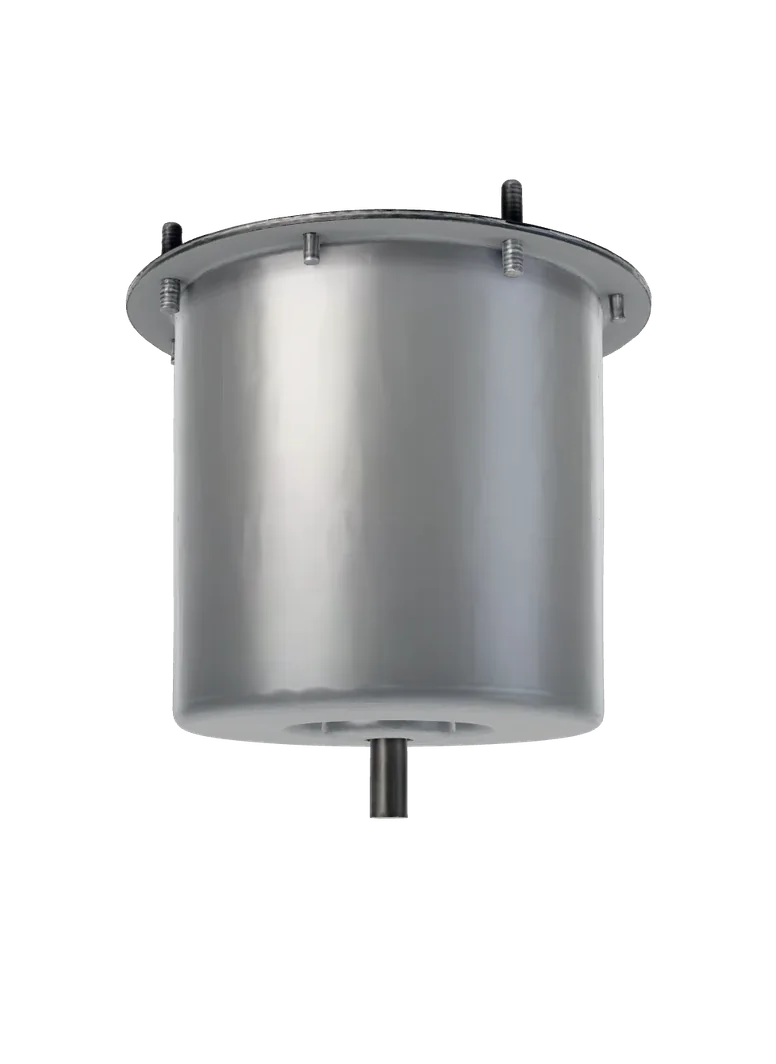
AC condenser fan motor test and replacement
Fan on top not spinning while the compressor hums? Check the capacitor first. If it is the motor, the swap is mostly about matching the new one exactly.
- Difficulty
- Moderate
- Time
- 45 min–1.5 hr
- Typical part cost
- $60–$400Pro: $200–$700
- Tools
- 8See the list
Lift the top grille, transfer the blade and reconnect a few wires. The care points are the high-voltage safety, matching the motor's specs, and setting the blade at the same height.
What it does
What the fan motor does
The motor hangs from the top grille with its shaft pointing up or down, and turns a large blade that pulls outdoor air in through the coil and blows it out the top.
It gets its starting boost from the fan side of the dual run capacitor. A weak capacitor is the most common reason a good fan motor will not start.
Why it fails
Bearings wear out after years outdoors in heat and rain. The motor slows, buzzes, gets hot, and eventually stops or smells burnt.
A motor that hums but only starts when the blade is nudged usually has a bad capacitor, not a bad motor.
Symptoms
Signs of a bad fan motor
Compressor hums, fan still
You hear the compressor running but the blade on top does not turn. Turn the unit off to protect the compressor.
Full diagnosisSpins slowly or needs a nudge
The fan turns sluggishly, or starts only if pushed. Test the capacitor before the motor.
Full diagnosisBuzzing, grinding or burning smell
Loud buzzing, grinding bearings or a hot, burnt smell from the top of the unit.
Full diagnosisWarm air indoors
With the fan stopped, the outdoor coil cannot shed heat, so the air inside stops getting cold.
Full diagnosis
How to test it
Test the fan motor before you buy
- With the power off, proven off and the capacitor discharged, test the capacitor's C to FAN section (see the capacitor guide).
- Good
- The fan section reads within tolerance. Move on to the spin test.
- Bad
- The fan section reads low. Replace the capacitor first and try the fan again before buying a motor.
- With the power still off, turn the blade by hand through the top grille using a stick, not your fingers.
- Good
- It turns freely and coasts. The bearings are fine. If it still will not run with a good capacitor, the motor windings have likely failed.
- Bad
- It is stiff, grinds, wobbles or stops at once. The bearings have failed. Replace the motor.
Safety first
Before you touch anything
- 1
Thermostat off, disconnect out, breaker off
Set the thermostat to off, pull or switch off the outdoor disconnect, and turn off the AC breaker in the main panel.
- 2
Prove it is dead
Open the electrical panel and test the incoming wires at the contactor with a voltage tester. It must stay silent. Never work inside the disconnect box.
- 3
Discharge the capacitor
The fan motor's wires connect to the capacitor. Discharge it with a resistor tool and confirm 0 V before you disconnect anything.
- 4
Gloves, and support the grille
The top grille carries the motor and blade and is heavy and awkward. Have a helper hold it, or rest it on the cabinet edge, while you work. Wear gloves.
Tools you'll need
Grab these first
Tool and part links are affiliate links. We may earn a commission at no extra cost to you, and it never changes what we tell you to check first. How this works
- Non-contact voltage testerPen styleConfirms the power is off at the unit before you open it.Typically $15–$30Shop this tool
- Capacitor discharge toolDischarges the capacitor before you disconnect the motor's wires.Typically $10–$25Shop this tool
- Digital multimeterΩ, V, µF, µATests the capacitor and confirms 0 V before you touch any wire.Typically $25–$60Shop this tool
- Nut driver5/16 in. hexMost top-grille screws on outdoor units are 5/16 in. hex heads.Typically $6–$15Shop this tool
- Hex key setSAE, L-shapedLoosens the set screw that locks the blade to the shaft.Typically $8–$20Shop this tool
- Socket set1/4 in. drive, with extensionRemoves the nuts holding the motor to the grille.Typically $20–$45Shop this tool
- Tape measureRecords the blade's position on the shaft before you remove it.Typically $6–$15Shop this tool
- Work glovesFan blades and cabinet edges are sharp.Typically $8–$20Shop this tool
Step by step
How to replace the fan motor
- 1
Shut it all off
Thermostat off. Disconnect pulled or switched off. AC breaker off. Tape the breaker so no one turns it on.
- 2
Open the panel, test, discharge
Remove the electrical access panel, confirm the tester stays silent on the incoming wires, and discharge the capacitor. Confirm 0 V.
- 3
Photograph and disconnect the motor wires
Find the fan motor's wires: usually one to the FAN terminal on the capacitor and others to the contactor. Photograph them, label them, and disconnect them.
Free the motor's wires from any clips so they can come up through the cabinet with the grille.
- 4
Lift off the top grille
Remove the screws around the top grille. Lift it straight up with the motor and blade attached, feeding the wires through, and set it upside down on a soft surface or across the cabinet.
- 5
Measure, then remove the blade
Measure and write down how far the blade's hub sits from the end of the shaft. The new blade position has to match.
Loosen the set screw on the hub and pull the blade off. It is often stuck: a little penetrating oil and patience help. Do not hammer on it.
- 6
Remove the old motor
Remove the nuts or bolts holding the motor to the grille and lift the motor away.
- 7
Match the new motor
Check the new motor's label against the old one: horsepower, voltage, RPM, rotation direction, shaft size and frame. RPM must match. Universal motors may need you to set the rotation and choose a capacitor value; follow their instructions.
Use a new blade if the old one is bent or chipped, with the same diameter, pitch and number of blades.
Buy the part
Condenser fan motor
Opens Amazon in a new tab. Where’s my model number?
What to look for
- The old motor's label: horsepower, voltage, RPM, rotation and frame size. RPM and horsepower must match.
- The same shaft diameter and length, so the blade fits and sits at the right height.
- Whether it needs a new run capacitor. Many motor kits list the capacitor value to use.
Universal condenser fan motors fit many units if the horsepower, voltage and RPM match. Follow their rotation and capacitor instructions exactly.
- 8
Mount the motor and blade
Bolt the new motor to the grille. Slide the blade onto the shaft to the same position you measured, with the set screw on the shaft's flat, and tighten it firmly.
Spin the blade by hand to check it clears the grille and the opening evenly.
- 9
Set the grille and reconnect
Feed the wires back down, set the grille in place and refit its screws. Connect the motor wires exactly as in your photo. If the new motor came with its own capacitor, or the old capacitor tested weak, replace it now.
- 10
Power up and watch
Refit the access panel, turn the breaker on, reinsert the disconnect and set the thermostat to cool.
The fan should start with the compressor and blow air up and out of the top. If it blows down into the unit, the rotation is wrong: shut everything off and fix it before you run it again.
Buy the part
Get the right replacement
Buy the part
Condenser fan motor
Opens Amazon in a new tab. Where’s my model number?
What to look for
- The old motor's label: horsepower, voltage, RPM, rotation and frame size. RPM and horsepower must match.
- The same shaft diameter and length, so the blade fits and sits at the right height.
- Whether it needs a new run capacitor. Many motor kits list the capacitor value to use.
Universal condenser fan motors fit many units if the horsepower, voltage and RPM match. Follow their rotation and capacitor instructions exactly.
Know your limits
When to call a pro
Stop and call a pro if
- The new motor runs but the compressor will not start or trips the breaker.
- Wires are burned or melted, or the motor's wires run to parts you cannot identify.
- The coil is damaged or you see oily spots on the refrigerant lines.
- You are not comfortable working with the power proven off and the capacitor discharged.
FAQ
Condenser fan motor questions
Is it the fan motor or the capacitor?
Check the capacitor first. A motor that hums but will not start, or starts only when nudged, usually has a weak capacitor. If the capacitor tests good and the motor is stiff or will not run, replace the motor.
Can I run the AC with the fan not spinning?
No. Without the fan, heat cannot leave the coil and the compressor overheats. Turn the system off at the thermostat until it is fixed.
Do I have to replace the blade too?
Only if it is bent, chipped or loose on its hub. If you reuse it, mount it at exactly the same height on the shaft.
Related
Keep going
- SymptomAC condenser fan not spinningIf the outdoor fan will not spin, the capacitor is the most likely part, especially if the fan hums or starts with a nudge. If the capacitor is good and the blade is stiff or the motor smells burnt, replace the fan motor.Open guide
- SymptomAC running but not coolingIf the indoor fan blows but the air is warm, look at the outdoor unit. A fan that will not spin, a hum with nothing turning, or a coil packed with debris all stop the cooling. Ice on the lines points to a dirty filter first, and to low refrigerant if the filter is clean.Open guide
- AC condenser partDual run capacitorThe dual run capacitor helps the compressor and the outdoor fan start and run. When it weakens, the unit hums without starting, the fan will not spin, or cooling fades. It is a few wires and one strap, but it must be discharged before you touch it.Open guide
- AC condenser partContactorThe contactor is the heavy switch that turns the outdoor unit on when the thermostat calls for cooling. Burned contacts or a dead coil leave the unit silent. Welded contacts keep it running nonstop. It swaps out with a few wires and two screws.Open guide
- AC condenser partCondenser coilThe condenser coil wraps the outside of the unit and gives off the heat from your house. When its fins clog with dirt and debris, the AC cools less and runs longer. Manufacturers tell owners to keep it clean with a soft brush and a gentle rinse.Open guide
Get the next fix before it breaks
A short email when the seasons turn: filters to change, detector batteries to check, and new repair guides. No spam, unsubscribe any time.
We send it with Kit. Privacy