Dishwasher heating element: test and replace
Dishes wet and cold at the end of the cycle? On dishwashers with a visible element in the tub floor, test it in a few minutes before you blame anything else.
- Difficulty
- Moderate
- Time
- 30 min–1.5 hr
- Typical part cost
- $40–$80Pro: $130–$300
- Tools
- 5See the list
Two wires and two nuts under the tub, then the element lifts out from inside. On some models the dishwasher has to come out of the cabinet to reach them.
What it does
What the heating element does
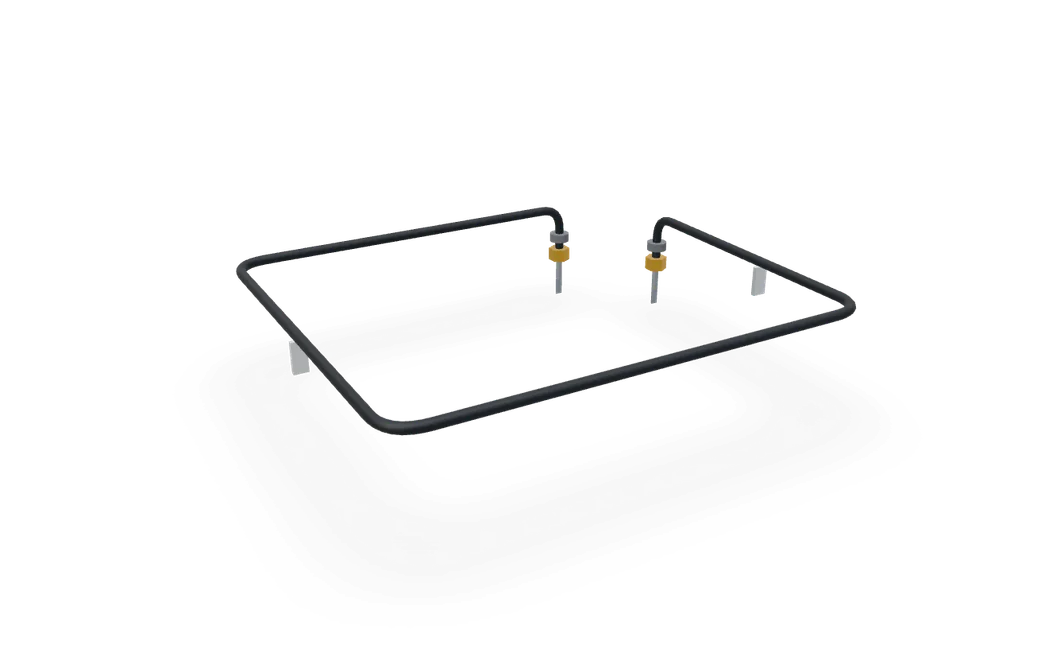
On many dishwashers, the heating element is a thin metal loop in the floor of the tub. Some newer dishwashers hide the heater under the tub, built into the wash pump, instead.
It heats the wash water and, in the drying step, warms the air so the dishes dry.
Why it fails
The wire inside burns through and opens the circuit. The element looks fine but no current flows.
Corrosion or a crack lets current leak to ground, which can trip the breaker or a GFCI outlet.
Symptoms
Signs of a bad heating element
Dishes wet at the end
Dishes stay wet and cool after the dry step.
Full diagnosisWater never feels hot
Open the door near the end of the wash. The tub and dishes should feel warm.
Full diagnosisBreaker trips when it heats
An element leaking to ground can trip the breaker when the heat comes on. Leave it off and test the element.
How to test it
Test the heating element before you buy
- Switch off the breaker and remove the kick plate.
- Find the two element terminals coming through the tub floor. Pull the wires off them.
- Touch one probe to each terminal.
A good element typically reads
About 8–30 Ω
Typical range. Check your part label or manual for the exact spec. Also test from each terminal to bare metal, such as the element's metal sheath or the frame. A good element reads OL there. Any reading means it is leaking to ground. Replace it.
- Good
- A steady reading in that range means the element is intact. Check the thermostat or high-limit and the control instead.
- Bad
- OL (open) means the element is burned out. Replace it.
Safety first
Before you touch anything
- 1
Breaker off
Switch off the dishwasher's breaker, or unplug it. The element runs on line voltage. If it is hardwired, check with a voltage tester that the power is off before you touch any wires.
- 2
Let it cool
The element stays hot for a while after a cycle. Wait before you touch it.
Wait about 20 min
- 3
Water off
Close the hot water shutoff under the sink in case you need to pull the dishwasher out.
Tools you'll need
Grab these first
Tool and part links are affiliate links. We may earn a commission at no extra cost to you, and it never changes what we tell you to check first. How this works
- Non-contact voltage testerPen styleOn a hardwired dishwasher, confirms the power is really off before you touch any wires.Typically $15–$30Shop this tool
- Multi-bit screwdriverPhillips, flat, squareRemoves the kick plate.Typically $10–$25Shop this tool
- Socket set1/4 in. drive, with extensionLoosens the terminal nuts and mounting nuts under the tub.Typically $20–$45Shop this tool
- Needle-nose pliersPulls the wire connectors off the terminals.Typically $8–$20Shop this tool
- Digital multimeterΩ, V, µF, µATests the element for resistance.Typically $25–$60Shop this tool
Step by step
How to replace the heating element
- 1
Power off, let it cool
Switch off the breaker, close the water shutoff, and give the element time to cool.
- 2
Reach the terminals
Remove the kick plate. The element's two ends come through the tub floor near the front.
If you cannot reach them, the dishwasher has to slide out of the cabinet. Remove the countertop brackets and pull it forward carefully, watching the hoses and wires.
- 3
Disconnect the element
Photograph the wires, then pull them off the terminals. Unscrew the nuts that hold the element ends to the tub floor.
- 4
Lift out the old element
From inside the tub, free the element from any clips or supports and lift it out, ends first.
- 5
Fit the new element
Feed the new element's ends down through the holes with any seals in place, clip it into the supports, and tighten the nuts below. Do not overtighten them. That can crack the tub floor.
Reconnect the wires as in your photo.
Buy the part
Heating element
Opens Amazon in a new tab. Where’s my model number?
What to look for
- The element listed for your dishwasher's model number.
- New terminal seals or nuts if they come with it.
- 6
Check for leaks and test
Open the water, switch the power on, and run a cycle. Watch below the element ends for drips.
When it stays dry, switch off and refit the kick plate.
Buy the part
Get the right replacement
Buy the part
Heating element
Opens Amazon in a new tab. Where’s my model number?
What to look for
- The element listed for your dishwasher's model number.
- New terminal seals or nuts if they come with it.
Know your limits
When to call a pro
Stop and call a pro if
- The breaker keeps tripping, even with a new element.
- The element tests good and dishes are still cold. The thermostat, high-limit or control board may be at fault.
- Your dishwasher has a hidden heater under the tub or in the pump. That is a bigger job.
FAQ
Heating element questions
Does every dishwasher have a heating element?
Every dishwasher heats water somehow, but not all have a visible loop. Some newer ones hide the heater under the tub, often in the wash pump, and dry with a fan or with leftover heat from a hot final rinse.
Why are my dishes still wet?
Plastic items often stay wet, and rinse aid helps a lot. If everything is wet and cool, test the element. See dishwasher not drying.
Can I test the element without removing it?
Yes. With the power off and the wires pulled off, you can test it in place from below.
Related
Keep going
- SymptomDishwasher not drying dishesDishes come out wet at the end of the cycle. Empty rinse aid and a heat-dry setting that is off cause a lot of it. On dishwashers with a heating element, a burned-out element is the usual part.Open guide
- SymptomDishwasher not cleaning dishesDishes come out gritty, filmy or with food still on them. A clogged filter or spray arms cause most of it. Low water, cool water, or a weak wash pump are next.Open guide
- Dishwasher partControl boardThe control board runs every step of the cycle and powers the valve, pumps and heater. It fails less often than the parts around it. When it is the cause, swap it inside the door.Open guide
- Dishwasher partCirculation pump and motorThe circulation pump pushes water through the spray arms. When its motor or bearings fail, the dishwasher fills but does not wash. It usually means pulling the dishwasher out to replace it.Open guide
Get the next fix before it breaks
A short email when the seasons turn: filters to change, detector batteries to check, and new repair guides. No spam, unsubscribe any time.
We send it with Kit. Privacy