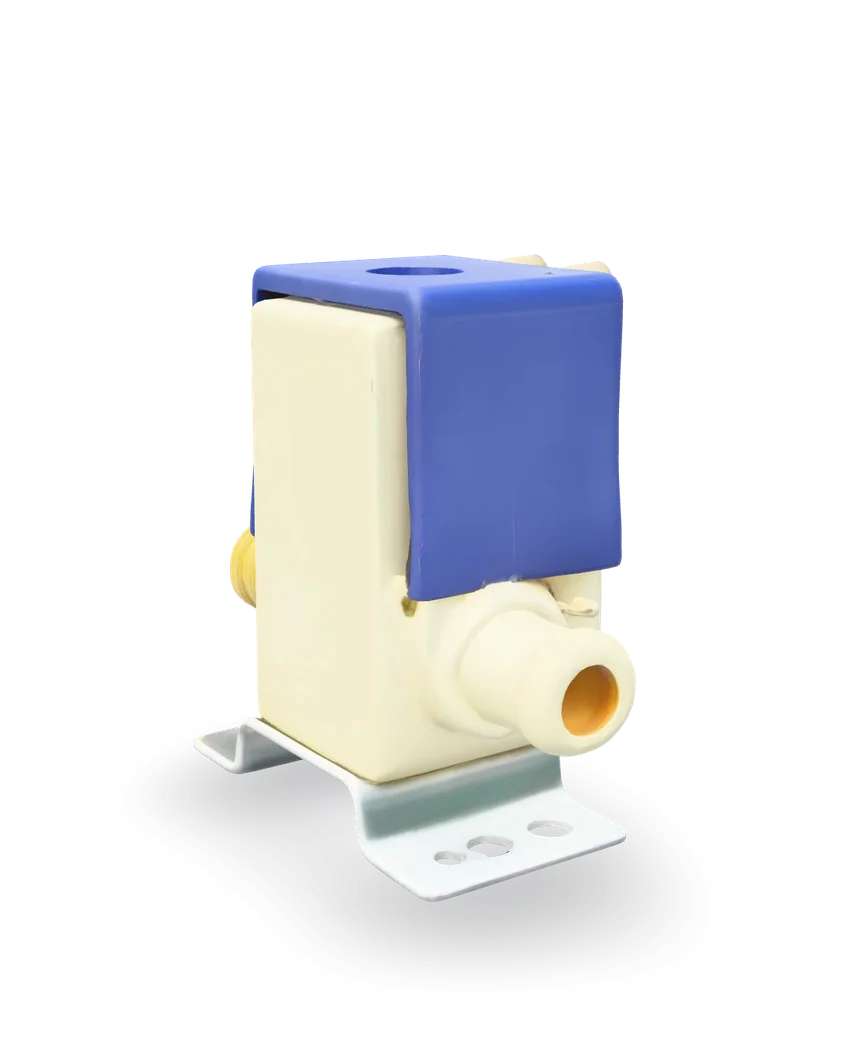
Dishwasher water inlet valve: test and replace
No water, too little water, or water creeping in when it is off? The inlet valve behind the kick plate is the usual cause, and it is a common DIY swap.
- Difficulty
- Easy
- Time
- 30 min–1 hr
- Typical part cost
- $20–$70Pro: $75–$200
- Tools
- 6See the list
Kick plate off, one supply nut, one hose clamp, two wires and a bracket. Have towels ready.
What it does
What the inlet valve does
The inlet valve sits in the base, usually at a front corner behind the kick plate, where the hot water supply line connects.
Most have one electric coil. When the control powers it, the valve opens and water flows into the tub. A small screen in the inlet catches grit.
Why it fails
The coil burns out, so the valve never opens.
Hard water and grit clog the inlet screen and slow the fill.
A worn seal lets water through when the dishwasher is off. A valve can pass a meter test and still need replacing for this reason.
Symptoms
Signs of a bad inlet valve
No water at the start
You hear the cycle start but no water comes in, and the tub floor stays dry.
Full diagnosisNot enough water
A slow, weak fill leaves the tub low and dishes dirty.
Full diagnosisFills when off
Water creeps into the tub when the dishwasher is not running. Turn the supply off until you replace the valve.
Full diagnosis
How to test it
Test the inlet valve before you buy
- Switch off the breaker and remove the kick plate (steps 1 and 2 below).
- Pull the two wires off the valve coil.
- Touch one probe to each coil terminal.
A good coil typically reads
Often about 700–1,600 Ω
Typical range. Check your part label or manual for the exact spec. A valve can pass this test and still leak through when off. If water creeps in with the dishwasher idle, replace the valve.
- Good
- A steady reading in the range for your valve means the coil is intact. Check the screen and the supply.
- Bad
- OL (open) means the coil is dead. A very low reading means it is shorted. Replace the valve.
- With the breaker and the water off, put a pan under the valve and undo the supply line nut.
- Look into the valve inlet and clear the screen if it is clogged.
- Hold the supply line over the pan and briefly open the shutoff. You should get a strong flow.
- Good
- Strong flow and a clean screen. If the coil also tests good, look at the float switch and the control.
- Bad
- Weak flow means a supply problem. A clogged screen that will not clean means a new valve.
Safety first
Before you touch anything
- 1
Breaker off
Switch off the dishwasher's breaker, or unplug it under the sink. The valve is wired to line voltage. If it is hardwired, check with a voltage tester that the power is off before you touch any wires.
- 2
Hot water off
Close the hot water shutoff under the sink before you loosen the supply line.
Tools you'll need
Grab these first
Tool and part links are affiliate links. We may earn a commission at no extra cost to you, and it never changes what we tell you to check first. How this works
- Non-contact voltage testerPen styleOn a hardwired dishwasher, confirms the power is really off before you touch any wires.Typically $15–$30Shop this tool
- Multi-bit screwdriverPhillips, flat, squareRemoves the kick plate and the valve bracket.Typically $10–$25Shop this tool
- Adjustable wrench8–10 in.Loosens the supply line nut on the valve.Typically $10–$25Shop this tool
- Hose clamp pliersReleases the fill hose clamp on the valve outlet.Typically $10–$25Shop this tool
- Shallow pan and towelsCatches the water in the supply line.Typically $5–$15Shop this tool
- Digital multimeterΩ, V, µF, µATests the valve coil.Typically $25–$60Shop this tool
- PTFE thread tapeOptionalOnly if your supply fitting is a threaded pipe fitting, not a compression nut.Typically $2–$6Shop this tool
Step by step
How to replace the inlet valve
- 1
Power and water off
Switch off the breaker and close the hot water shutoff under the sink.
- 2
Remove the kick plate
Take out the screws along the bottom of the door frame and pull off the kick plate.
- 3
Disconnect the valve
Set the pan under the valve. Undo the supply line nut with the wrench.
Pull the two wires off the coil. Release the clamp and pull the fill hose off the valve outlet.
- 4
Swap the valve
Remove the screws that hold the valve bracket and take the valve out.
If the supply elbow screws into the old valve, move it to the new one. Seal its threads the way the old one was sealed.
Buy the part
Water inlet valve
Opens Amazon in a new tab. Where’s my model number?
What to look for
- The valve listed for your dishwasher's model number.
- The same inlet and outlet fittings and the same bracket.
- 5
Reconnect everything
Mount the new valve, push the fill hose on and clamp it, reconnect the two wires and tighten the supply nut.
- 6
Check for leaks, then close up
Open the hot water shutoff slowly and watch the supply nut for a few minutes. Switch the power on and start a cycle.
When it fills and stays dry, switch off and refit the kick plate.
Buy the part
Get the right replacement
Buy the part
Water inlet valve
Opens Amazon in a new tab. Where’s my model number?
What to look for
- The valve listed for your dishwasher's model number.
- The same inlet and outlet fittings and the same bracket.
Know your limits
When to call a pro
Stop and call a pro if
- The shutoff under the sink will not close fully, or leaks at its stem. Call a plumber.
- Water pressure is weak at the sink too. That is a house plumbing issue.
- A new valve and a good supply, and it still will not fill. The float switch or the control board may be at fault.
FAQ
Water inlet valve questions
Why is my dishwasher not filling with water?
Check the shutoff under the sink is open, then the float switch is not stuck up, then test the valve coil. See dishwasher won't fill.
Can a valve test good and still be bad?
Yes. The coil can be fine while the seal inside leaks. If water seeps in with the dishwasher off, the valve needs replacing.
Does a dishwasher use hot or cold water?
Most built-in dishwashers connect to the hot water supply under the sink. Follow your installation instructions.
Related
Keep going
- SymptomDishwasher won't fill with waterYou hear the cycle start but no water comes in. A closed shutoff, a stuck float, or a failed inlet valve causes most of it. The latch and the control come next.Open guide
- SymptomDishwasher leaking waterWater on the floor in front of or under the dishwasher. The wrong soap, a dirty or worn door gasket, or a loose hose or valve connection causes most leaks.Open guide
- SymptomDishwasher not cleaning dishesDishes come out gritty, filmy or with food still on them. A clogged filter or spray arms cause most of it. Low water, cool water, or a weak wash pump are next.Open guide
- Dishwasher partFloat and float switchThe float in the tub floor rises with the water and trips a switch to stop an overfill. A stuck float stops the fill. A bad switch can stop the fill or let it overfill. Clean it, test it and replace it.Open guide
- Dishwasher partControl boardThe control board runs every step of the cycle and powers the valve, pumps and heater. It fails less often than the parts around it. When it is the cause, swap it inside the door.Open guide
Get the next fix before it breaks
A short email when the seasons turn: filters to change, detector batteries to check, and new repair guides. No spam, unsubscribe any time.
We send it with Kit. Privacy