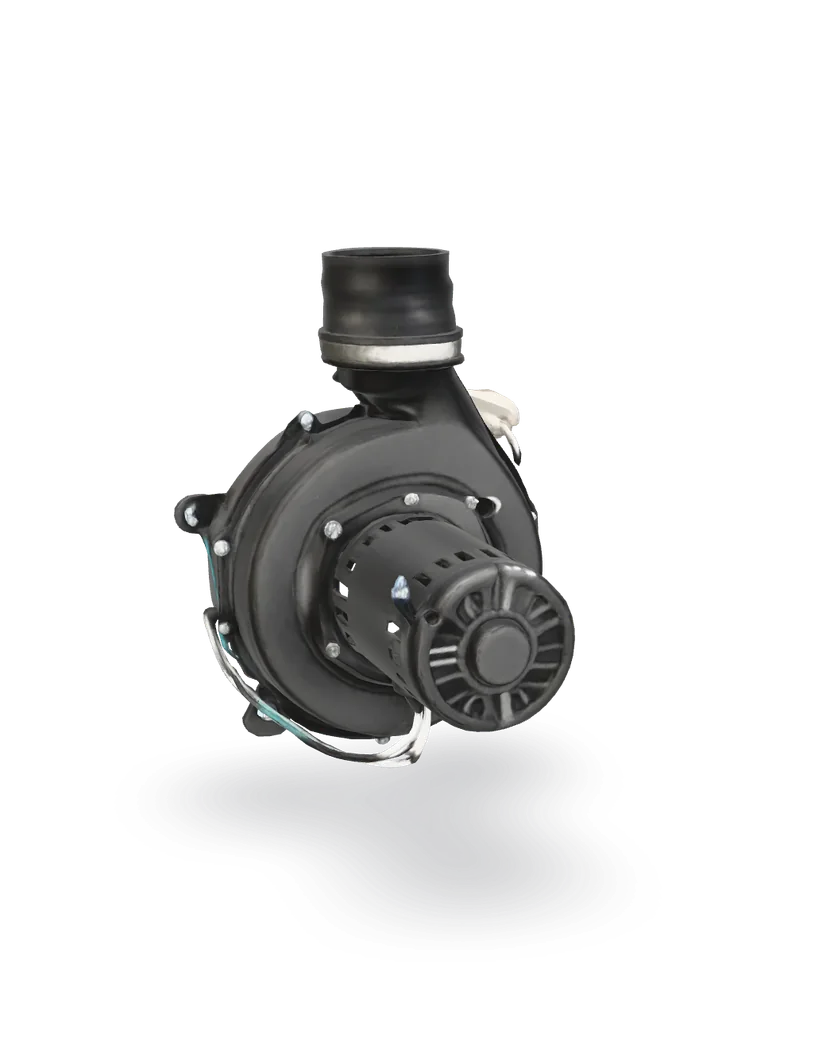
Furnace inducer motor replacement
Loud whine, grinding, or a hum with no spin? The inducer is usually telling you plainly that it is done. A careful swap takes an hour or two.
- Difficulty
- Moderate
- Time
- 1 hr–2 hr
- Typical part cost
- $100–$500Pro: $400–$1,100
- Tools
- 7See the list
A plug, a hose, a vent coupling and a few screws. The care is in the seal: the gasket has to sit perfectly, because this part handles exhaust.
What it does
What the inducer motor does
The inducer is a small motor with a fan wheel, bolted to the collector box on the burner side of the furnace. It is the first thing to start when the thermostat calls for heat.
It pulls combustion air through the burners and the heat exchanger, then pushes the exhaust out the vent pipe. The pressure switch watches that draft through a small rubber hose connected to the inducer.
Before every start, the control board checks that the pressure switch is open, turns on the inducer, and waits for the switch to close. Only then does it run a short purge and heat the igniter. No draft, no fire. That is a safety feature, not a fault.
Why it fails
Like any motor, it wears at the bearings. A worn inducer usually gets noisy first, with a whine, a growl or a grind, then slows down or stalls.
A weak inducer can still spin but not pull enough draft to close the pressure switch. The furnace then sits with the inducer running and never lights.
Other things cause that same symptom: a blocked vent or air intake pipe, a blocked condensate drain, or a pinched or blocked pressure switch hose. Rule those out before you buy an inducer.
Symptoms
Signs of a bad inducer motor
Whining or grinding at start-up
A high whine, a growl or a metal-on-metal grind in the first seconds of a cycle, often getting louder over a few weeks. Worn bearings make that sound.
Full diagnosisHums but does not spin
You hear a buzz from the inducer but the fan does not turn, or turns very slowly. The motor is getting power but is seized or too weak to start.
Full diagnosisRuns, but the igniter never glows
The inducer spins, yet the furnace never moves on to ignition. A weak inducer cannot pull enough draft to close the pressure switch. Many boards flash a pressure switch code.
Full diagnosisRattle or wobble
A ticking or rattling that follows the motor speed. A loose or damaged fan wheel, or a failing bearing, lets the wheel wobble.
Hot or burning smell
A sharp electrical smell near the inducer, or a motor too hot to touch after a short run. Shut the furnace off and have it looked at.
How to test it
Test the inducer motor before you buy
- If your furnace vents through plastic pipes on an outside wall, check both pipes outside for snow, ice, leaves or nests.
- With the power off, find the small rubber hose from the inducer to the pressure switch. Check it for kinks, cracks, water or debris.
- On a high-efficiency furnace, check that the condensate drain lines are not clogged and that water is not standing in them.
- Read the error code on the control board, if it has a light. A pressure switch code with a normal-sounding inducer points at these items first.
- Good
- Everything is clear and the inducer still sounds rough, hums or will not spin. Move on to the spin check.
- Bad
- You found a blocked pipe, a clogged drain or a bad hose. Fix that first. The [pressure switch guide](/furnace/pressure-switch) shows how to check the hose and its port.
- Power off at the service switch or breaker, and let the inducer cool.
- Look into the inducer outlet, or remove the vent coupling, so you can see the fan wheel.
- Turn the wheel gently with a pencil or a gloved finger. Never do this with the power on.
- Feel for side-to-side play in the wheel or shaft.
Do not take apart a sealed inducer housing to look inside. Replacement inducers come as a complete assembly.
- Good
- The wheel turns freely, coasts a little, and makes no noise. There is no play. If it also ran quietly, look at the pressure switch, the wiring and the control board next.
- Bad
- It drags, grinds, catches at one spot, wobbles, or will not turn. That means worn bearings or a damaged wheel. Replace the inducer.
Safety first
Before you touch anything
- 1
Kill the power
Flip the furnace service switch off, or turn off its breaker. Check the inducer wires with a voltage tester before you touch them.
- 2
Close the gas shutoff
Turn the handle on the gas line a quarter turn so it sits crosswise to the pipe. You will not open any gas fittings in this job. This is just a second layer of safety.
- 3
Let it cool
The inducer and vent pipe carry hot exhaust. Give them time to cool before you grab anything.
- 4
Have a CO alarm working
This part handles exhaust. Make sure a working carbon monoxide alarm is near the furnace before you start, and keep an eye on it after the repair.
Tools you'll need
Grab these first
Tool and part links are affiliate links. We may earn a commission at no extra cost to you, and it never changes what we tell you to check first. How this works
- Nut driver1/4 in. hexDoor screws and many inducer mounting screws are 1/4 in. hex heads.Typically $6–$15Shop this tool
- Nut driver5/16 in. hexSome inducers and vent fittings use 5/16 in. hex screws instead.Typically $6–$15Shop this tool
- Multi-bit screwdriverPhillips, flat, squareLoosens the hose clamps on a rubber vent coupling.Typically $10–$25Shop this tool
- Painter's tape and markerLabel each wire and the hose before anything comes off.Typically $5–$12Shop this tool
- Non-contact voltage testerPen styleConfirms the power is really off before you unplug the motor. Try it on a working outlet first.Typically $15–$30Shop this tool
- HeadlampThe inducer screws sit in a tight, shadowy corner of the burner compartment.Typically $12–$30Shop this tool
- Work glovesSheet metal edges around the inducer are sharp.Typically $8–$20Shop this tool
Step by step
How to replace the inducer motor
- 1
Shut off the power and the gas
Flip the service switch on or near the furnace to off. If you cannot find one, turn off the furnace breaker.
Then turn the gas shutoff handle a quarter turn so it sits crosswise to the pipe.
Tip. Not sure the power is off? The status light on the control board goes dark when it is.
- 2
Take off the upper door
The upper door covers the burner compartment, where the inducer lives. Most lift up and pull away. Some have screws along the top edge.
- 3
Photograph and label everything
Find the inducer: the round fan housing with a motor on it, joined to the vent pipe. Take a few clear photos from different angles.
Put a strip of tape on each wire and on the pressure switch hose, and mark where each one goes.
Tip. Photos of the vent pipe joint matter most. That is the connection you most need to get right going back together.
- 4
Unplug the inducer
Touch the voltage tester to the inducer wires to confirm there is no power. Then squeeze the locking tab and pull the inducer plug apart.
On some furnaces the motor wires run straight to the control board. Pull each terminal off by its body, not by the wire.
- 5
Pull off the pressure switch hose
Find the small rubber hose from the inducer to the pressure switch. Twist it gently and slide it off its port on the inducer.
Look inside the hose and the port while it is off. Water, debris or a crack in the hose can look just like a bad inducer.
- 6
Free the vent pipe
Many high-efficiency furnaces join the inducer to the plastic vent pipe with a rubber coupling and hose clamps. Loosen the clamp on the inducer side and work the coupling off the inducer outlet.
Other furnaces join the vent with screws or a metal collar. Remove those fasteners and keep them.
Careful. If the plastic vent pipe is glued directly to the inducer, stop here. Cutting and rejoining vent pipe is a job for a pro.
- 7
Remove the mounting screws
The inducer is held to the collector box by a few screws around its base plate. Back them out and keep them together.
Support the inducer with your other hand as the last screw comes out.
Tip. A magnetic nut driver keeps the screws from dropping down into the burner area.
- 8
Lift the old inducer out
Wiggle the inducer gently and pull it straight away from the furnace. The old gasket may stick. Ease it free without bending anything.
Clean every bit of old gasket off the mounting surface. It must be clean and flat so the new gasket can seal.
- 9
Match the new inducer
Hold the old and new inducers side by side. The mounting holes, the outlet size and direction, the pressure port and the plug should all match.
Fit a new gasket. Replacement kits generally include one. Do not reuse the old one, even if it looks fine. If your kit's instructions call for sealant, use the kind they name.
Careful. The gasket is what keeps exhaust inside the furnace. A torn, folded or missing gasket can leak carbon monoxide.
Buy the part
Inducer motor
Opens AppliancePartsPros in a new tab. Where’s my model number?
What to look for
- The part number on the inducer's label, or your furnace model and serial number from the rating plate.
- The same mounting pattern, outlet size and outlet direction, so it lines up with your vent pipe.
- The same plug and wiring. Match the part number, not just the looks.
- A new gasket in the box, or order one with it.
Get the replacement listed for your furnace model and serial number. A universal inducer that needs an adapter or a different vent fitting is not worth the risk of an exhaust leak.
- 10
Install the new inducer
Set the new gasket in place, then the inducer. Start every screw by hand before you tighten any of them.
Tighten them evenly, a little at a time in a crisscross pattern, so the gasket compresses the same all the way around. If your kit lists a tightening spec, follow it.
- 11
Reconnect the vent, hose and wires
Slide the vent coupling fully onto the inducer outlet and tighten its clamp. Check it against your photo. No gap, no twist.
Push the pressure switch hose all the way onto its port. Plug the inducer back in until it clicks.
Route the wires and the hose at least an inch away from the vent pipe and any other hot surface.
- 12
Doors on, then test
Refit the upper door before you run the furnace. Manufacturers warn that the access panels must be in place while the furnace runs, so exhaust cannot be drawn into the room.
Open the gas shutoff, turn the power on, and call for heat. Listen through the door louvers. The inducer should spin up smoothly and quietly, then the igniter glows and the burners light.
Let it run a full cycle. Keep an eye on the CO alarm over the next few days.
Buy the part
Get the right replacement
Buy the part
Inducer motor
Opens AppliancePartsPros in a new tab. Where’s my model number?
What to look for
- The part number on the inducer's label, or your furnace model and serial number from the rating plate.
- The same mounting pattern, outlet size and outlet direction, so it lines up with your vent pipe.
- The same plug and wiring. Match the part number, not just the looks.
- A new gasket in the box, or order one with it.
Get the replacement listed for your furnace model and serial number. A universal inducer that needs an adapter or a different vent fitting is not worth the risk of an exhaust leak.
Know your limits
When to call a pro
Stop and call a pro if
- You smell gas at any point. Do not touch any switches. Leave the house and call your gas utility from outside.
- Your carbon monoxide alarm goes off. Get everyone outside to fresh air, then call 911 or the fire department from outside.
- You see or feel exhaust leaking around the inducer or vent pipe. Turn the furnace off and leave it off until it is checked.
- The vent pipe is glued to the inducer, or it is cracked, sagging or holding water.
- Water keeps collecting in the inducer or the drain lines keep clogging.
- A new inducer runs well but the pressure switch still will not close.
- The inducer cannot come out without removing the burners, gas manifold or other gas parts.
FAQ
Inducer motor questions
Can I oil a noisy inducer motor?
Usually not. Manufacturers typically say the bearings are permanently lubricated and need no oil. Once an inducer starts to whine or grind, it rarely gets better. Replace it.
How do I know it is the inducer and not the pressure switch?
Listen and watch. A healthy inducer spins up fast and quiet. If it is loud, slow, or hums without spinning, suspect the inducer. If it sounds normal but the igniter never glows, start with the pressure switch, its hose, and the vent pipes.
Why do I need a new gasket?
The old gasket has been squashed and heated into shape and will not seal reliably again. A leak here can let exhaust, including carbon monoxide, into the room. A new gasket costs very little and matters more than anything else in this job.
Can I run the furnace without the inducer?
No. The furnace will not light without it, by design. Never bypass the pressure switch to get around a dead inducer. Without the draft, exhaust can spill into your home.
The inducer runs nonstop and nothing else happens. Is it bad?
Maybe, but check the simple things first. A blocked vent or intake pipe, a clogged condensate drain, or a blocked or pinched pressure switch hose all cause the same thing. If those are clear, a weak inducer is likely.
Related
Keep going
- SymptomInducer runs but the furnace never tries to lightThe draft inducer starts and keeps running, but the igniter never glows. The board is waiting for the pressure switch to say the vent is clear. Check the vent pipes and the switch hose first.Open guide
- SymptomFurnace making loud or unusual noisesSqueals and grinding usually mean a worn motor or a loose blower wheel. Rattles mean something is loose. Humming points to a motor or capacitor. A boom at start-up is delayed ignition and needs a pro.Open guide
- SymptomFurnace control board blinking an error codeThe light on the control board flashes a code when something fails. Count the flashes, match them to the chart inside the blower door, and write the code down before you reset anything.Open guide
- Furnace partPressure switchThe pressure switch proves the inducer fan is pulling exhaust out before the furnace is allowed to light. When it stays open, the inducer runs and nothing else happens. Often the real fix is a clear hose or vent.Open guide
- Furnace partControl boardThe control board runs the furnace's start-up sequence and flashes a code when something fails. Read the blink code first, because most codes point at a part the board is reporting on.Open guide
- Furnace partBlower motor and wheelThe blower motor spins a squirrel-cage wheel that pushes warm air through your ducts. A dusty wheel chokes airflow, and a worn motor hums, squeals or stops. You can clean both, and replace a standard motor yourself.Open guide