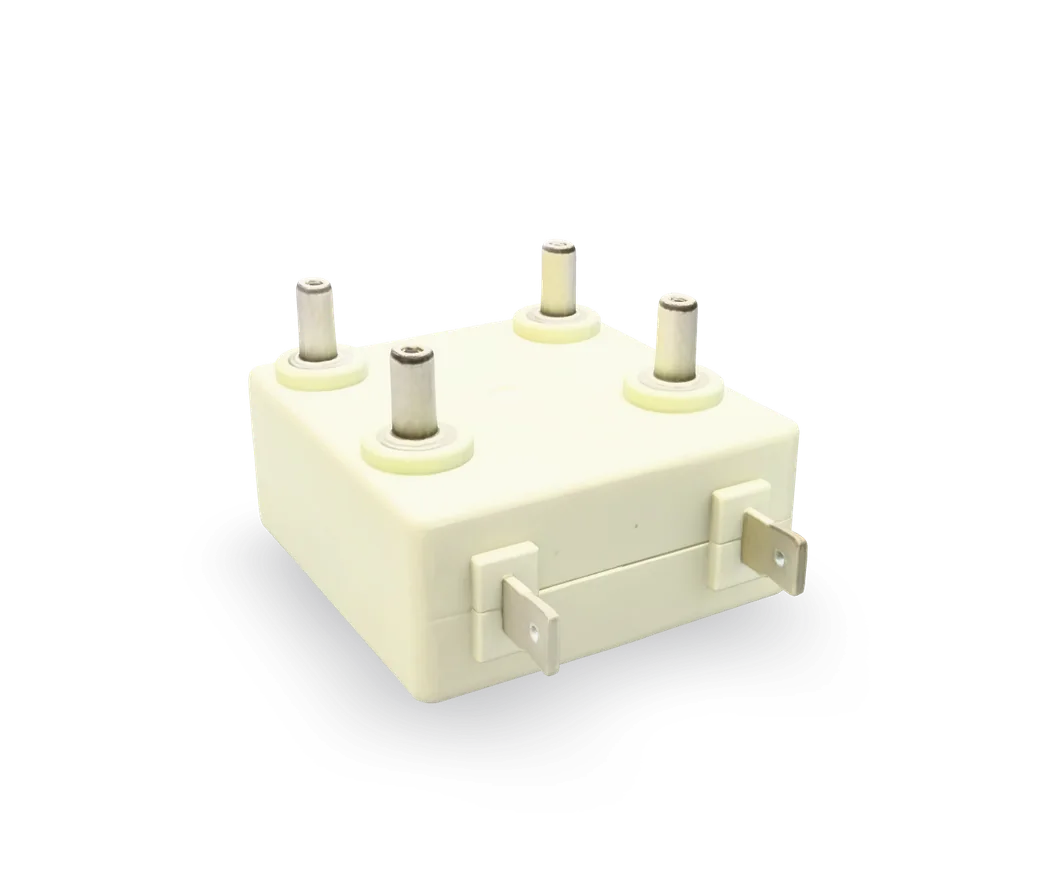
Gas range spark module troubleshooting and replacement
Gas ranges only. When none of the burners spark, or they all click nonstop, the small box that makes the spark is the suspect, once the burners are clean and dry.
- Difficulty
- Moderate
- Time
- 30 min–1 hr
- Typical part cost
- $35–$110Pro: $115–$230
- Tools
- 4See the list
Finding it is the work: under the cooktop, behind the control panel or behind the lower back panel. Once found, it is a few screws and plugs.
What it does
What the spark module does
When you turn any knob to Lite, a small switch on that valve tells the spark module to fire. The module sends a rapid series of high-voltage pulses to the electrodes beside the burners, and you hear the clicking.
On many ranges every burner sparks at once, no matter which knob you turned. That is normal.
Why it fails
The module's electronics wear out. Sparks get weak or slow, become intermittent, or stop altogether.
Moisture and spills cause most spark trouble, though, not the module. Rule out wet or dirty burners and a cracked electrode first.
Symptoms
Signs of a bad spark module
No spark at any burner
Turning a knob to Lite, no burner clicks or sparks. Turn the knob off right away, then check that the range is plugged in and the breaker is on.
Full diagnosisWeak, slow or patchy sparks
Several burners spark weakly, slowly or only sometimes. One weak burner on its own points more to its electrode.
Full diagnosisClicks with every knob off
All the igniters click nonstop even with the knobs off and everything dry. The module or a knob switch has failed.
Full diagnosis
How to test it
Test the spark module before you buy
- Make sure the range is plugged in and its breaker is on.
- Lift off each cap and head, check the electrode's porcelain for cracks, and make sure everything is clean and dry. Reseat the caps flat and centered.
- In a dim room, turn one knob to Lite for no more than a few seconds and watch every burner. Turn it off. If nothing lit, wait a few minutes for the gas to clear before trying again.
- Good
- Every burner sparks a strong, fast blue spark. The module is fine. If one burner still will not light, look at its cap and electrode.
- Bad
- No spark anywhere, or weak, slow sparks at several burners, with everything clean and dry. The module is the likely part.
Safety first
Before you touch anything
- 1
Unplug the range
The module makes high-voltage sparks and runs on household power. Unplug the range before you touch it or its wires.
- 2
Close the gas shutoff
Turn off the gas supply to the range before you lift the cooktop or remove panels. You will not open any gas fitting.
Tools you'll need
Grab these first
Tool and part links are affiliate links. We may earn a commission at no extra cost to you, and it never changes what we tell you to check first. How this works
- Nut driver1/4 in. hexMost rear panels and module screws are 1/4 in. hex.Typically $6–$15Shop this tool
- Multi-bit screwdriverPhillips, flat, squareFor Phillips screws on the cooktop or control panel.Typically $10–$25Shop this tool
- Needle-nose pliersHelps release the electrode wires from the module.Typically $8–$20Shop this tool
- HeadlampThe module often hides under the cooktop.Typically $12–$30Shop this tool
Step by step
How to replace the spark module
- 1
Power off, gas off
Unplug the range and close its gas shutoff valve. Make sure every knob is off.
- 2
Find the module
The module is usually under the cooktop, behind the control panel, or behind the lower back panel. Your model's parts diagram shows where. Start with the back panel: it is the easiest to check.
To lift the cooktop, take off the grates, caps and heads, then remove the screws holding the cooktop and raise it carefully.
- 3
Photograph and unplug the wires
Take a photo of every wire on the module: the power plug and one high-voltage lead to each electrode. Unplug them, pulling on the connectors, not the wires.
- 4
Remove the old module
Remove the module's mounting screws and lift it out.
- 5
Install the new module
Mount the new module in the same spot and reconnect every wire to match your photo. Push each electrode lead on firmly.
Buy the part
Spark module
Opens Amazon in a new tab. Where’s my model number?
What to look for
- Your range's model number. Modules come with different numbers of outputs and plugs.
- The same number of electrode outputs as your burners.
- The part number on the old module's label.
- 6
Close up and test
Refit the panel or cooktop and the burner parts. Open the gas valve, plug the range in and push it back so the anti-tip bracket engages.
Turn each burner to Lite in turn. Each should spark and light within a few clicks, and the clicking should stop once it lights.
Buy the part
Get the right replacement
Buy the part
Spark module
Opens Amazon in a new tab. Where’s my model number?
What to look for
- Your range's model number. Modules come with different numbers of outputs and plugs.
- The same number of electrode outputs as your burners.
- The part number on the old module's label.
Know your limits
When to call a pro
Stop and call a pro if
- You smell gas at any point. Leave the house and call your gas supplier from outside.
- A new module still gives no spark, or the clicking continues with every knob off. A knob switch or the wiring needs testing.
- Reaching the module means disconnecting any gas tube or valve.
FAQ
Spark module questions
Only one burner will not spark. Is it the module?
Usually not. One burner points to its own electrode, its cap or moisture. When the module fails, several burners act up at once.
Can I light the burners with a match while I wait?
Some gas range manuals explain how to light the surface burners with a match during a power outage. Only do it if your manual describes it, and follow its exact steps.
Why do all the burners click when I turn one knob?
On many ranges the spark module fires every electrode at once. Only the burner whose valve is open has gas, so only that one lights.
Related
Keep going
- SymptomGas stove burner won't lightA gas cooktop burner clicks but will not catch, catches slowly, or does not click at all. Wet or dirty ports and a misaligned cap cause most of these. If no burner sparks, look at power and the spark module.Open guide
- SymptomGas stove keeps clickingThe igniters keep clicking after the burner lights, or click with every knob off. Moisture and a misaligned cap cause most of it. If it continues with everything dry and seated, a knob switch or the spark module has failed.Open guide
- Range partBurner caps and headsGas ranges only. Each surface burner has a head with a ring of small ports and a cap that sits on top. Spills clog the ports, water from cleaning stops the spark, and a cap knocked off-center keeps the flame from catching. Cleaning and reseating them fixes most burners that will not light.Open guide
- Range partGas oven igniterGas ranges only. The oven igniter glows to light the bake burner and, at the same time, opens the oven safety valve. A weak igniter still glows but cannot draw enough current to open the valve, so the oven heats slowly or not at all.Open guide
Get the next fix before it breaks
A short email when the seasons turn: filters to change, detector batteries to check, and new repair guides. No spam, unsubscribe any time.
We send it with Kit. Privacy