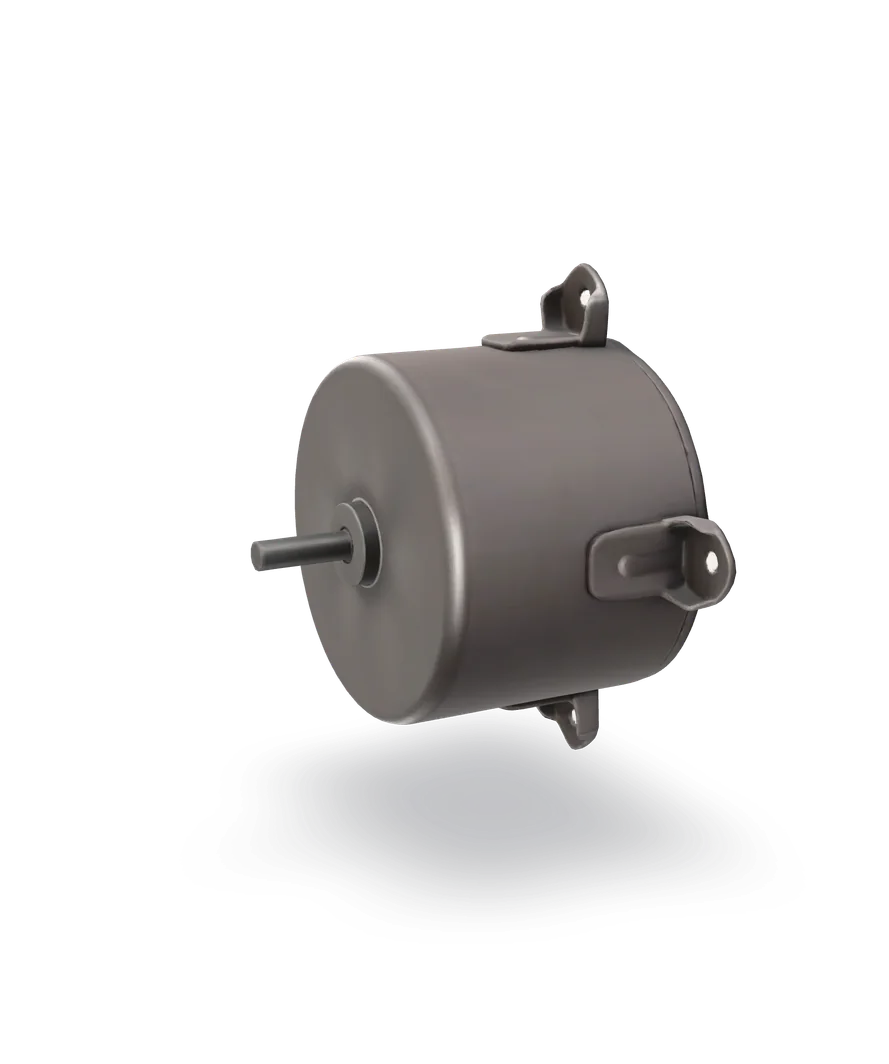
Refrigerator condenser fan motor test and replacement
Both sections warm, and the back of the refrigerator feels hot? The fan by the compressor may have quit.
- Difficulty
- Easy
- Time
- 30 min–1 hr
- Typical part cost
- $50–$140Pro: $200–$350
- Tools
- 5See the list
Pull the refrigerator out and remove the back panel. The motor is a few screws, a blade and one plug.
What it does
What the condenser fan does
On refrigerators with the condenser coil under the cabinet, a small fan in the machine compartment pulls room air through the coil and over the compressor. That air carries away the heat the refrigerator has pulled out of the food.
It usually runs whenever the compressor runs. Refrigerators with a coil exposed on the back of the cabinet usually do not have one; those rely on air rising past the coil instead.
Why it fails
The motor can wear out, and its rubber mounting grommets can wear and rattle.
Worn rubber mounting grommets let the fan rattle against its bracket. That noise is often fixable without a new motor.
Symptoms
Signs of a bad condenser fan
Both sections warm
The freezer and the fresh-food section both run warm while the compressor runs and the fan inside the freezer still blows.
Full diagnosisFan blade still while the compressor hums
Pull the refrigerator out and listen. If the compressor hums but the fan blade at the back does not turn, the fan is the problem.
Rattle or squeal from the bottom back
A worn motor squeals; a loose one rattles against its bracket.
Full diagnosis
How to test it
Test the condenser fan before you buy
- Pull the refrigerator out. With it running, look through the rear panel's vents. If you cannot see the blade, unplug it, remove the panel, plug it back in and watch from a distance with your hands well clear.
- When the compressor is humming, the fan blade should be spinning.
Keep fingers, tools and loose clothing away from the blade while the refrigerator is plugged in.
- Good
- The blade spins steadily. Clean the coil and look elsewhere.
- Bad
- The blade is still, slow or wobbly while the compressor runs. Unplug the refrigerator and do the next checks.
- Unplug the refrigerator and remove the rear access panel.
- Clear any debris and spin the blade by hand. It should turn freely.
- Disconnect the motor's plug and touch one probe to each motor terminal.
A good motor typically shows
Continuity: a steady reading, not OL
Typical range. Check your part label or manual for the exact spec. Many newer fans are electronic motors that a resistance check cannot judge. For those, the watch-it-run test and the spin test are the better checks.
- Good
- Free spin and a steady reading. The motor is probably fine. Check whether power reaches its plug.
- Bad
- Stiff, gritty or locked, or OL on the meter. Replace the motor.
Safety first
Before you touch anything
- 1
Unplug the refrigerator
Pull the plug before you reach into the machine compartment. The fan can start without warning when the compressor does.
- 2
Water off, if you have ice or water
If the refrigerator has an ice maker or dispenser, close its water supply valve before you pull it out so the line does not get stretched or kinked.
Tools you'll need
Grab these first
Tool and part links are affiliate links. We may earn a commission at no extra cost to you, and it never changes what we tell you to check first. How this works
- Nut driver1/4 in. hexMost rear access panels and fan brackets use 1/4 in. hex screws.Typically $6–$15Shop this tool
- Digital multimeterΩ, V, µF, µAConfirms the motor windings are open before you buy one.Typically $25–$60Shop this tool
- Shop vacuumClean the coil and the fan area while the panel is off.Typically $40–$90Shop this tool
- Needle-nose pliersSome blades are held by a clip or a small nut.Typically $8–$20Shop this tool
- HeadlampThe machine compartment is dark and low.Typically $12–$30Shop this tool
Step by step
How to replace the condenser fan
- 1
Unplug and pull it out
Close the water supply valve if you have one, unplug the refrigerator and pull it out from the wall.
- 2
Remove the rear access panel
Remove the screws around the lower rear panel and set it aside.
- 3
Unplug the fan and take off the blade
Pull the motor's plug apart.
Remove the blade from the motor shaft: some pull straight off, others have a clip or nut on the front. Note which way the blade faces.
- 4
Remove the motor
Take out the screws holding the motor to its bracket or the bracket to the cabinet, and lift the motor out. Keep any rubber grommets.
- 5
Match and assemble the new motor
Compare the shaft, the mounting holes and the plug. Move the bracket and grommets to the new motor if it did not come with its own.
Fit the blade facing the same way, pushed on to the same depth.
Buy the part
Condenser fan motor
Opens Amazon in a new tab. Where’s my model number?
What to look for
- The part number on the old motor's label, or the one in your model's parts list.
- The same plug and mounting. Some kits come with a bracket and wiring adapter.
- Plain motor or electronic: they are not interchangeable.
Universal condenser fan kits fit some models. The motor listed for your model number is the safer choice.
- 6
Install it and clean the coil
Mount the motor, reconnect the plug and spin the blade by hand to check it clears everything.
While the panel is off, vacuum the condenser coil and the compartment.
- 7
Panel on and power up
Refit the rear panel, open the water valve, plug the refrigerator in and push it back, leaving the air gaps your manual asks for.
Buy the part
Get the right replacement
Buy the part
Condenser fan motor
Opens Amazon in a new tab. Where’s my model number?
What to look for
- The part number on the old motor's label, or the one in your model's parts list.
- The same plug and mounting. Some kits come with a bracket and wiring adapter.
- Plain motor or electronic: they are not interchangeable.
Universal condenser fan kits fit some models. The motor listed for your model number is the safer choice.
Know your limits
When to call a pro
Stop and call a pro if
- The new fan runs but the refrigerator still does not cool. The sealed system may be the problem.
- The compressor clicks off soon after starting even with the fan running.
- You see oily residue on the tubing in the machine compartment.
FAQ
Condenser fan motor questions
My refrigerator has a coil on the back. Does it have a condenser fan?
Usually not. Refrigerators with the coil on the back of the cabinet cool it by natural airflow. The fan is on models with the coil underneath, in the machine compartment.
Can a dirty coil cause the same symptoms?
Yes. A coil caked in dust holds heat in just like a stopped fan. Clean the condenser coils first, because it is free.
The fan rattles but runs. Do I need a new motor?
Not always. Check the rubber grommets and the screws holding the motor. Worn or loose mounts are a common cause of rattling.
Related
Keep going
- SymptomRefrigerator not coolingThe freezer and the fresh-food section are both too warm. The usual causes are a dirty condenser coil, a stopped condenser fan, a failed start relay or an iced-over evaporator coil. The sealed system is the last thing to suspect, not the first.Open guide
- SymptomRefrigerator making noiseClicks, pops, gurgles, hums and sizzles are usually normal. A squeal or chirp from the freezer points to the evaporator fan. A rattle or squeal from the bottom back points to the condenser fan. Repeated clicking with no cooling points to the start relay.Open guide
- Refrigerator partCondenser coilsThe condenser coil gives off the heat the refrigerator removes from your food. Dust, lint and pet hair on it hold that heat in, so the refrigerator runs longer and cools less. Cleaning it takes a vacuum and a soft brush.Open guide
- Refrigerator partCompressor start relay and overloadThe start relay plugs onto the side of the compressor and helps it start. When it fails, the compressor never starts and you hear a click every few minutes as it tries. It pulls straight off and pushes straight on.Open guide
- Refrigerator partEvaporator fan motorThe evaporator fan blows the freezer coil's cold air around the freezer and into the fresh-food section. When it stops, the freezer can stay cold while the fridge warms up. It is usually a few screws and one plug.Open guide
Get the next fix before it breaks
A short email when the seasons turn: filters to change, detector batteries to check, and new repair guides. No spam, unsubscribe any time.
We send it with Kit. Privacy