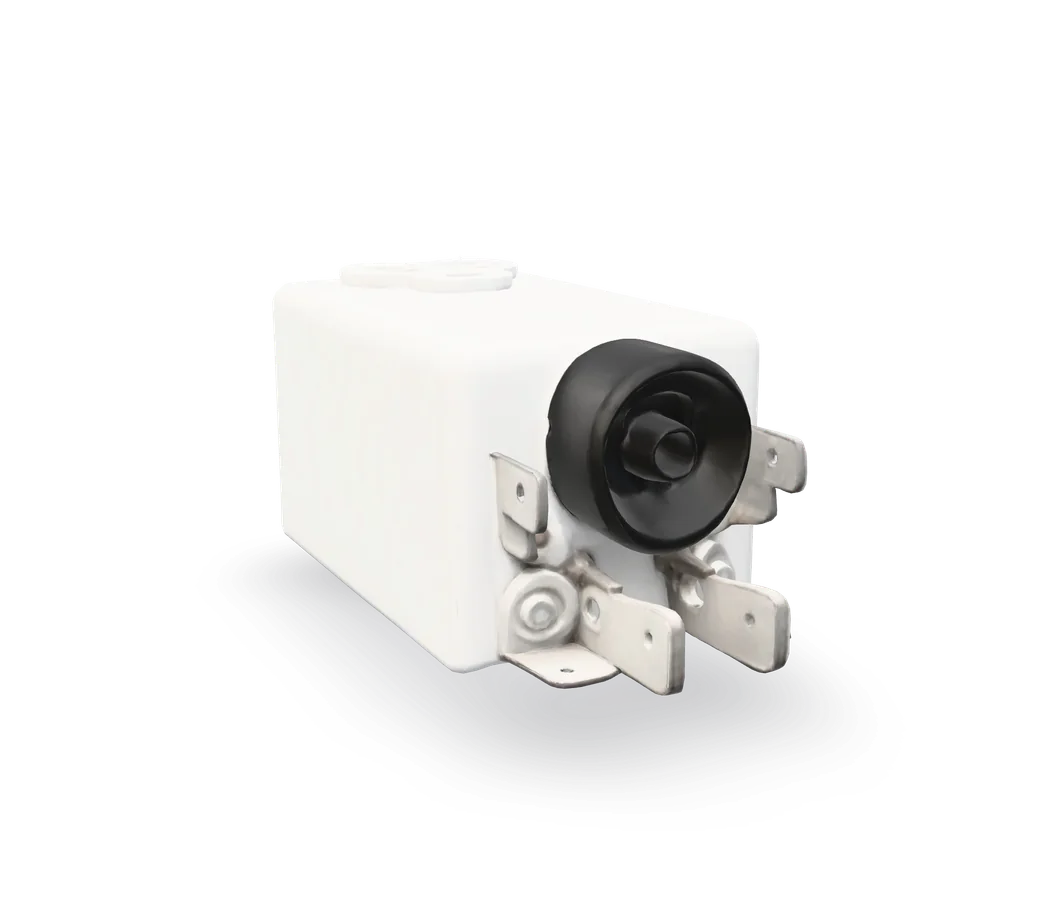
Refrigerator start relay test and replacement
Clicking every few minutes and getting warmer? Before anyone says compressor, check the cheap plug-on part beside it.
- Difficulty
- Easy
- Time
- 20–45 min
- Typical part cost
- $8–$80Pro: $95–$190
- Tools
- 4See the list
Pull the refrigerator out, remove the back panel, and pull one part off the compressor. Matching the replacement is the only real care point.
What it does
What the start relay does
The compressor needs a boost to start. The start relay, sometimes called the start device, gives it that boost for a moment, then drops out once the motor is up to speed.
On most refrigerators it plugs directly onto pins on the side of the compressor in the machine compartment at the bottom back. An overload protector sits with it, often in the same housing, and cuts power if the compressor draws too much current or gets too hot.
Why it fails
The relay's internals wear out or break. Then the compressor cannot start, and the overload clicks off, cools, and lets it try again every few minutes.
Heat and repeated hard starts age it. A compressor that is struggling can also wear out a relay, so a new relay that fails quickly is a warning sign.
Symptoms
Signs of a bad start relay
Click every few minutes, no cooling
A click from the back bottom, a short hum or nothing, then silence, repeating every few minutes while both sections warm up.
Full diagnosisFans run, compressor does not
The lights and fans work, but the compressor near the floor at the back never hums for long and stays warm to the touch.
Full diagnosisA rattle when you shake it
Pulled off and shaken, a bad relay often rattles. Some good ones do too, so use it as a clue, not proof.
How to test it
Test the start relay before you buy
- With the refrigerator plugged in, listen at the back near the floor for a few minutes.
- Note whether you hear a click followed by a hum that stops, repeating every few minutes.
- Good
- The compressor starts and keeps humming. The relay is doing its job. A click or chirp right as it restarts can be normal.
- Bad
- A click, a short hum or none, then silence, again and again, with the refrigerator getting warmer. The start relay is the first suspect.
- Unplug the refrigerator, remove the rear access panel and pull the relay off the compressor (steps below).
- Look for burn marks, melted plastic or a scorched terminal. Then shake it next to your ear.
Some relays are electronic modules with their own circuit board. Those cannot be checked by shaking or with a meter, so replacing them is often the test.
- Good
- No damage and no rattle. The relay may be fine. If the compressor still will not start with a good relay, call a pro.
- Bad
- Burned, melted or rattling. Replace it.
Safety first
Before you touch anything
- 1
Unplug the refrigerator
Pull the plug at the wall before you open the machine compartment. The relay and compressor terminals carry household voltage.
- 2
Let the compressor cool
A compressor that has been trying to start can be hot. Give it a few minutes before you reach in.
Wait about 10 min
Tools you'll need
Grab these first
Tool and part links are affiliate links. We may earn a commission at no extra cost to you, and it never changes what we tell you to check first. How this works
- Nut driver1/4 in. hexRemoves the rear access panel on most refrigerators.Typically $6–$15Shop this tool
- Multi-bit screwdriverPhillips, flat, squareA flat bit helps release the relay's cover clip.Typically $10–$25Shop this tool
- Needle-nose pliersGrips small push-on connectors in a tight space.Typically $8–$20Shop this tool
- HeadlampThe machine compartment is dark and low.Typically $12–$30Shop this tool
Step by step
How to replace the start relay
- 1
Unplug and pull the refrigerator out
Unplug the refrigerator. If it has an ice maker or water dispenser, close the water supply valve first and leave enough slack in the line.
Pull it out far enough to work behind it.
- 2
Remove the rear access panel
Take out the screws around the lower rear panel and set it aside. The compressor is the black dome inside.
- 3
Photograph the wiring
Find the relay on the side of the compressor. Unclip or lift off its cover if it has one.
Take a clear photo of every wire on the relay and the overload before you touch anything.
- 4
Pull the relay off
Disconnect the wires from the relay, then pull it straight off the compressor pins. Do not twist or rock it. The pins are part of the sealed compressor.
If the overload is a separate part, it comes off the same way.
Careful. Pull straight out. Bending or breaking a compressor pin turns a cheap fix into a sealed-system repair.
- 5
Match the new relay
Compare the new part with the old one: the socket pattern, the plug, and whether it includes the overload. Kits often include the relay, the overload and a cover with instructions.
Buy the part
Compressor start relay and overload
Opens Amazon in a new tab. Where’s my model number?
What to look for
- The part number printed on the old relay or overload, or the one in your model's parts list.
- Whether your model needs the relay alone, the overload alone, or a combined device or kit.
- The compressor's model number, stamped on its label, if the parts list offers more than one relay.
Universal start devices exist for some compressors, but they must match the compressor's size and type. The part listed for your model is safer.
- 6
Push the new relay on
Line it up the same way the old one sat and push it fully onto the compressor pins until it seats.
Reconnect the wires to match your photo and refit the cover and its clip. Keep the wires clear of the condenser fan blade.
- 7
Panel on and test
Refit the rear panel, reopen the water valve if you closed it, plug the refrigerator in and push it back.
Listen for the compressor to start and keep running. Check the temperatures after a few hours.
Buy the part
Get the right replacement
Buy the part
Compressor start relay and overload
Opens Amazon in a new tab. Where’s my model number?
What to look for
- The part number printed on the old relay or overload, or the one in your model's parts list.
- Whether your model needs the relay alone, the overload alone, or a combined device or kit.
- The compressor's model number, stamped on its label, if the parts list offers more than one relay.
Universal start devices exist for some compressors, but they must match the compressor's size and type. The part listed for your model is safer.
Know your limits
When to call a pro
Stop and call a pro if
- A new relay goes on and the compressor still clicks without starting. The compressor itself may be failing.
- The compressor runs but the refrigerator still will not cool. That points to the sealed system.
- A compressor pin is bent, loose or burned, or the terminals are scorched.
- The breaker trips when the compressor tries to start.
FAQ
Compressor start relay and overload questions
Is the clicking always the start relay?
No. A click or chirp when the compressor restarts can be normal, and some refrigerators click as dampers and the control board switch. The warning sign is clicking every few minutes while the refrigerator gets warmer and the compressor never keeps running.
Does a rattle always mean the relay is bad?
It is a strong hint, but some good relays rattle too. If it rattles and the compressor clicks without starting, replacing the relay is a cheap next step.
Is it the relay or the compressor?
A homeowner cannot safely tell for certain without testing the compressor windings. Try the relay first because it is cheap. If the compressor still will not start with a new relay, it is time for a pro's diagnosis.
Related
Keep going
- SymptomRefrigerator not coolingThe freezer and the fresh-food section are both too warm. The usual causes are a dirty condenser coil, a stopped condenser fan, a failed start relay or an iced-over evaporator coil. The sealed system is the last thing to suspect, not the first.Open guide
- SymptomRefrigerator making noiseClicks, pops, gurgles, hums and sizzles are usually normal. A squeal or chirp from the freezer points to the evaporator fan. A rattle or squeal from the bottom back points to the condenser fan. Repeated clicking with no cooling points to the start relay.Open guide
- Refrigerator partCompressorThe compressor pumps refrigerant around the sealed system. It is the heart of the refrigerator and the most expensive part to replace. Replacing it means opening the refrigerant loop, which takes EPA certification and special equipment.Open guide
- Refrigerator partCondenser fan motorThe condenser fan sits in the machine compartment at the bottom back. It pulls air through the condenser coil and over the compressor. When it stops, heat cannot leave and the whole refrigerator warms up.Open guide
- Refrigerator partCondenser coilsThe condenser coil gives off the heat the refrigerator removes from your food. Dust, lint and pet hair on it hold that heat in, so the refrigerator runs longer and cools less. Cleaning it takes a vacuum and a soft brush.Open guide
Get the next fix before it breaks
A short email when the seasons turn: filters to change, detector batteries to check, and new repair guides. No spam, unsubscribe any time.
We send it with Kit. Privacy