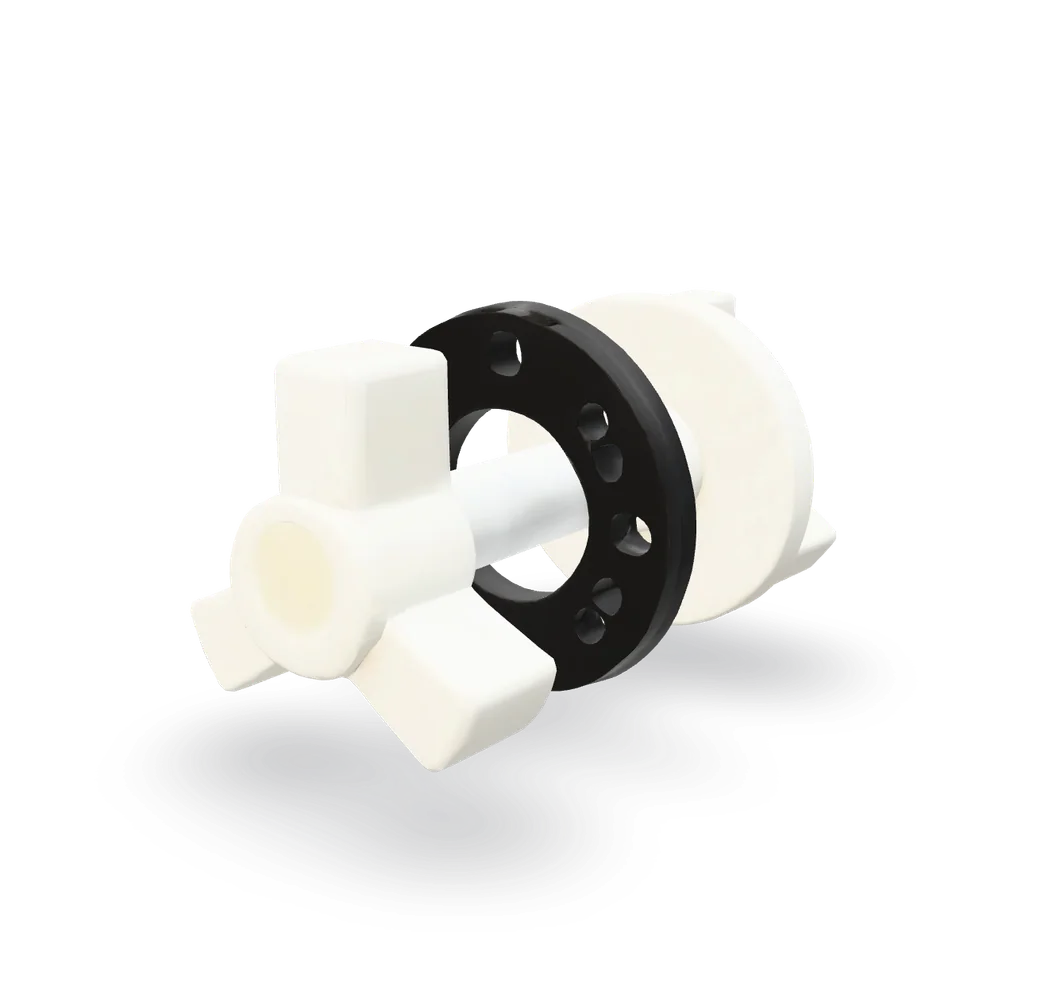
Washer motor coupler replacement
Fills and drains fine, but will not agitate or spin? On direct-drive top loaders, that is the classic sign of a broken motor coupler, a small plastic and rubber part.
- Difficulty
- Moderate
- Time
- 30 min–1 hr
- Typical part cost
- $5–$30Pro: $85–$250
- Tools
- 4See the list
Take the cabinet off, then two clips and a couple of screws to drop the motor. Not hard, but there are a few steps.
What it does
What the motor coupler does
Some top loaders have no belt. The motor bolts to the bottom of the transmission, and a coupler joins the two shafts: a plastic cog on each shaft with a rubber disk between them.
The coupler is designed to be the weak link. If the drive jams, it breaks before the motor burns out.
Why it fails
Overloading and big unbalanced loads strain the drive. Over time the plastic cogs crack or the rubber disk wears through.
A jammed transmission or tub can snap it all at once.
Symptoms
Signs of a bad motor coupler
Fills and drains, but no agitate or spin
The motor hums or runs, the water goes in and out, but the agitator and basket do not move.
Full diagnosisMotor buzzes
A buzz or hum from under the washer when it should be agitating.
Burning rubber smell
The rubber part of the coupler is slipping or chewed up.
Black or plastic crumbs under the washer
Pieces of a broken coupler can fall out under the motor.
How to test it
Test the motor coupler before you buy
- Unplug the washer and take off the cabinet (steps 1 to 3 below).
- Look at the coupler between the motor and the transmission. Cracked cogs, chewed rubber or loose pieces mean it is done.
- It can look fine and still be broken, so if in doubt, remove the motor and look at both halves.
- Good
- Both cogs whole and the rubber disk intact. Check the [lid switch](/washer/lid-switch) and the drive next.
- Bad
- Any crack, chewed rubber or missing teeth. Replace the whole coupler.
Safety first
Before you touch anything
- 1
Unplug the washer
Pull the plug before you take the cabinet off. The motor is right there, and it is heavy, so have a helper if you need one.
- 2
Shut off the water and drain
Close both supply valves and drain the tub. You will be working right under it.
Tools you'll need
Grab these first
Tool and part links are affiliate links. We may earn a commission at no extra cost to you, and it never changes what we tell you to check first. How this works
- Putty knifeStiff, 1-1/2 in.Releases the clips that hold the console and cabinet on many direct-drive washers.Typically $5–$12Shop this tool
- Multi-bit screwdriverPhillips, flat, squarePries off the motor clips and removes console screws.Typically $10–$25Shop this tool
- Nut driver1/4 in. hexRemoves the screws on the motor clips and the console on many direct-drive washers.Typically $6–$15Shop this tool
- Socket set1/4 in. drive, with extensionOptionalRemoves the bolts on the coupler halves if they need persuading.Typically $20–$45Shop this tool
- Work glovesThe cabinet edges are sharp.Typically $8–$20Shop this tool
Step by step
How to replace the motor coupler
- 1
Unplug, water off, tub drained
Pull the plug, close the valves and make sure the tub is empty.
- 2
Open the console and remove the cabinet
On these washers, the console is held by screws or by spring clips under its end caps. Release them, then swing the console up and back. Unplug the lid switch, pry the two cabinet clips free with a flat screwdriver, then lift the back of the cabinet, slide it forward and set it aside.
Careful. Remember to plug the lid switch back in later, or the washer will not spin.
- 3
Drop the motor
If the drain pump is mounted on the motor shaft, release its clips and move it aside with the hoses still on. Unplug the motor.
Remove the screws on the motor clips and pry the clips off with a flat screwdriver. Hold the motor as the last clip comes off, because it is heavy, and pull it straight off.
- 4
Replace both coupler halves
Pry the old cog off the motor shaft and the old cog off the transmission shaft. They can be tight. Clean both shafts.
Tap the new cogs on until each shaft is flush with its cog, and put the new rubber disk between them. Install both cogs even if only one looks broken.
Buy the part
Motor coupler
Opens Amazon in a new tab. Where’s my model number?
What to look for
- The part listed for your washer's model number.
- A complete kit: two cogs and the rubber disk.
- 5
Refit the motor and the pump
Line the motor up so the coupler halves mesh, push it home and snap the clips back on. Refit the pump and plug the motor in.
- 6
Cabinet on and test
Hook the cabinet back on, refit its clips, plug the lid switch in and close the console. Plug in and run a short cycle.
Buy the part
Get the right replacement
Buy the part
Motor coupler
Opens Amazon in a new tab. Where’s my model number?
What to look for
- The part listed for your washer's model number.
- A complete kit: two cogs and the rubber disk.
Know your limits
When to call a pro
Stop and call a pro if
- The new coupler breaks again soon. The transmission may be binding.
- The motor does not run or hum at all with a good coupler.
- The agitator and basket will not turn by hand with the motor removed.
FAQ
Motor coupler questions
How do I know if my washer is direct drive?
Look under or behind the cabinet. A direct-drive washer has the motor bolted to the bottom of the transmission with no belt. Many older top loaders of one common design use it.
Is it the coupler or the agitator?
If only the top half of the agitator stops moving, look at the agitator dogs. If nothing moves and the motor runs, the coupler is the usual cause.
Why did the coupler break?
It is meant to break before the motor does. Overloading and heavy unbalanced loads are common causes.
Related
Keep going
- SymptomWasher won't spinThe clothes come out soaking, or the washer agitates but never spins. Check drainage, the lid switch or door lock, and the load first, then the belt or motor coupler.Open guide
- Washer partAgitator and agitator dogsOn two-piece agitators, small cogs called agitator dogs drive the top half. Worn dogs, or a stripped agitator coupler, leave clothes floating instead of turning over. Both are quick fixes from inside the tub.Open guide
- Washer partLid switch or lid lockThe lid switch tells a top loader its lid is shut, and on many newer washers it also locks the lid. When it fails the washer will not spin or start. Test it and swap it in under an hour.Open guide
- Washer partDrive motorThe drive motor turns the agitator or drum through a coupler, a belt, or directly. It fails less often than the parts around it. Check the error code and the cheaper parts first, then swap it.Open guide
Get the next fix before it breaks
A short email when the seasons turn: filters to change, detector batteries to check, and new repair guides. No spam, unsubscribe any time.
We send it with Kit. Privacy