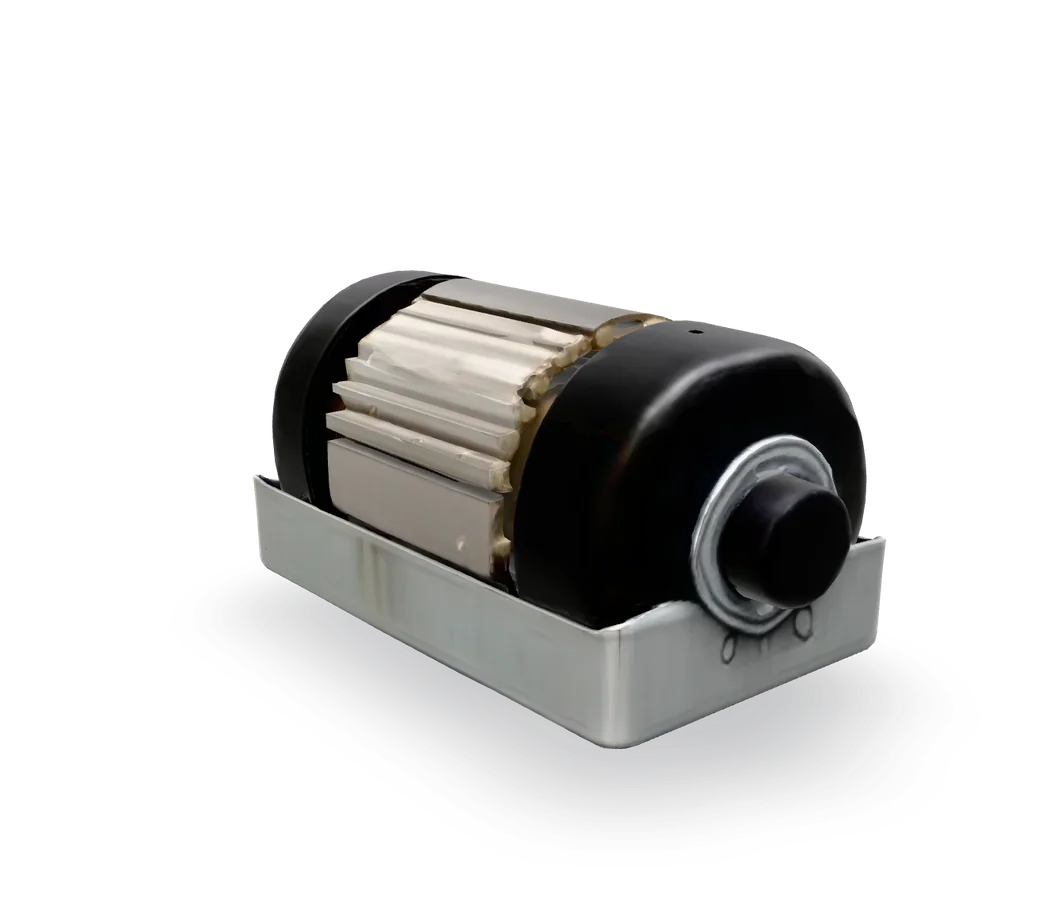
Washer drive motor: rule it out, then replace
A dead motor is less common than a belt, a pump or a lock. Rule those out first. If the motor really is gone, many are a bolt-out swap.
- Difficulty
- Hard
- Time
- 1 hr–2 hr
- Typical part cost
- $100–$350Pro: $250–$700
- Tools
- 4See the list
Heavy, awkward, and different on every design. The swap itself is bolts and plugs, but proving the motor is dead takes care.
What it does
What the motor does
Every washer has a drive motor. Belt-drive washers turn a pulley on the drum. Direct-drive top loaders turn the transmission through a coupler. Many front loaders mount a large flat motor straight on the back of the drum, with a magnet rotor that bolts on over a fixed stator.
The control board, and on some front loaders a separate motor control board, tells the motor how fast and which way to turn.
Why it fails
Windings can overheat and burn out.
A loose speed sensor, a damaged harness or a wiring fault can look exactly like a dead motor and throw the same error code.
Water leaking onto a motor from a bad tub seal can damage it from the outside.
Symptoms
Signs of a bad motor
Silent when it should turn
No hum and no movement when the washer should agitate, tumble or spin, often with a motor error code.
Full diagnosisHums but will not turn
A loud hum with nothing moving can be a seized motor, or a jammed drive or pump.
Burning smell or smoke
Stop and unplug the washer right away. Overheated windings smell hot and sharp.
How to test it
Test the motor before you buy
- Note the error code, if any, and look it up in your manual or on the sheet inside the console.
- Check the cheaper suspects: the drive belt on belt washers, the motor coupler on direct-drive top loaders, and the lid switch or door lock.
- Unplug the washer and check the motor's wire plugs are firmly seated and undamaged.
- Good
- If one of those is the fault, fix it first. Motors are rarely the first failure.
- Bad
- Everything else checks out and the code points to the motor. Test or replace the motor.
- Unplug the washer and unplug the motor.
- Find the winding pins on the tech sheet for your washer, often inside the console or the rear panel.
- Measure across each pair of winding pins it lists.
Good windings typically read
A low, steady reading that matches your tech sheet
Typical range. Check your part label or manual for the exact spec. Motor windings and pin layouts differ a lot between designs. Without your washer's tech sheet, skip this test.
- Good
- Readings that match the tech sheet and each other point away from the motor. Check the wiring and the board.
- Bad
- OL on any pair, or a reading far off the sheet, means a failed winding. Replace the motor.
Safety first
Before you touch anything
- 1
Unplug the washer
Pull the plug before you touch the motor or its plugs. If you smelled burning, leave it unplugged.
- 2
Water off, tub empty
Close both valves and drain the tub. You will be working under it.
- 3
Gloves and a helper
Motors are heavy and the frame edges are sharp. Have someone help with the lift.
Tools you'll need
Grab these first
Tool and part links are affiliate links. We may earn a commission at no extra cost to you, and it never changes what we tell you to check first. How this works
- Socket set1/4 in. drive, with extensionRemoves the motor mounting bolts and, on direct-drive front loaders, the rotor bolt.Typically $20–$45Shop this tool
- Multi-bit screwdriverPhillips, flat, squareRemoves the rear or lower panel.Typically $10–$25Shop this tool
- Nut driver1/4 in. hexOptionalMany panels and brackets use hex-head screws.Typically $6–$15Shop this tool
- Digital multimeterΩ, V, µF, µAChecks the wiring and the windings when your service sheet gives readings.Typically $25–$60Shop this tool
- Work glovesThe motor is heavy and the frame edges are sharp.Typically $8–$20Shop this tool
Step by step
How to replace the motor
- 1
Unplug, water off, drained
Pull the plug, close the valves, drain the tub, and pull the washer out.
- 2
Open the panel to the motor
On most front loaders, remove the rear panel. On top loaders, the motor is usually reached from the front panel or from underneath.
- 3
Unplug the motor
Photograph the plugs, then release their tabs and pull them off. Take off the belt first on a belt-drive washer.
- 4
Unbolt and remove the motor
Belt and top-load motors: remove the mounting bolts and lift the motor out.
Direct-drive front loaders: remove the center bolt and pull the rotor straight off, then remove the bolts that hold the stator and unplug it.
- 5
Fit the new motor
Bolt the new motor in place, or slide the stator on, bolt it, and push the rotor back on with its center bolt. Some guides call for thread-locking compound on that bolt. Follow the instructions with your part.
Reconnect the plugs and any green ground wire as in your photo, and refit the belt if there is one.
Buy the part
Drive motor
Opens Amazon in a new tab. Where’s my model number?
What to look for
- The part listed for your washer's model number.
- The motor's part number from its label. Direct-drive stators and rotors are sometimes sold separately.
- 6
Close up and test
Refit the panel. Plug in, open the water, and run a rinse and spin.
Buy the part
Get the right replacement
Buy the part
Drive motor
Opens Amazon in a new tab. Where’s my model number?
What to look for
- The part listed for your washer's model number.
- The motor's part number from its label. Direct-drive stators and rotors are sometimes sold separately.
Know your limits
When to call a pro
Stop and call a pro if
- You smelled burning or saw smoke. Have the wiring checked as well as the motor.
- A new motor does not fix it. The control board, motor control board or wiring is likely at fault.
- The motor is wet. Find and fix the leak, often a tub seal, first.
- Your washer is older and the repair quote is close to half the price of a new washer.
FAQ
Drive motor questions
How do I know it is the motor and not the board?
Often you cannot be sure without the tech sheet. A motor error code, good wiring and a winding test that fails point to the motor. Good windings point to the wiring, the speed sensor or a control board.
Is a motor worth replacing?
On a newer washer, often yes. On an older one, compare the cost with a new washer. The repair or replace calculator can help.
Can I test a motor without a tech sheet?
You can check for an open winding, but the right readings vary too much to judge more than that. Look for the sheet inside the console or the rear panel.
Related
Keep going
- SymptomWasher won't spinThe clothes come out soaking, or the washer agitates but never spins. Check drainage, the lid switch or door lock, and the load first, then the belt or motor coupler.Open guide
- SymptomWasher won't startNothing happens when you press Start, or it lights up but will not begin. Power, the child lock or delay start, and the lid switch or door lock cause most of it.Open guide
- Washer partDrive beltOn belt-drive washers, a ribbed belt links the motor to a big pulley on the drum. When it slips off or snaps, the motor runs and the drum sits still. Swap it from the rear panel.Open guide
- Washer partMotor couplerOn direct-drive top loaders, the motor coupler links the motor to the transmission and breaks on purpose to protect the motor. When it fails, the washer fills and drains but will not agitate or spin.Open guide
- Washer partControl boardThe control board runs every step of the cycle and powers the pump, valve, lock and motor. It is the last part to suspect. When it is the cause, swap it plug by plug.Open guide
Get the next fix before it breaks
A short email when the seasons turn: filters to change, detector batteries to check, and new repair guides. No spam, unsubscribe any time.
We send it with Kit. Privacy