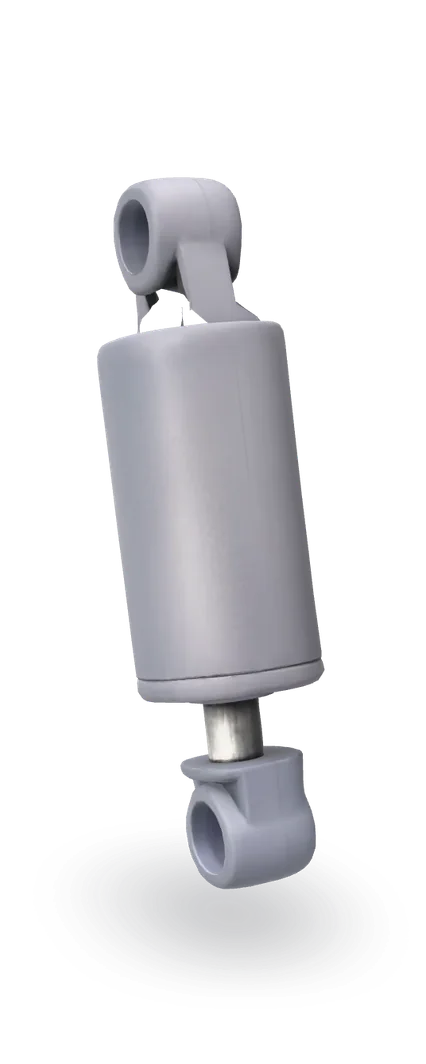
Front-load washer shock absorber replacement
Banging and walking on spin, even with a balanced load and a level washer? Worn shocks are the usual reason, and they are a bolt-on part.
- Difficulty
- Moderate
- Time
- 30 min–1.3 hr
- Typical part cost
- $30–$150Pro: $120–$350
- Tools
- 4See the list
A lower or rear panel, then a pin or bolt at each end of each shock. Reaching the back ones takes some contortion.
What it does
What the shocks does
A front loader's tub hangs on springs at the top and is held from below by shock absorbers, often two to four of them. The shocks run from the tub down to the base frame.
They work like the shocks on a car. During spin they resist the tub's swing so it cannot slam the cabinet.
Why it fails
The damping wears out over years of spins. A worn shock slides too easily and lets the tub swing.
Mounting pins and bushings crack or fall out, and a shock can come loose at one end.
Some shocks leak their fluid. A wet, oily shock is done.
Symptoms
Signs of a bad shocks
Loud banging on spin
The tub hits the cabinet as the spin speeds up, even with a normal load.
Full diagnosisWalks across the floor
The washer shuffles out of place during spin.
Full diagnosisTub drops and moves too easily
With the washer off, push down on the top of the drum through the door. A tub that bounces freely has weak shocks.
Keeps stopping to rebalance
The washer pauses and tumbles again and again, or shows an unbalance code, before it will spin.
How to test it
Test the shocks before you buy
- Put a level on top of the washer, front to back and side to side. Adjust the legs until it is level and does not rock, then lock the leg nuts.
- Run a rinse and spin with no clothes in it.
- Good
- If it spins smoothly empty, the problem was the load or the leveling. Wash bulky items in a fuller, balanced load.
- Bad
- Still banging when level and empty. Check the shocks.
- Unplug the washer and remove the lower front or rear panel, depending on your model.
- Look at each shock for broken mounts, missing pins and oily fluid on the body.
- Disconnect the shock and push it in by hand. A good one is very hard to compress and moves evenly.
- Good
- Every shock is firmly mounted, dry and very hard to push in.
- Bad
- A loose mount, a missing pin, a leak, or a shock that slides with almost no resistance. Replace the set.
Safety first
Before you touch anything
- 1
Unplug the washer
Pull the plug before you open a panel or reach under the tub.
- 2
Mind the edges
The cabinet edges and the base frame are sharp sheet metal. Wear work gloves.
Tools you'll need
Grab these first
Tool and part links are affiliate links. We may earn a commission at no extra cost to you, and it never changes what we tell you to check first. How this works
- Socket set1/4 in. drive, with extensionMany shocks are held by bolts at the tub or base.Typically $20–$45Shop this tool
- Needle-nose pliersHelps release the locking tabs or pins on some shock mounts.Typically $8–$20Shop this tool
- Multi-bit screwdriverPhillips, flat, squareRemoves the lower or rear access panel.Typically $10–$25Shop this tool
- Torx driver bitsT15, T20, T25OptionalSome panels use Torx screws.Typically $6–$15Shop this tool
- HeadlampThe rear shocks sit deep under the tub.Typically $12–$30Shop this tool
Step by step
How to replace the shocks
- 1
Unplug and pull it out
Pull the plug and close both supply valves. Pull the washer out so you can reach the panel the shocks are behind.
- 2
Open the access panel
Depending on your model, remove the lower front panel, the front panel, or the rear panel to reach the shocks.
- 3
Remove one shock
Work on one shock at a time so the tub stays supported.
At each end, release the locking tab, pin or bolt. How it is held varies by model. Lift the shock out.
- 4
Fit the new shock
Line the new shock up with the mounts and fasten each end the same way the old one was held.
Repeat for each shock. Replace them all, not just the worst one, so they damp evenly.
Buy the part
Shock absorbers
Opens Amazon in a new tab. Where’s my model number?
What to look for
- The part listed for your washer's model number. Front and rear shocks can be different parts.
- A kit with new mounting pins or bolts. Old pins often break on removal.
- 5
Close up and test
Refit the panel. Level the washer again, plug it in, and run a rinse and spin with a normal towel load.
Buy the part
Get the right replacement
Buy the part
Shock absorbers
Opens Amazon in a new tab. Where’s my model number?
What to look for
- The part listed for your washer's model number. Front and rear shocks can be different parts.
- A kit with new mounting pins or bolts. Old pins often break on removal.
Know your limits
When to call a pro
Stop and call a pro if
- New shocks and a level washer still bang. The tub springs, the counterweights or the drum bearings may be the problem.
- You hear grinding or roaring on spin. That points to the drum bearings, which is a big job.
- A counterweight on the tub is cracked or loose.
FAQ
Shock absorbers questions
Do I need to replace all the shocks?
Yes. Repair guides say to replace them as a set, because they wear at about the same rate.
Could it just be the load?
Often. A single heavy item, like a bath mat, cannot balance. Pause, spread the load out, and test with an empty rinse and spin. See washer shaking and banging.
Does a top loader have shock absorbers?
Top loaders use suspension rods at the corners instead. They do the same job a different way.
Related
Keep going
- SymptomWasher shaking, banging or walkingThe washer bangs, shakes or walks during spin. Rebalance the load and level the washer first. If it still bangs, the suspension rods or shock absorbers are worn.Open guide
- Washer partSuspension rodsFour suspension rods hang a top loader's tub from the cabinet corners and damp it on spin. Worn rods let it bang and walk. Replace all four as a set.Open guide
- Washer partDrive beltOn belt-drive washers, a ribbed belt links the motor to a big pulley on the drum. When it slips off or snaps, the motor runs and the drum sits still. Swap it from the rear panel.Open guide
- Washer partDrain pumpThe drain pump pushes the water out at the end of each wash and rinse. Clean the filter first. If it still will not drain, test the pump and swap it.Open guide
Get the next fix before it breaks
A short email when the seasons turn: filters to change, detector batteries to check, and new repair guides. No spam, unsubscribe any time.
We send it with Kit. Privacy