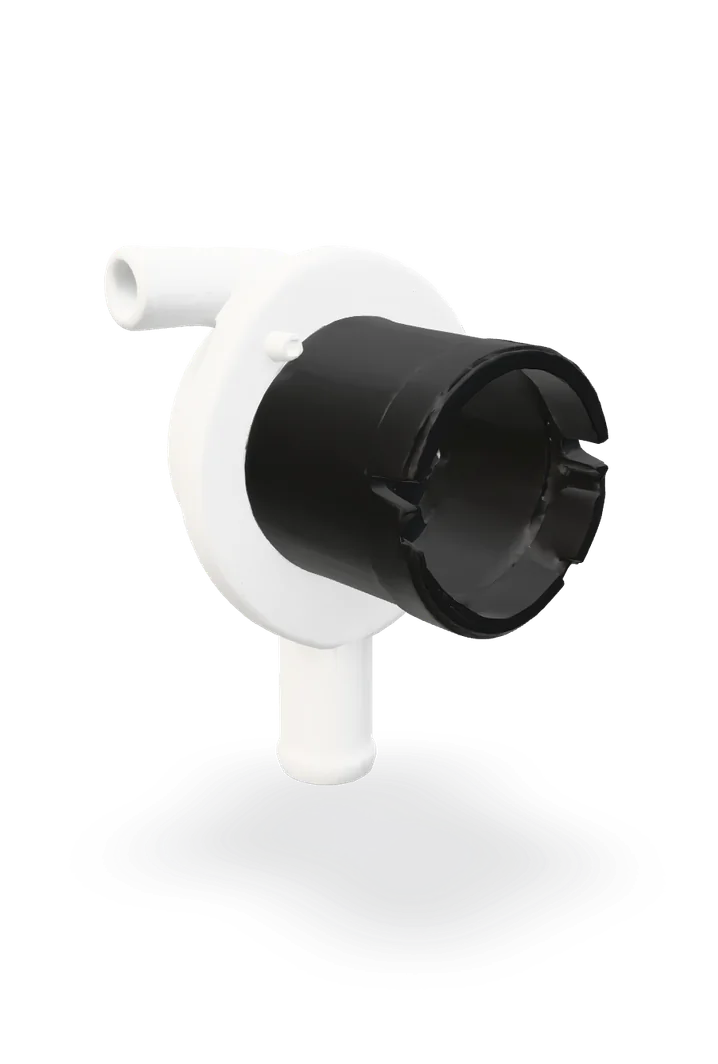
Washer drain pump: clean the filter, test and replace
Good news: a washer that will not drain is often just a clogged pump filter. Cleaning it is quick and costs nothing.
- Difficulty
- Easy
- Time
- 30 min–1.3 hr
- Typical part cost
- $20–$100Pro: $125–$400
- Tools
- 5See the list
Cleaning the filter is easy. Swapping the pump means a lower panel, a plug, two hose clamps and a few screws, plus a pan of water to catch.
What it does
What the drain pump does
The drain pump is a small electric pump at the bottom of the washer. When the wash or rinse ends, the control switches it on and it pushes the water up and out the drain hose. A soft hum and some gurgling while it runs is normal.
Front loaders put a filter, sometimes called a coin trap, right in front of the pump. It catches coins, buttons, hair ties and lint before they reach the pump. You reach it through a small door at the bottom front of the washer.
The pump matters for spinning too. A washer will not spin while the tub is still full, so a pump problem often looks like a spin problem.
Why it fails
Most of the time the pump is fine and the filter is packed. Lint and small objects build up until water barely gets through, and the washer drains slowly or not at all.
A sock, a coin or a bra wire can also get past the filter and jam the impeller. The pump hums but cannot turn.
The motor itself can burn out. Then the pump stays silent, and a meter test shows an open circuit or a reading far from normal.
Symptoms
Signs of a bad drain pump
Water left in the tub
The cycle ends, or stops partway, with water still sitting in the tub. Many washers show a drain error code.
Full diagnosisHums but no water moves
You hear the pump hum during drain, but the water level does not drop. Something is jamming the impeller.
Full diagnosisClothes come out soaking wet
The washer cannot spin while water is still in the tub, so a weak pump leaves the load dripping.
Full diagnosisGrinding or rattling at drain
A coin or a bra wire in the pump makes a rattle or grind each time it starts.
Water under the front
A filter that was not screwed back in all the way, or a cracked pump housing, drips onto the floor at the front.
Full diagnosis
How to test it
Test the drain pump before you buy
- Unplug the washer. Make sure the tub has no visible water in it, or be ready for a lot more than a pan holds.
- Open the small door at the bottom front. Put a shallow pan and towels under it.
- If there is a small drain hose, pull it out, take the cap off and let it drain into the pan.
- Turn the filter counterclockwise slowly and let the water run out. Pull it out and clear off lint and anything caught in it.
- Shine a light into the opening and look for anything still stuck. Nudge the impeller with a pencil or a finger. It should move, not stay jammed.
Top loaders usually have no filter you can reach. Skip to the listening test.
- Good
- Refit the filter clockwise as far as it goes, close the door, plug in and run a drain and spin. If it now drains, you are done.
- Bad
- It still will not drain with a clean filter, or the impeller will not budge at all. Move on to the next test.
- Plug in and start a drain and spin, or a rinse and spin.
- Put your ear near the lower front of the washer when the drain step starts.
- Good
- A steady hum with water running out is normal. The pump is working.
- Bad
- A hum with no water moving means a jam. Silence means no power to the pump or a dead motor. Unplug before you go further.
- Unplug the washer.
- Take off the lower access panel and find the pump. Photograph its plug, then unplug it.
- Touch one probe to each pin on the pump. Polarity does not matter.
A good pump motor typically reads
About 10–300 Ω, depending on the pump
Typical range. Check your part label or manual for the exact spec. Pumps vary a lot. Some read in the tens of ohms and others in the hundreds. What matters most is open, shorted or far from the figure for your exact part. Your tech sheet or the part listing may give it.
- Good
- A steady reading in the range for your pump means the motor windings are intact. Check for a jam or a blocked hose instead.
- Bad
- OL (open) or a reading near 0 Ω means the motor has failed. Replace the pump.
Safety first
Before you touch anything
- 1
Unplug the washer
Pull the plug from the outlet. If you cannot reach it, switch off the washer's breaker. Do not rely on the power button.
- 2
Close the supply valves
Turn the hot and cold valves behind the washer off. It keeps a stuck inlet valve from filling the tub while you work.
- 3
Get the water out first
Drain the tub through the pump filter or the drain hose before you open the pump. A full front-load tub holds far more water than one pan.
Tools you'll need
Grab these first
Tool and part links are affiliate links. We may earn a commission at no extra cost to you, and it never changes what we tell you to check first. How this works
- Multi-bit screwdriverPhillips, flat, squareOpens the filter door and removes the lower panel screws on many washers.Typically $10–$25Shop this tool
- Nut driver1/4 in. hexSome lower panels and pump brackets use 1/4 in. hex screws.Typically $6–$15Shop this tool
- Torx driver bitsT15, T20, T25OptionalMany front-load panels and pump brackets use Torx screws.Typically $6–$15Shop this tool
- Hose clamp pliersSqueezes the spring clamps that hold the hoses on the pump.Typically $10–$25Shop this tool
- Shallow pan and towelsThe filter and pump always hold some water. A pan fits where a bucket will not.Typically $5–$15Shop this tool
- Digital multimeterΩ, V, µF, µAConfirms the pump motor is dead before you buy a new one.Typically $25–$60Shop this tool
Step by step
How to replace the drain pump
- 1
Unplug it and close the valves
Pull the power plug, then turn both supply valves behind the washer off.
- 2
Drain the tub
Front load: drain it through the filter as in the first test, a pan at a time. Close the filter between pans.
Top load: lower the end of the drain hose into a bucket below the tub and let it run, or bail the water out first.
Tip. Towels on the floor are cheaper than a mopped-up kitchen.
- 3
Open the lower panel
On many front loaders the pump sits behind the lower access panel or the front panel. Take out the screws and lift it away.
Some top loaders reach the pump from the front panel. On others you tip the washer forward, with a helper, and reach it from underneath. Your manual or the parts diagram for your model shows which.
- 4
Unplug the pump
Take a photo of the wires, then squeeze the tab on the plug and pull it off. Pull on the plug, not the wires.
- 5
Take the hoses off
Set the pan under the pump. Squeeze each spring clamp with the pliers, slide it back along the hose, and twist the hose off.
More water will come out. Let it drain into the pan.
- 6
Remove the pump
Take out the screws that hold the pump to the base or its bracket. Some pumps twist and slide out of a clip instead.
Check the pump body and the hoses for a coin, a sock or a bra wire before you buy anything.
- 7
Match the new pump
Hold the old and new pumps side by side. The mounting points, the hose outlets and the plug should all match.
If your pump came with the filter housing attached, move the filter over or use the new one.
Buy the part
Drain pump
Opens Amazon in a new tab. Where’s my model number?
What to look for
- The part number printed on the old pump's label.
- The same mounting, the same hose outlets and the same plug. Top load and front load pumps are different.
- Whether your pump comes with or without the filter housing.
- 8
Install the new pump
Set the pump in place and put the screws back in. Snug is enough. The housing is plastic.
- 9
Reconnect the hoses and the plug
Push each hose fully onto its outlet, then slide the clamp back over the ridge so it grips.
Plug the pump back in until the tab clicks. Match your photo.
- 10
Close up and test
Refit the lower panel. Check the filter is screwed in all the way. Turn the valves on and plug the washer in.
Run a rinse and spin. Watch the floor at the front for drips, and listen for a steady hum as the water goes out.
Buy the part
Get the right replacement
Buy the part
Drain pump
Opens Amazon in a new tab. Where’s my model number?
What to look for
- The part number printed on the old pump's label.
- The same mounting, the same hose outlets and the same plug. Top load and front load pumps are different.
- Whether your pump comes with or without the filter housing.
Know your limits
When to call a pro
Stop and call a pro if
- The new pump runs, the filter and hoses are clear, and the washer still will not drain. The drain hose, the standpipe or the house drain may be blocked.
- The pump never gets power. The wiring or the control board may be at fault.
- Water is coming from the tub itself or from around the drum shaft, not from the pump or its hoses.
- You cannot get the water out of a full tub safely.
FAQ
Drain pump questions
How often should I clean the pump filter?
Several front-load manuals say about once a month. Do it sooner if you hear rattling or the washer drains slowly. Top loaders usually do not have one you can reach.
Why does so much water come out of the filter?
Expect up to about a quart even when the tub looks empty. If there is water in the tub, it all comes out through that filter, so drain in batches and close the filter between pans.
Is a humming pump a bad pump?
Not always. A hum with water flowing is normal. A hum with no water moving usually means something is jammed in the pump. Clear it first. The motor may be fine.
Can a clogged pump stop the washer from spinning?
Yes. The washer will not spin with water in the tub. See washer won't spin if the water does drain and it still will not spin.
Related
Keep going
- SymptomWasher won't drainThe cycle stops with water in the tub, or the clothes come out soaking. A clogged pump filter, a kinked drain hose or a jammed pump causes most of it.Open guide
- SymptomWasher won't spinThe clothes come out soaking, or the washer agitates but never spins. Check drainage, the lid switch or door lock, and the load first, then the belt or motor coupler.Open guide
- SymptomWasher leaking waterA puddle under or behind the washer. Front leaks are usually the door seal or the pump filter. Back leaks are usually the fill hoses or the inlet valve. Find the spot first.Open guide
- Washer partFill hosesFill hoses carry water from the wall valves to the washer and are under pressure all the time. Several washer makers say to replace them every five years. Here is how to check and swap them.Open guide
- Washer partLid switch or lid lockThe lid switch tells a top loader its lid is shut, and on many newer washers it also locks the lid. When it fails the washer will not spin or start. Test it and swap it in under an hour.Open guide
- Washer partDoor lock assemblyThe door lock latches a front-load door for the whole cycle and tells the control it is locked. When it fails the washer will not start, spin or unlock. Swapping it takes about 30 minutes.Open guide
Get the next fix before it breaks
A short email when the seasons turn: filters to change, detector batteries to check, and new repair guides. No spam, unsubscribe any time.
We send it with Kit. Privacy