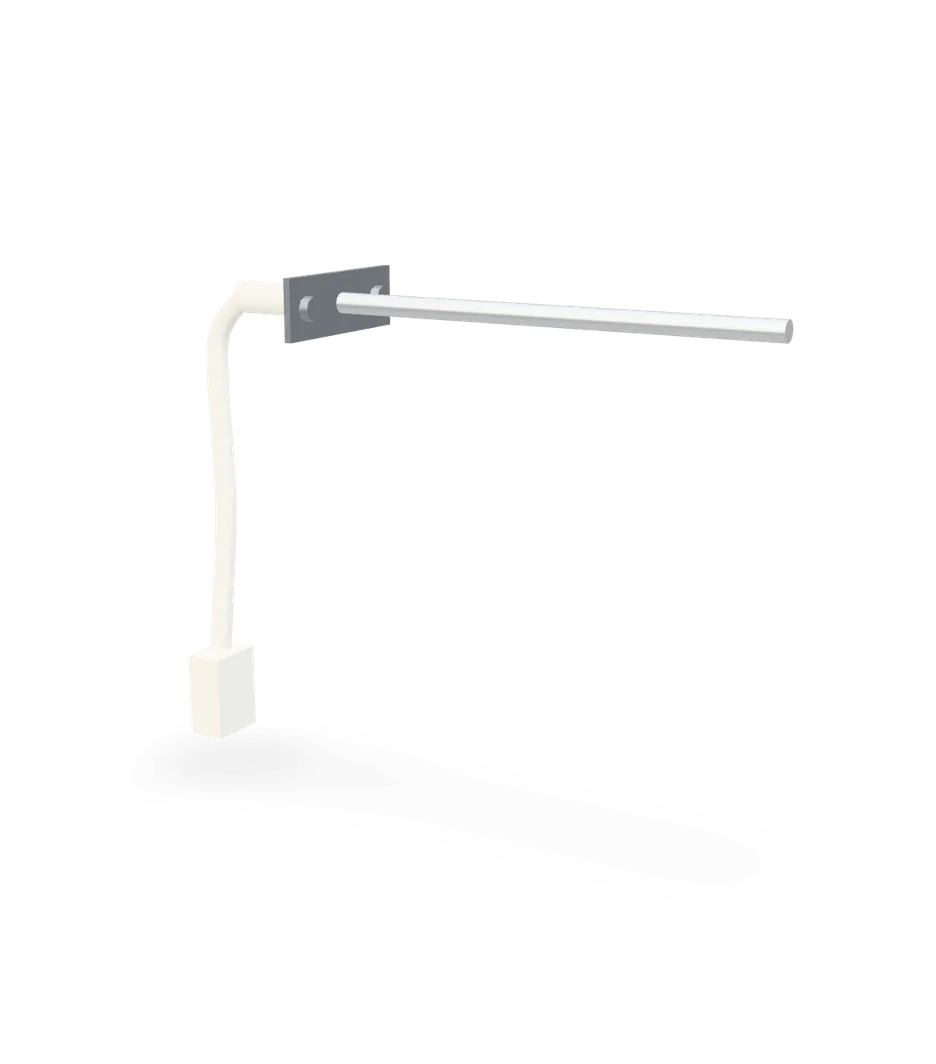
Oven temperature sensor test and replacement
Oven running hot, cold, or throwing a sensor code? A meter and room temperature are all it takes to test the thin probe on the back wall.
- Difficulty
- Anyone can do it
- Time
- 15–30 min
- Typical part cost
- $15–$35Pro: $100–$250
- Tools
- 3See the list
One or two screws on the oven's back wall and one plug. The test needs only a meter.
What it does
What the temperature sensor does
The sensor is a thin metal probe, a few inches long, mounted near the top of the oven's back wall. Its resistance rises as the oven heats up.
The control reads that resistance and switches the bake element or burner on and off to hold the temperature you set. Gas and electric ovens with electronic controls both use one.
Why it fails
Over time a sensor can drift, so the control thinks the oven is hotter or cooler than it really is. It can also fail open or shorted, which most controls catch and report as an error code.
Its wires or plug behind the back wall can work loose or get damaged by heat.
Symptoms
Signs of a bad temperature sensor
Oven runs hot or cold
Food burns or stays raw at the usual times, and an oven thermometer shows a big gap from the setting.
Full diagnosisSensor error code
The display shows an error code that your manual lists as a sensor fault, and the oven stops heating.
Full diagnosisHeats, then cuts out
The oven starts heating and then shuts off early, or swings well above and below the setting.
Full diagnosis
How to test it
Test the temperature sensor before you buy
- Unplug the range or turn off its breaker, and let the oven cool to room temperature.
- Remove the sensor's mounting screws inside the oven, pull it forward a little and unplug it. On some models the plug is reached from the rear panel instead.
- Probe the two pins of the sensor's plug.
A good sensor typically reads, at room temperature
About 1,000–1,100 Ω
Typical range. Check your part label or manual for the exact spec. The reading rises as the sensor warms, roughly 2 Ω per °F. Test it cool, and allow for a slightly higher number in a warm kitchen.
- Good
- About 1,080 Ω at room temperature means the sensor is fine. If the oven still runs off, try the calibration offset or look at the control.
- Bad
- Open (OL), very low, or more than about 100 Ω away from the expected value. Replace the sensor.
Safety first
Before you touch anything
- 1
Power off
Unplug the range or turn off its breaker before you unplug the sensor.
- 2
Let the oven cool
The test needs the oven at room temperature anyway.
Wait about 30 min
Tools you'll need
Grab these first
Tool and part links are affiliate links. We may earn a commission at no extra cost to you, and it never changes what we tell you to check first. How this works
- Nut driver1/4 in. hexThe sensor's mounting screws are usually 1/4 in. hex heads.Typically $6–$15Shop this tool
- Multi-bit screwdriverPhillips, flat, squareSome sensors use Phillips screws, and the rear panel may too.Typically $10–$25Shop this tool
- Digital multimeterΩ, V, µF, µAThe whole test is one resistance reading.Typically $25–$60Shop this tool
Step by step
How to replace the temperature sensor
- 1
Power off and cool down
Unplug the range or turn off its breaker. Let the oven cool completely and take out the racks.
- 2
Unscrew the sensor
Find the sensor near the top of the back wall. Remove its one or two mounting screws.
- 3
Pull it forward and unplug it
Gently pull the sensor forward. Its wire and plug come through the hole in the back wall. Unplug it, holding the range-side plug so it does not fall back through.
If the wire will not come through far enough, the plug is reached from the back of the range: pull the range out and remove the rear panel.
- 4
Fit the new sensor
Plug the new sensor in until it clicks, feed the plug back through the wall, and refit the screws.
Buy the part
Oven temperature sensor
Opens Amazon in a new tab. Where’s my model number?
What to look for
- Your range's model number. Sensors differ in probe length, mounting and plug.
- The same plug as the old sensor. Some kits include an adapter.
- 5
Power on and check
Restore power, put a reliable oven thermometer on the middle rack and set 350°F. Average a few readings once it has preheated.
If you moved the range, re-engage the anti-tip bracket.
Buy the part
Get the right replacement
Buy the part
Oven temperature sensor
Opens Amazon in a new tab. Where’s my model number?
What to look for
- Your range's model number. Sensors differ in probe length, mounting and plug.
- The same plug as the old sensor. Some kits include an adapter.
Know your limits
When to call a pro
Stop and call a pro if
- The sensor reads correctly but the oven still runs far off or keeps showing the same error. The control may be at fault.
- The sensor's wiring behind the oven is burned or damaged.
FAQ
Oven temperature sensor questions
My oven is 20 degrees off. Do I need a new sensor?
Maybe not. Most electronic ovens let you adjust the temperature up or down by up to about 35°F in the settings. Test the sensor first; if it reads correctly, adjust the offset as your manual describes.
What does an oven sensor error code mean?
Many controls show a code when the sensor reads open or shorted. The code chart in your manual will say. Test the sensor before you replace anything else.
Is it the sensor or the control board?
Test the sensor first. If it reads about 1,080 Ω at room temperature, the control board becomes the more likely cause.
Related
Keep going
- SymptomOven temperature wrongFood burns, stays raw or browns unevenly. Measure the real temperature first. A small, steady offset is often fixed in the settings. A big swing usually means a temperature sensor, an element or igniter that is failing, or a door that does not seal.Open guide
- SymptomOven not heatingThe oven will not heat, or barely warms. On an electric range the bake element is the usual cause, after the breaker. On a gas range a weak igniter is the most likely, after the gas supply. The sensor and the control come later.Open guide
- Range partOven control boardThe control board is the electronic control behind the keypad and display. It reads the temperature sensor and switches the bake and broil elements or the gas igniters. When it fails, the display goes dead or garbled, keys stop responding, or the oven will not heat even with good parts.Open guide
- Range partBake elementElectric ranges only. The bake element is the heating loop along the bottom of the oven. When it burns out, the oven heats slowly, unevenly or not at all on bake. It is usually two screws and two wires.Open guide
- Range partGas oven igniterGas ranges only. The oven igniter glows to light the bake burner and, at the same time, opens the oven safety valve. A weak igniter still glows but cannot draw enough current to open the valve, so the oven heats slowly or not at all.Open guide
Get the next fix before it breaks
A short email when the seasons turn: filters to change, detector batteries to check, and new repair guides. No spam, unsubscribe any time.
We send it with Kit. Privacy