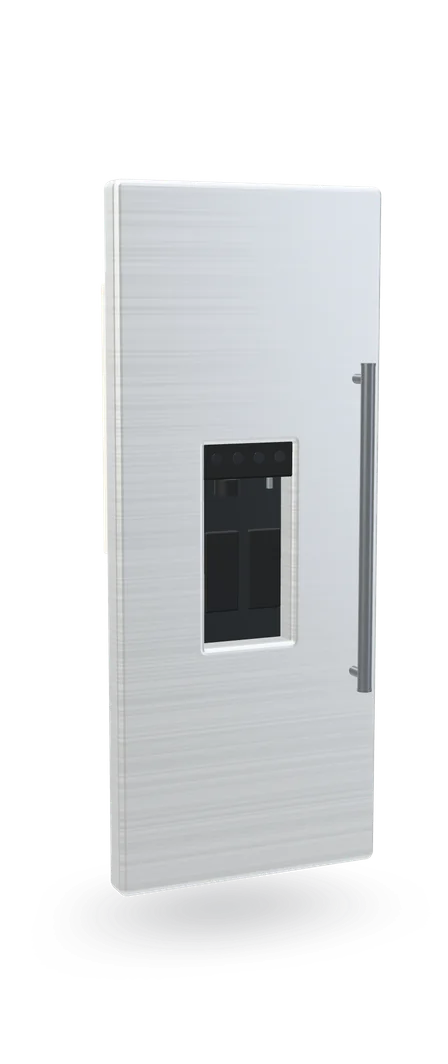
How to level and align uneven French refrigerator doors
Doors out of line at the top, or one that will not close? Most of the time the cabinet just needs leveling. If not, the bottom hinge has an adjuster made for exactly this.
- Difficulty
- Easy
- Time
- 20 min–1 hr
- Typical part cost
- $0Pro: $70–$200
- Tools
- 3See the list
Small turns with a wrench and a hex key, checked with a level. Patience matters more than skill: adjust a little, check, repeat.
What it does
What the door alignment does
The cabinet stands on two adjustable leveling legs at the front. Each French door hangs from a top hinge and sits on a bottom hinge, and on most models the bottom hinge has a screw or bolt that raises or lowers that door.
The left door carries a hinged strip on its free edge, the flipper mullion or center flap. It sits folded in while the door is open. As the left door closes, a pin at its top rides into a guide on the cabinet, and the flap seals the gap between the two doors.
Why it fails
The most common cause is the cabinet, not the doors: a refrigerator that is not level side to side, or that leans forward so the doors do not swing shut on their own.
Door bins loaded with heavy bottles pull a door down a little. The doors are set up for a normal load, so an empty refrigerator can look uneven.
A door that sits low makes the center flap's pin miss its guide, so the left door will not close or seal. A flap left folded out does the same.
Symptoms
Signs of a bad door alignment
Tops not level
One French door sits higher than the other where they meet at the top.
Full diagnosisLeft door will not close
The left door bounces back or will not seal. The center flap is sticking out instead of folded in, or its pin is missing the guide at the top.
Full diagnosisDoors do not swing shut
A door let go half open stays put or drifts open. The cabinet is likely tilted forward.
Condensation along the door edge
Water beads on the gasket or the center flap, or a shelf near the door runs warm. Air is leaking past a door that does not sit flat.
Full diagnosis
How to test it
Test the door alignment before you buy
- Load the door bins the way you normally do. An empty refrigerator can look uneven.
- Set a level across the top of the cabinet, side to side. Then lay it front to back.
- Push on each corner of the cabinet. All four should rest firmly on the floor with no rocking.
- Good
- Level side to side, a touch higher at the front than the back, and solid on the floor. Go straight to the door adjustment.
- Bad
- Off level, leaning forward or rocking. Level the cabinet first.
- Open the left door and look at the flap on its free edge. It should swing freely and sit folded in, not sticking out.
- With it folded in, close the left door slowly and watch the pin at the top enter its guide.
- Good
- It swings freely and tracks into the guide. The flap is fine.
- Bad
- It was sticking out, it drags, or the pin hits beside the guide. Push it in by hand, then raise the left door as described below. A flap with no spring tension needs a new flap or a service visit.
Safety first
Before you touch anything
- 1
Unplug the refrigerator
Unplug it before you take off the base grille or reach under the cabinet. The condenser fan is under there.
- 2
Mind the floor and the doors
Turn the legs and hinges a little at a time and never drag the refrigerator across the floor to adjust it. Keep a hand on a door while you change its height.
Tools you'll need
Grab these first
Tool and part links are affiliate links. We may earn a commission at no extra cost to you, and it never changes what we tell you to check first. How this works
- Bubble level9 to 24 in.Checks the cabinet side to side and front to back before you touch a hinge.Typically $5–$20Shop this tool
- Adjustable wrench8–10 in.Turns the leveling legs and, on some models, the hinge adjuster and its lock nut.Typically $10–$25Shop this tool
- Hex key setSAE, L-shapedMany bottom hinges adjust with a hex key. Your manual names the size.Typically $8–$20Shop this tool
- Multi-bit screwdriverPhillips, flat, squareOptionalTakes off the hinge cover or the base grille on models that have them.Typically $10–$25Shop this tool
Step by step
How to level and align the doors
- 1
Unplug it and load it normally
Unplug the refrigerator.
Leave the usual food in the door bins. The doors are set up to hang right under a normal load, so adjusting them empty can leave them crooked later.
- 2
Fold the center flap and close the doors
Make sure the flap on the left door's edge is folded in, not sticking out. Then close the left door, then the right.
Look at the gap between the doors and the line across their tops. Note which door sits high or low.
- 3
Check the cabinet with a level
Lay a level across the top of the cabinet side to side, then front to back. Push on the corners to see whether it rocks.
- 4
Level the cabinet with the front legs
Find the two leveling legs at the front corners. On some models you take off the base grille first. Turn them with a wrench to raise or lower each corner until the cabinet is level side to side.
Then raise both front legs a little so the front sits slightly higher than the back, about 1/8 to 1/4 inch on many models. The doors should now swing closed on their own from half open.
On an uneven floor, a shim under a foot can help it sit solid.
Tip. Make the same number of turns on each leg when tilting it back, so you do not undo the side-to-side level.
- 5
Adjust the low door at its bottom hinge
Still uneven? Find the bottom hinge of the door you want to move. On many models you open the freezer drawer to reach it. Loosen the lock nut or set screw if there is one.
Turn the hinge adjuster with the wrench or hex key your manual names, a little at a time, to raise or lower that door. Which way raises it differs by model, so check your manual, or make a quarter turn and look.
When the tops line up, tighten the lock nut or set screw so it holds.
Careful. If the doors are out of line front to back, rather than up and down, stop. Some makers warn that forcing it can damage the floor or the hinge, and advise a service call.
- 6
Check that the flap tracks its guide
Close the left door slowly with the flap folded.
The pin at the top of the flap should slide into its guide on the cabinet. If it lands beside the guide, raise the left door a little more at its bottom hinge.
- 7
Paper-test the gaskets
Close each door and the freezer drawer on a sheet of paper at several points around the gasket and pull it out. You should feel drag everywhere.
A spot where the paper slides out freely is leaking. Clean the gasket with warm soapy water and test again. If it is torn or flat, see the door gasket guide.
- 8
Plug it back in
Refit any hinge cover or base grille you removed and plug the refrigerator in.
Buy the part
Get the right replacement
Buy the part
French-door alignment
Opens Amazon in a new tab. Where’s my model number?
What to look for
- Your model number. Leveling legs, hinge parts and center flaps are made for specific models.
- On some models, small door spacers or clips at the hinge raise a door that has run out of adjustment.
- A new center flap (flipper mullion) assembly if the old one's spring has broken or the flap is loose.
Know your limits
When to call a pro
Stop and call a pro if
- The doors are out of line front to back, or a hinge is bent or cracked.
- The center flap has no spring tension or its pin is broken, and you cannot find the part for your model.
- The hinge adjuster is at its limit and the door still sits low.
- The floor under the refrigerator is too uneven or soft to level it.
FAQ
French-door alignment questions
Why are my French doors uneven?
Usually the cabinet is not level side to side, or it leans forward. Heavy door bins also pull a door down a little. Level the cabinet first: it fixes most uneven doors without touching the hinges.
Which way do I turn the hinge to raise the door?
It depends on the model, and makers give opposite directions for different hinges. Your manual shows it. If you do not have it, make a quarter turn and look, then go the other way if the door moved the wrong way.
My left door will not close. What is wrong?
Check the center flap on its edge. It must be folded in, not sticking out, before the door closes. If it is folded and the door still bounces back, the pin on top is missing its guide: raise the left door slightly at its bottom hinge.
Should the refrigerator lean back?
Slightly. A front that sits a little higher than the back lets the doors swing shut on their own. Keep it level side to side.
Related
Keep going
- SymptomFrench doors uneven or will not sealFrench-door refrigerators only. One door sits higher than the other, the doors will not swing shut on their own, or there is a gap where they meet. Level the cabinet with a slight tilt back, clear anything in the way, flip the center seal back into place, then adjust the door height.Open guide
- SymptomFrench-door freezer drawer won't closeFrench-door and bottom-freezer refrigerators only. The freezer drawer stops short, springs back open or closes crooked. Check what is in it, whether the basket sits on its rails and whether ice has built up, then look at the slides, the rollers and the gasket.Open guide
- SymptomRefrigerator not coolingThe freezer and the fresh-food section are both too warm. The usual causes are a dirty condenser coil, a stopped condenser fan, a failed start relay or an iced-over evaporator coil. The sealed system is the last thing to suspect, not the first.Open guide
- Refrigerator partDoor gasketThe door gasket is the soft magnetic seal around each door. When it tears, hardens or pulls away, warm air leaks in: you get condensation, frost near the door and a refrigerator that runs and runs.Open guide
- Refrigerator partFreezer drawer slidesFrench-door refrigerators only. The freezer drawer rides out on two slides with rollers. A drawer that will not close or sits crooked usually has a basket off its rails, too much food, frost in the track, or a broken roller or bent slide. A sheet of ice behind the drawer is a defrost problem, not a slide problem.Open guide
- Refrigerator partDoor water lineFrench-door refrigerators only. The water for the dispenser and the in-door ice maker crosses into the left door at a hinge and runs past the cold ice box. If it freezes, nothing comes out. Thaw it gently, then fix the cause: a freezer set too cold, a door that does not seal, or blocked airflow.Open guide
Get the next fix before it breaks
A short email when the seasons turn: filters to change, detector batteries to check, and new repair guides. No spam, unsubscribe any time.
We send it with Kit. Privacy