Dryer high-limit thermostat: test and replace
The high limit is the dryer's overheat switch. Like the thermal fuse, it usually points to an airflow problem, and it is a two-screw part to swap.
- Difficulty
- Easy
- Time
- 20–45 min
- Typical part cost
- $5–$35Pro: $80–$175
- Tools
- 6See the list
Two screws and two wires. The work is reaching it, and on a gas dryer, keeping your hands off the burner and gas parts next to it.
What it does
What the high limit does
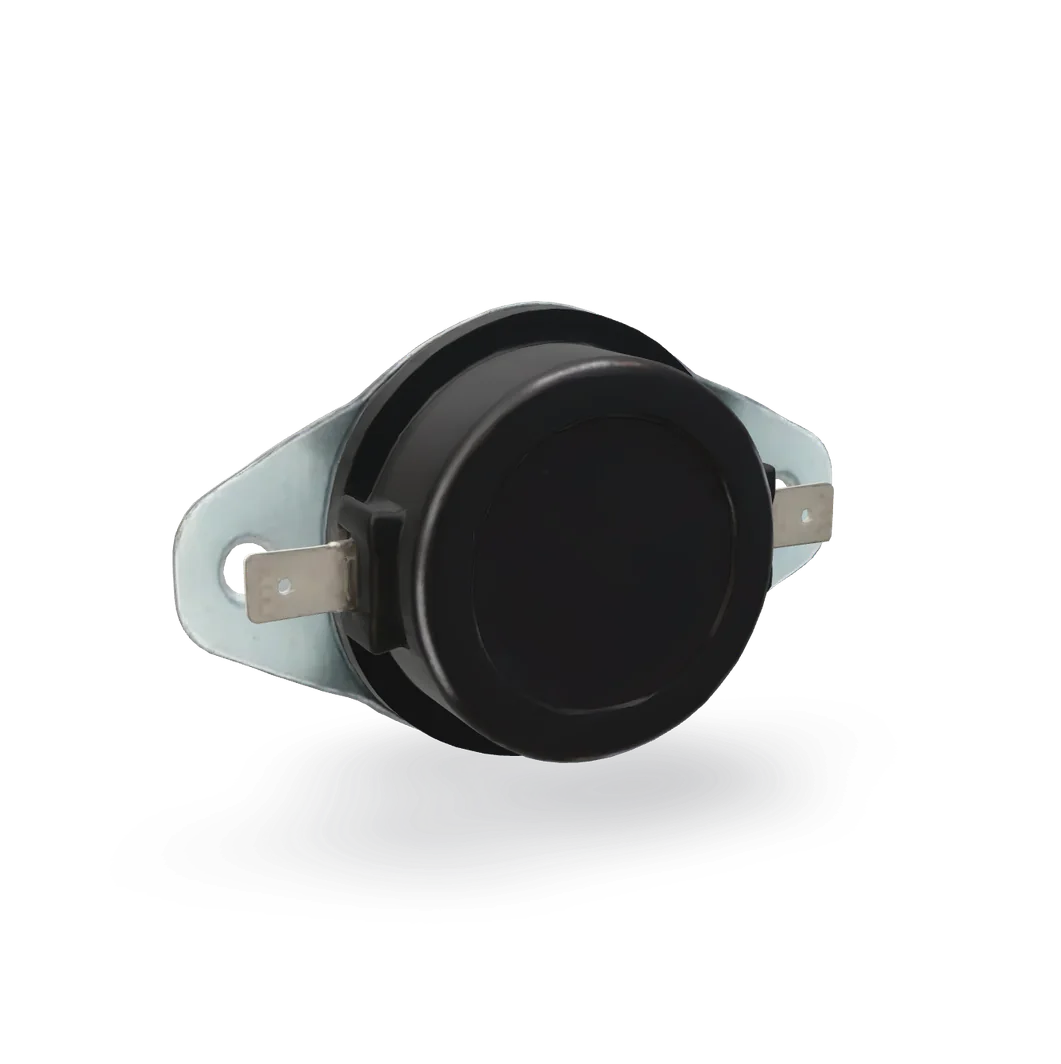
The high-limit thermostat is a small round safety switch mounted right at the heat source. Gas and electric dryers both have one. It is wired in line with the cycling thermostat, so both have to be closed for the heat to run.
Where it sits depends on the version. On an electric dryer it mounts on the heating element housing. On a gas dryer it mounts on the burner housing, next to the flame.
In normal drying it stays closed and does nothing. If the heat source gets far too hot, it opens and shuts the heat off. On many dryers it closes again once it cools, unlike the thermal fuse, which blows once and has to be replaced.
Why it fails
When it trips, airflow is the usual reason. A clogged vent or lint screen traps heat at the heat source until the limit opens.
It can also fail outright. A switch that trips over and over can wear out and stay open, and some fail open for good. An open high limit gives the same no-heat result as a blown thermal fuse.
Symptoms
Signs of a bad high limit
Tumbles, but no heat
A high limit that has failed open keeps the heat off for good. The drum turns, the clothes stay cold.
Full diagnosisHeat comes and goes, drying takes forever
A limit that keeps tripping on a blocked vent cuts the heat over and over. Loads take much longer than they should.
Full diagnosisThe thermal cut-off is open too
On designs that pair the high limit with a thermal cut-off on the element housing, finding either one open means both get replaced.
How to test it
Test the high limit before you buy
- Clean the lint screen and look into its slot for packed lint.
- Run the dryer on air only and check for a strong flow at the outside vent hood.
- Check that the duct behind the dryer is not crushed or kinked.
- Good
- Strong airflow and a clean duct. Airflow is probably not tripping the limit. Test the switch.
- Bad
- Weak airflow. Clean the [exhaust vent](/dryer/exhaust-vent) first. A good high limit will keep tripping on a blocked vent.
- Unplug the dryer. On a gas dryer, also close the gas shutoff. Let the dryer cool to room temperature.
- Take off the panel that gets you to the heat source and find the round high limit on the element housing (electric) or the burner housing (gas).
- Check the wires with a voltage tester, then pull one wire off the thermostat.
- Touch one probe to each terminal.
A good high limit at room temperature shows
Continuity (near 0 Ω)
Typical range. Check your part label or manual for the exact spec. Test it cold. A warm switch can read open and still be fine. A pass also cannot show whether it opens at the right temperature.
- Good
- Near zero, or a beep, means it is closed. It is not what is stopping the heat.
- Bad
- OL, or no beep, at room temperature means it is stuck open. Replace it.
Safety first
Before you touch anything
- 1
Unplug the dryer
Pull the plug from the wall. If you cannot reach it, turn off the dryer's breaker. Check the thermostat wires with a voltage tester before you touch them.
- 2
Gas dryer: close the gas shutoff
Turn the handle on the dryer's gas line a quarter turn so it sits crosswise to the pipe. On a gas dryer the high limit is right on the burner housing. You will only touch the thermostat's own screws and wires, never the burner, gas valve or gas tubing.
- 3
Let it cool
The high limit sits at the hottest spot in the dryer. Give it time to cool so you do not get burned and so the test reads true.
Wait about 20 min
Tools you'll need
Grab these first
Tool and part links are affiliate links. We may earn a commission at no extra cost to you, and it never changes what we tell you to check first. How this works
- Nut driver1/4 in. hexPanel and thermostat screws are often 1/4 in. hex heads.Typically $6–$15Shop this tool
- Nut driver5/16 in. hexThe other common dryer screw size.Typically $6–$15Shop this tool
- Digital multimeterΩ, V, µF, µAA continuity test shows whether the high limit is stuck open.Typically $25–$60Shop this tool
- Non-contact voltage testerPen styleConfirms the dryer is dead before you touch the thermostat wires.Typically $15–$30Shop this tool
- Needle-nose pliersPulls tight spade connectors straight off the terminals.Typically $8–$20Shop this tool
- HeadlampThe high limit sits deep in the cabinet next to the heat source.Typically $12–$30Shop this tool
Step by step
How to replace the high limit
- 1
Unplug the dryer and close the gas
Pull the dryer out and unplug it. On a gas dryer, turn the gas shutoff handle a quarter turn so it sits crosswise to the pipe. Move the dryer gently so you do not strain the gas line.
- 2
Open the cabinet
Take off the panel that gets you to the heat source. Which panel that is depends on the model, so check your manual or parts diagram first.
- 3
Find the high limit
Electric dryer: look on the heating element housing for a small round thermostat with two wires. A flat thermal cut-off often sits next to it.
Gas dryer: look on the burner housing, near the flame sensor. Take a photo before you touch anything.
Careful. On a gas dryer, do not loosen the burner, the gas valve, its coils or any gas tubing. If the high limit cannot come off without moving one of those, stop and call a pro.
- 4
Disconnect the wires
Hold the voltage tester to the two wires. It should stay quiet. Then pull them straight off the terminals, gripping the connector, not the wire.
- 5
Remove the old high limit
Back out the screws that hold it and lift it off. Keep the screws.
- 6
Match the new part
The new high limit should match the old part number, or list your dryer's model number. Some high limits are made only for gas dryers and others fit both, and their temperature ratings differ.
Tip. On designs that pair the high limit with a thermal cut-off, the manufacturer says to replace both if either one is open. They are often sold as a kit.
Buy the part
High-limit thermostat
Opens AppliancePartsPros in a new tab. Where’s my model number?
What to look for
- The part number stamped on the old thermostat, or the dryer's model number from the rating plate inside the door.
- The right version for your dryer. Some high limits are gas-only, and look-alike parts can open at different temperatures.
- A kit with the thermal cut-off if your dryer pairs the two and either one tested open.
- 7
Install it and reconnect the wires
Set the new high limit flat in the same spot and drive the screws in snug. Push both wires back onto the terminals.
- 8
Close up and run a heat cycle
Refit the panel. On a gas dryer, turn the gas handle back in line with the pipe. Plug the dryer in and run a timed heat cycle. The air in the drum should get warm.
Buy the part
Get the right replacement
Buy the part
High-limit thermostat
Opens AppliancePartsPros in a new tab. Where’s my model number?
What to look for
- The part number stamped on the old thermostat, or the dryer's model number from the rating plate inside the door.
- The right version for your dryer. Some high limits are gas-only, and look-alike parts can open at different temperatures.
- A kit with the thermal cut-off if your dryer pairs the two and either one tested open.
Know your limits
When to call a pro
Stop and call a pro if
- You smell gas at any point. Do not touch any switches. Leave the house and call your gas utility from outside.
- On a gas dryer, reaching the high limit means moving the burner, the gas valve or any gas tubing.
- A new high limit keeps tripping even with a clean vent and strong airflow.
- You see scorch marks, melted wires or burned lint near the heat source.
FAQ
High-limit thermostat questions
Is the high limit the same as the thermal fuse?
No, but they work as a team. The high limit opens when the heat source overheats and, on many dryers, closes again when it cools. The thermal fuse is a one-time backup that blows and stays open.
Where is the high limit on a gas dryer?
On the burner housing, near the flame. That is why the gas should be off and why you only touch the thermostat's own screws and wires. Exact positions vary, so check your manual or parts diagram.
Why does my high limit keep tripping?
Almost always airflow. Clean the exhaust vent and the lint screen first. If it still trips with strong airflow, a stuck cycling thermostat or another heat problem may be the cause.
Related
Keep going
- SymptomDryer runs but won't heatThe drum tumbles but the air stays cold. On an electric dryer, start with the breaker and the thermal fuse. On a gas dryer, start with the gas shutoff and watch the igniter.Open guide
- SymptomDryer takes too long to dryLoads need two cycles, or come out damp. On gas and electric dryers alike, the usual cause is restricted airflow: a clogged lint screen, a blocked vent or a crushed duct. Load size matters too.Open guide
- SymptomDryer shuts off earlyThe cycle ends, or the dryer stops mid-cycle, and the clothes are still damp. On gas and electric dryers, the usual causes are a blocked vent making it overheat, a coated moisture sensor, or a door that will not stay shut.Open guide
- Dryer partThermal fuseThe thermal fuse is a one-time safety fuse that blows when the dryer overheats. Gas and electric dryers both have one. A blown fuse is a warning about airflow, so clean the vent before you replace it.Open guide
- Dryer partCycling thermostatThe cycling thermostat switches the heat on and off to hold the drying temperature. Gas and electric dryers both use one. When it fails, the dryer gets no heat or runs too hot.Open guide
- Dryer partHeating elementElectric dryers only. The heating element is a coil of resistance wire that heats the air on its way into the drum. A broken coil means no heat. A quick ohm test confirms it.Open guide
- Dryer partExhaust vent and ductThe exhaust duct carries hot, damp air and lint from the back of the dryer to a hood outside. When lint packs into it, drying slows and the dryer runs hot. Gas and electric dryers both need it cleaned about once a year.Open guide
- Dryer partLint screenThe lint screen catches fluff before it reaches the vent. A clogged or coated screen slows drying and makes the dryer run hot. Gas and electric dryers both have one, and cleaning it takes a minute.Open guide