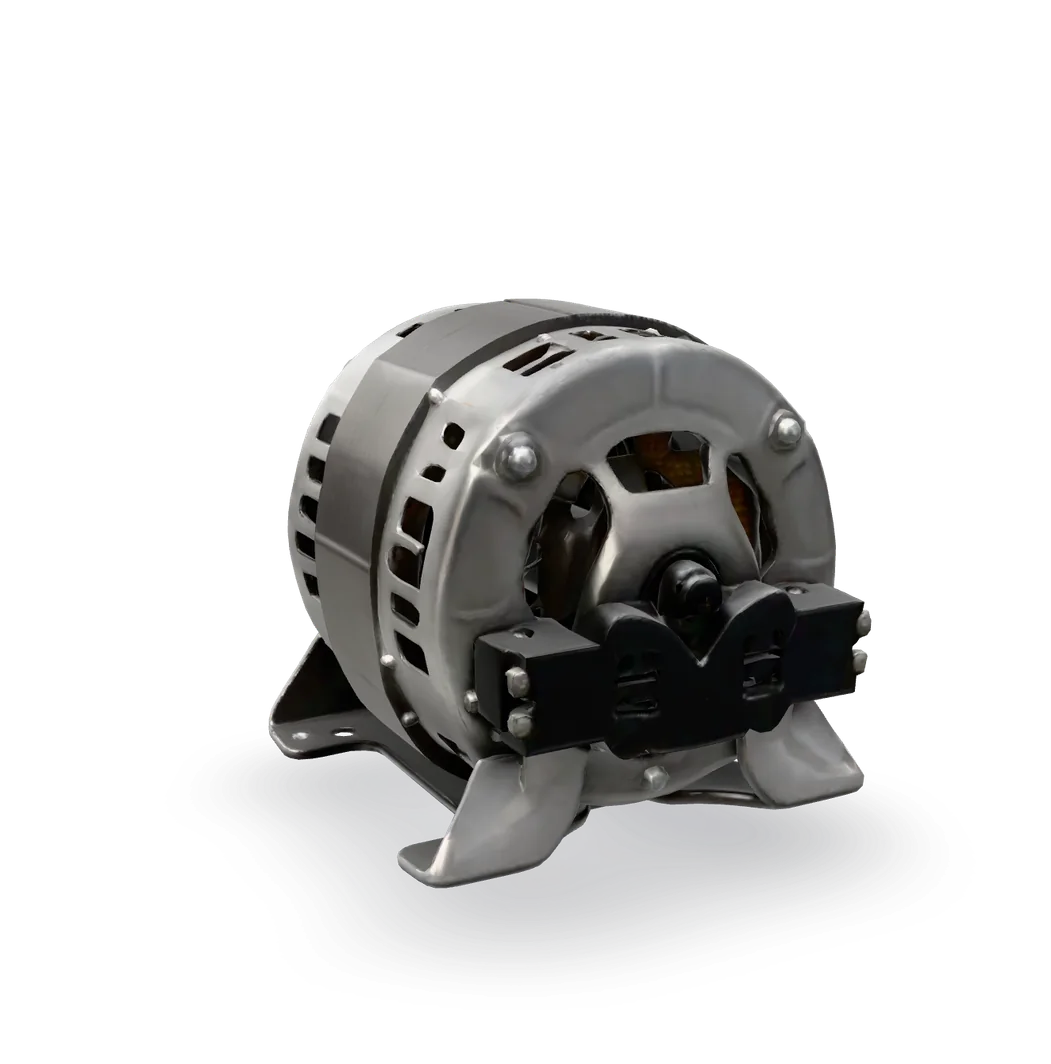
Dryer drive motor replacement
Motors are tough, so rule out the cheap parts first. If the motor really is done, this is a big job, but a careful DIYer can do it in an afternoon.
- Difficulty
- Hard
- Time
- 1 hr–3 hr
- Typical part cost
- $60–$200Pro: $150–$450
- Tools
- 8See the list
Honest rating: this is a big job. The drum comes out, the blower wheel often fights you coming off the shaft, and you rewire the motor from your photos.
What it does
What the motor does
The drive motor sits low in the cabinet, under the drum. A small pulley on one end of its shaft drives the drum belt. On many dryers the blower wheel threads onto the other end, so one motor both turns the drum and pulls air through the dryer.
Some dryers use a separate motor for the blower. Your service manual or tech sheet shows which design you have.
Inside the motor is a centrifugal switch. As the motor gets up to speed it switches off the start winding. On many dryers, gas and electric, it also closes a circuit that lets the heat come on, so heat only runs while the motor turns.
Why it fails
Motors wear slowly. The bearings can wear and grind, and the start winding or the centrifugal switch can fail so the motor hums but cannot start turning.
A motor that has to fight a dragging load runs hot. A seized roller or idler, or a blower wheel packed with lint, can make the built-in thermal protector trip again and again and shorten the motor's life.
That is also why a humming motor is not always a bad motor. A broken belt or a jammed drum or blower can look the same, so check those first.
Symptoms
Signs of a bad motor
Hums but the drum does not turn
You hear a hum when you press start, but nothing moves. If the belt is good and the drum and blower turn freely by hand, the motor's start winding or switch may have failed.
Full diagnosisStops mid-cycle, starts again later
The dryer runs for a while, stops, then starts again after it cools. The motor's thermal protector may be tripping, often because something is dragging on it.
Full diagnosisTumbles but no heat
On many dryers a switch inside the motor has to close before the heat can come on. If that switch fails, the drum turns but the dryer stays cold.
Full diagnosisGrinding from under the drum
Worn motor bearings grind, and the noise does not go away with a new belt, idler or blower wheel.
Full diagnosis
How to test it
Test the motor before you buy
- Unplug the dryer and open the cabinet (see the steps below).
- Take the belt off the motor pulley. Turn the drum by hand, then turn the motor pulley by hand.
- Look at the blower wheel for lint or debris packed around it.
- Good
- The drum, the motor pulley and the blower all turn freely. A jam is ruled out, so test the motor itself next.
- Bad
- The drum or the blower is stiff or stuck. Fix that first. A jammed drum or blower can make a good motor hum and trip.
- Unplug the dryer. Label and unplug the motor's wiring connector.
- Find the run winding and start winding terminals on the motor wiring diagram in your tech sheet.
- Touch the probes to the run winding terminals and read the meter. Then do the same for the start winding. The two readings can differ.
A good winding typically reads
Roughly 1–15 Ω, varies by motor
Typical range. Check your part label or manual for the exact spec. Values vary by motor, and the centrifugal switch sits in some of these circuits, so use your motor's wiring diagram to pick the terminals. Guesswork here can make a good motor look bad.
- Good
- Each winding shows a low, steady reading in the typical range or the range on your wiring diagram.
- Bad
- OL on either winding means that winding is open. The motor needs replacing.
- With the motor wiring still unplugged, touch one probe to a motor terminal and the other to bare metal on the motor housing.
- Repeat for each terminal.
A good motor reads
OL (open) from every terminal to the housing
Typical range. Check your part label or manual for the exact spec.
- Good
- OL every time. The windings are not shorted to the frame.
- Bad
- Any reading at all means a winding is shorted to the housing. Replace the motor.
Safety first
Before you touch anything
- 1
Unplug the dryer
Pull the power cord from the wall. If you cannot reach the plug, turn off the dryer's breaker. Do this before you take off any panel, and never test the motor with power on.
- 2
Gas dryers: close the gas shutoff
Turn the shutoff handle on the gas line behind the dryer a quarter turn so it sits crosswise to the pipe. You will not open any gas fittings. If you pull the dryer out, move it gently so you do not kink or strain the gas line.
- 3
Wear gloves
The sheet metal edges inside a dryer cabinet can be sharp.
- 4
Let it cool
A motor that has been tripping its thermal protector gets hot. Let the dryer cool before you reach in.
Tools you'll need
Grab these first
Tool and part links are affiliate links. We may earn a commission at no extra cost to you, and it never changes what we tell you to check first. How this works
- Nut driver1/4 in. hexMany dryer panel and housing screws are 1/4 in. hex heads.Typically $6–$15Shop this tool
- Nut driver5/16 in. hexThe other common panel screw size. Your dryer may use one or both.Typically $6–$15Shop this tool
- Multi-bit screwdriverPhillips, flat, squareA flat blade releases the motor clamps on many dryers.Typically $10–$25Shop this tool
- Adjustable wrench8–10 in.Holds the flat on the motor shaft while you turn the blower wheel.Typically $10–$25Shop this tool
- Socket set1/4 in. drive, with extensionA second wrench for the blower wheel hub. Sizes vary by model.Typically $20–$45Shop this tool
- Digital multimeterΩ, V, µF, µAChecks the motor windings before you buy a new motor.Typically $25–$60Shop this tool
- Painter's tape and markerLabel every motor wire before you unplug it.Typically $5–$12Shop this tool
- Work glovesDryer cabinet edges can be sharp.Typically $8–$20Shop this tool
- Shop vacuumOptionalClears the lint that packs around the motor and blower.Typically $40–$90Shop this tool
Step by step
How to replace the motor
- 1
Unplug the dryer and close the gas
Pull the power cord from the wall, or turn off the dryer's breaker if you cannot reach the plug.
On a gas dryer, also turn the gas shutoff handle a quarter turn so it sits crosswise to the pipe.
Careful. If you slide the dryer out, move it gently. Do not kink or strain the gas line, and never disconnect it yourself.
- 2
Open the cabinet
On many dryers you open or remove the top, label and unplug the door switch wires, then lift off the front panel. Dryers differ, so check your dryer's service manual or tech sheet for your model's order.
Tip. Take photos at every stage, especially of wires. You will rely on them later.
- 3
Take the belt off and lift the drum out
Photograph the belt path. Reach under the drum, push the idler pulley to slacken the belt and slip it off the motor pulley. Let the idler back slowly.
Lift the drum slightly and slide it out through the front.
Careful. The idler is under strong spring tension. Keep hold of it so it does not snap back on your fingers.
- 4
Take the blower wheel off the motor
If the blower wheel is on the motor shaft, open the blower housing as your manual shows. Hold the motor shaft still with a wrench on the flat at the pulley end, and turn the blower wheel hub with a second wrench.
The wheel is usually reverse threaded, so it loosens clockwise. Many wheels have an arrow showing which way to turn. Follow the arrow or your manual.
Tip. Old wheels can seize to the shaft. Steady pressure works better than jerking. If the wheel cracks, plan on a new blower wheel with the motor.
- 5
Unplug the motor wiring
Photograph and label every wire on the motor, including the belt switch wire if there is one. Then unplug the motor harness and any separate wires.
Pull on the connector body, not the wire.
- 6
Release the clamps and lift the motor out
Unhook the idler spring if it is attached to the motor bracket. Release the motor clamps or spring straps, often with a flat screwdriver pushed into the clamp tab.
Lift the motor out of its cradle.
Careful. Motor clamps are springy. Keep your fingers clear as they release.
- 7
Match the new motor
Set the old and new motors side by side. The mounting, the shaft ends, the pulley and the wiring connector should match. Check that it lists your dryer's model number.
If the new motor does not come with a pulley or other fittings, move them over from the old motor.
Buy the part
Drive motor
Opens AppliancePartsPros in a new tab. Where’s my model number?
What to look for
- A motor listed for your dryer's model number, from the rating plate. Match the part number on the old motor's label if you can read it.
- The same shaft ends, mounting and wiring connector as the old motor.
- Go by the full model number. Motors that look alike can have different shafts, mounts or connectors.
If the old blower wheel is cracked or seized to the shaft, buy a new wheel along with the motor.
- 8
Mount the new motor and wire it
Set the motor into its cradle facing the same way as the old one, and snap the clamps back on. Re-hook the idler spring.
Reconnect every wire using your labels and photos.
- 9
Refit the blower wheel
Thread the blower wheel back onto the shaft, the opposite way to how it came off. Hold the shaft and snug it with the wrenches. Close the blower housing.
Spin the wheel by hand. It should turn without rubbing the housing.
- 10
Put the drum and belt back
Slide the drum in and set its back edge on the rear rollers first. Then loop the belt around the idler and the motor pulley as in your photo.
Turn the drum by hand. It should turn smoothly with the belt centered.
- 11
Close up and test
Refit the front panel, reconnect the door switch wires and close the top.
On a gas dryer, turn the gas shutoff handle back in line with the pipe. Plug the dryer in and run a heated cycle. The drum should turn and the dryer should heat.
Buy the part
Get the right replacement
Buy the part
Drive motor
Opens AppliancePartsPros in a new tab. Where’s my model number?
What to look for
- A motor listed for your dryer's model number, from the rating plate. Match the part number on the old motor's label if you can read it.
- The same shaft ends, mounting and wiring connector as the old motor.
- Go by the full model number. Motors that look alike can have different shafts, mounts or connectors.
If the old blower wheel is cracked or seized to the shaft, buy a new wheel along with the motor.
Know your limits
When to call a pro
Stop and call a pro if
- You smell gas. Do not touch any switches. Leave the house and call your gas utility from outside.
- The job would mean disconnecting or moving the gas line. Leave gas connections to a pro.
- A new motor hums, trips or overheats too. Something else may be dragging, or the control or wiring may be at fault.
- You see scorch marks, melted wires or a burnt smell at the motor or its wiring.
- Your tests do not clearly point at the motor. A pro can check it under power safely.
FAQ
Drive motor questions
My dryer hums but won't turn. Is the motor dead?
Not always. A broken drum belt is the more common cause, and a jammed drum or a blower full of lint can stall a good motor too. Take the belt off and check that the drum and blower turn freely before you blame the motor.
Why does my dryer stop and then start again after a while?
The motor's built-in thermal protector may be tripping. It cuts the motor when it overheats and lets it restart once it cools. Look for a cause of drag first: worn drum rollers, a seized idler pulley or a blower wheel packed with lint.
Can a bad motor stop the dryer from heating?
Yes, on many dryers. A switch inside the motor closes the heat circuit only once the motor is up to speed. If that switch fails, the drum can turn while the heat never comes on.
Should I fix it or replace the dryer?
A motor job is one of the pricier dryer repairs, often a few hundred dollars with a pro. Doing it yourself costs mostly the part. On an older dryer with other problems, it is worth weighing against a new one.
Related
Keep going
- SymptomDryer runs but won't tumbleThe dryer starts and the motor runs, but the drum stays still or barely moves. The usual cause is a broken drum belt, then the idler pulley that keeps it tight, then worn drum rollers.Open guide
- SymptomDryer shuts off earlyThe cycle ends, or the dryer stops mid-cycle, and the clothes are still damp. On gas and electric dryers, the usual causes are a blocked vent making it overheat, a coated moisture sensor, or a door that will not stay shut.Open guide
- SymptomDryer runs but won't heatThe drum tumbles but the air stays cold. On an electric dryer, start with the breaker and the thermal fuse. On a gas dryer, start with the gas shutoff and watch the igniter.Open guide
- SymptomDryer won't startThe dryer is dead, the lights come on but the drum never turns, or it hums without starting. Start with the breaker and the door, then the thermal fuse, the door switch and the start switch.Open guide
- Dryer partDrum beltThe drum belt wraps around the drum and the motor pulley and turns the drum. When it breaks, the drum stops tumbling. Gas and electric dryers both have one, and the swap is the same on both.Open guide
- Dryer partIdler pulleyThe idler pulley is a small spring-loaded wheel that keeps the drum belt tight. When its bearing wears, it squeals. Gas and electric dryers both have one.Open guide
- Dryer partBlower wheelThe blower wheel is the fan that pulls air through the drum and pushes it out the vent. A cracked, loose or lint-packed wheel means slow drying and odd noises. Gas and electric dryers both have one.Open guide
- Dryer partDrum support rollersDrum support rollers are small wheels the drum rides on. When they wear flat or their bearings dry out, the dryer thumps, rumbles or squeaks. Gas and electric dryers both have them.Open guide